
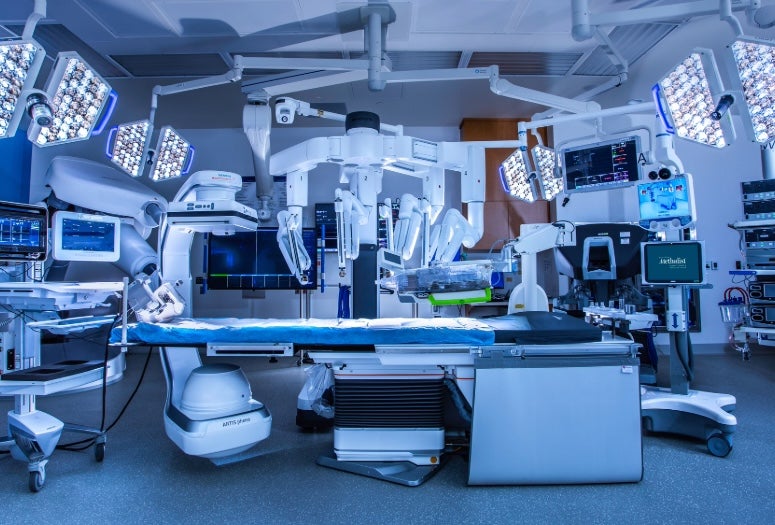
Rice University researchers were among the scholars exploring the future of surgery at the 2026 Surgical Technology and Robotics Summit (STaRS), held Oct. 26-30 at Houston Methodist. The five-day event brought together surgeons, engineers, researchers and industry leaders to examine how robotics, artificial intelligence and advanced imaging technologies are transforming surgical care.
Centered on the theme Exploring Embodied Surgical Intelligence, the summit featured research presentations, multidisciplinary discussions and hands-on demonstrations connecting engineering innovations with real-world clinical challenges.
Farshid Alambeigi, associate professor of mechanical engineering at Rice and director of robotics, imaging and autonomous surgery at Houston Methodist’s Bookout Center, served as a course director alongside Stuart Corr, the center’s director of innovation engineering. Notably, Corr earned his master’s in chemistry and completed postdoctoral research at Rice.
With joint appointments at Rice and Houston Methodist, Alambeigi works at the intersection of engineering and medicine, developing intelligent robotic systems that combine AI, medical imaging and minimally invasive surgical technologies. He also leads the Advanced Robotic Technologies for Surgery Laboratory.
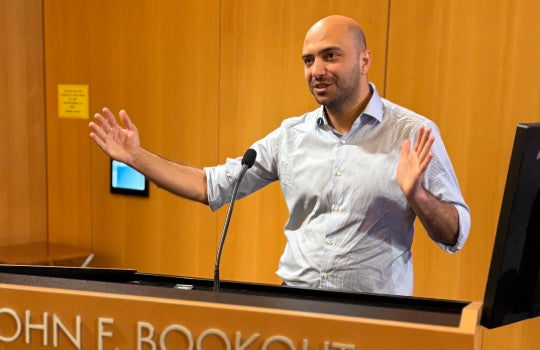
“Translating new technologies into better patient care requires clinicians, researchers, industry partners and entrepreneurs working together. Each brings an essential perspective, and leaving any one out creates a gap that can prevent promising innovations from reaching patients,” Alambeigi said. “At the Bookout Center, we are building an ecosystem that connects these communities from the outset. STaRS helps accelerate those connections and bridge the gap between discovery and clinical practice across the Texas Medical Center, throughout Texas and beyond.”
Rice expertise was included throughout the week, highlighting advances in robotics, human-machine interaction, computational imaging and digital health.
Marcia O’Malley, chair of Rice’s Department of Mechanical Engineering and the Thomas Michael Panos Family Professor, presented research on haptics, which are technologies that recreate the sensation of touch. She spoke about how robotic systems can assess and assist human performance with potential applications in surgical training and rehabilitation.
Ashok Veeraraghavan, professor and chair of electrical and computer engineering at Rice, highlighted advances in computational imaging and digital health technologies.
David Pynadath, the executive director of research initiatives for Rice’s Ken Kennedy Institute, highlighted interdisciplinary computing research and collaboration for global impact.
The summit also showcased immersive technologies developed by Rice’s Experiential Pixels Lab, led by Robert LiKamWa, associate professor of electrical and computer engineering and director of spatial computing systems at Houston Methodist Academic Institute’s Bookout Center. Demonstrations included medical virtual reality experiences and live volumetric capture, which creates three-dimensional representations of people and environments. These technologies could support surgical visualization, training and collaboration.
The event spanned several clinical specialties, including cardiovascular, gynecologic, general and reconstructive surgery, along with lung transplantation.
“Some of the most promising advances in surgical technology emerge when researchers and clinicians work together from the earliest stages of development,” Corr said. “Through STaRS, we’re building connections that can help translate promising research into practical tools that improve patient care.”
Rice’s participation reflects the growing collaboration between the university and Houston Methodist, bringing engineering, computing and clinical expertise together to advance the next generation of intelligent medical and surgical technologies.