
Farshid Alambeigi refers to one of his most ambitious research efforts as “the sci-fi project.”
The idea lives up to the name. He is developing robotic technology that could one day help manufacture living tissue — potentially even functioning organs — for transplantation.
“Imagine printing a functional liver,” said Alambeigi, an associate professor of mechanical engineering at Rice University. “Instead of transplanting a liver from one human to another, you print it on a 3D printer and then put it into the body.”
That future remains far beyond today’s clinical possibilities, but tackling problems that seem almost impossibly difficult is precisely what draws Alambeigi to them.
“I always tell my students, if others can do it, why are we doing it?” he said. “I want to do something others are not doing, something more challenging. That’s exciting.”
Alambeigi’s research spans engineering, robotics, artificial intelligence, medical imaging, advanced manufacturing and surgery. In addition to his faculty appointment at Rice, he holds a joint role with Houston Methodist, where he serves as director of robotics, imaging and autonomous surgery at The Bookout Center at Houston Methodist Research Institute. He is also a member of Rice’s Ken Kennedy Institute and the Houston Methodist-Rice Digital Health Institute.
The arrangement places him exactly where he wants to be: between the engineering lab and the operating room. His goal is not simply to build more sophisticated robots, but rather to create technologies surgeons will actually use — tools that address real clinical problems, improve patient care and have a realistic path from prototype to hospital.
He has even coined a word for that approach: “surgineering.”
“It’s the engineering of surgery,” Alambeigi said.
A conversation
For Alambeigi, a new surgical technology rarely starts with a machine. Instead, it starts with a conversation. Before designing a robot or device, he talks with surgeons about their work and, whenever possible, observes procedures in the operating room.
“You need to be able to speak their language and understand what they are doing,” he said.
From there, clinical challenges become engineering questions. How much room does a device have to maneuver? How flexible should it be? What kinds of tissue will it encounter? What does the surgeon need to see or feel? And how can the technology fit into an operating room already crowded with people and equipment?
That exchange continues long after the first prototype is built.
“You build prototypes, they use it, you get feedback, and it’s a cycle,” Alambeigi said. “Without this process, you build something that, at the end of the day, no one is going to use.”
Augmenting people
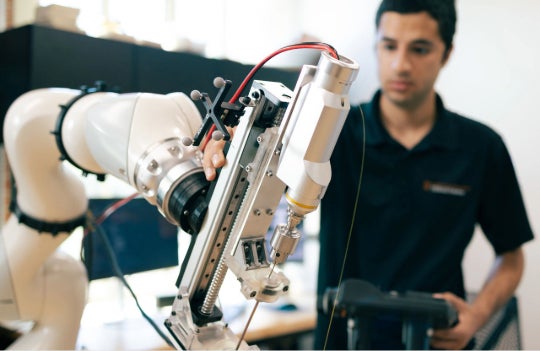
Robotic surgery has already shown how technology can extend a surgeon’s capabilities. But there is no one-size-fits-all surgical robot, Alambeigi said. A device designed for the abdomen may look very different from one built for the eye, a blood vessel or the spine. That challenge has helped shape his work on flexible and continuum robots, which are designed to bend and navigate through complex anatomy rather than rely on the rigid joints and links common in traditional industrial robots.
Alambeigi is also exploring how AI could provide another layer of support in the operating room. Rather than focusing on screening or diagnosis, he is interested in how AI might help surgeons interpret information, anticipate challenges and make better decisions during a procedure.
Surgery places enormous physical and mental demands on physicians, who must manipulate instruments while interpreting images, monitoring sensors, responding to complications and deciding what to do next. Experienced surgeons often develop an almost instinctive ability to recognize patterns and react after years of training. Alambeigi wants to explore whether AI could help make some of that accumulated expertise more accessible to less experienced surgeons.
“Can we use AI to understand what’s happening and help inform physicians or help them make a better plan?” Alambeigi said. “My whole mindset of AI is augmenting people. It’s not replacing them.”
The sci-fi project
Alambeigi’s move into robotic bioprinting began almost by accident. A few years ago, he started talking with researchers in biomaterials and regenerative medicine, fields that were largely new to him.
“I heard the word ‘bioprinting,’” he recalled. “I said, ‘By the way, if you use robotics — if you use the things I do — it might actually be helpful.’”
That conversation eventually grew into a research proposal focused on volumetric muscle loss, a severe injury in which large amounts of muscle are destroyed by combat wounds, major trauma or other causes. Already scientists can create biological scaffolds containing living cells, but producing them at sizes large enough to be clinically useful presents a very different engineering challenge.
“That’s a good application to use robots,” Alambeigi said. “When the scale goes from tiny things to something much bigger, everything is changing.”
His role is to develop robotic systems that can precisely place and organize the biological material, while his collaborators focus on the cells, biomaterials and tissue-engineering strategies needed to make those structures viable.
“The material aspect needs to be developed with the tools we build in robotics to make sure they work together,” he said.
The longer-term goal is far more ambitious: developing technologies that could one day build living tissue with the structure and function needed to repair the damaged muscle. And eventually, perhaps, create replacement tissues or entire organs.
Why Houston
With Rice’s engineering expertise, Houston Methodist’s renowned clinical capabilities and the broader Texas Medical Center, Alambeigi sees an unusually strong environment for moving ideas from the lab to the bedside. And he envisions Rice students as part of that ecosystem. They can develop technologies using the university’s engineering courses, laboratories and faculty expertise, then work more closely with clinicians at Houston Methodist as prototypes mature.
“They are complementary,” he said. “Rice has the courses, the education and training, the young talent. Then when the technology is ready, you want to bring it to the hospital.”
For Alambeigi, this kind of collaboration is essential to the kind of problems he wants to solve.
“I can’t do this work alone,” he said. “It takes people who want to collaborate, share their expertise and work toward something bigger together. In Houston, we have the people, the resources and the right ingredients to do great things.”