
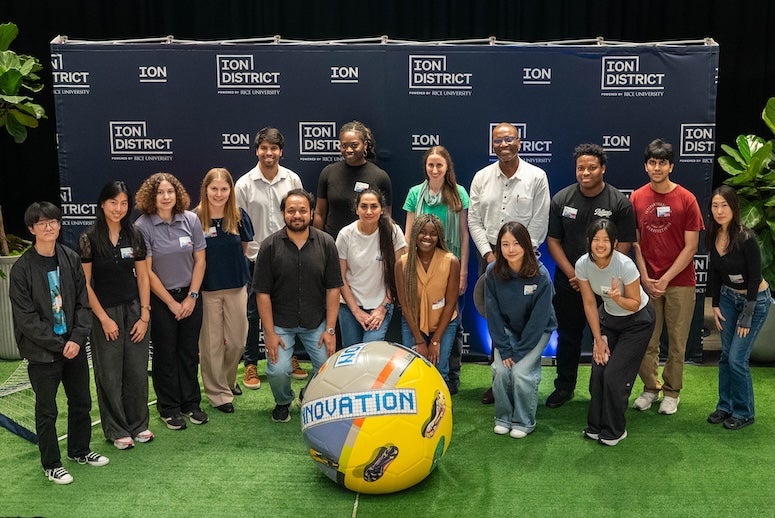
Rice University recently held a two-day Urban Sustainability Innovation Sprint and the opening reception for the Rice Urban Sustainability Projects Portfolio at the Ion.
The portfolio brings together a series of connected initiatives designed to use Houston’s role in the 2026 FIFA World Cup as a living laboratory for sustainability, resilience, public engagement and applied research. The work is led by David Abraham, lecturer in Rice’s Wiess School of Natural Sciences, in partnership with colleagues including Evan Siemann of the Department of BioSciences, Kristianna Bowles of the Office of Sustainability, Robert LiKamWa of the Department of Electrical and Computer Engineering, and Xinwu Qian of the Department of Civil and Environmental Engineering. Together, the projects connect international best-practice research, student innovation, public art, science communication and data-informed planning.
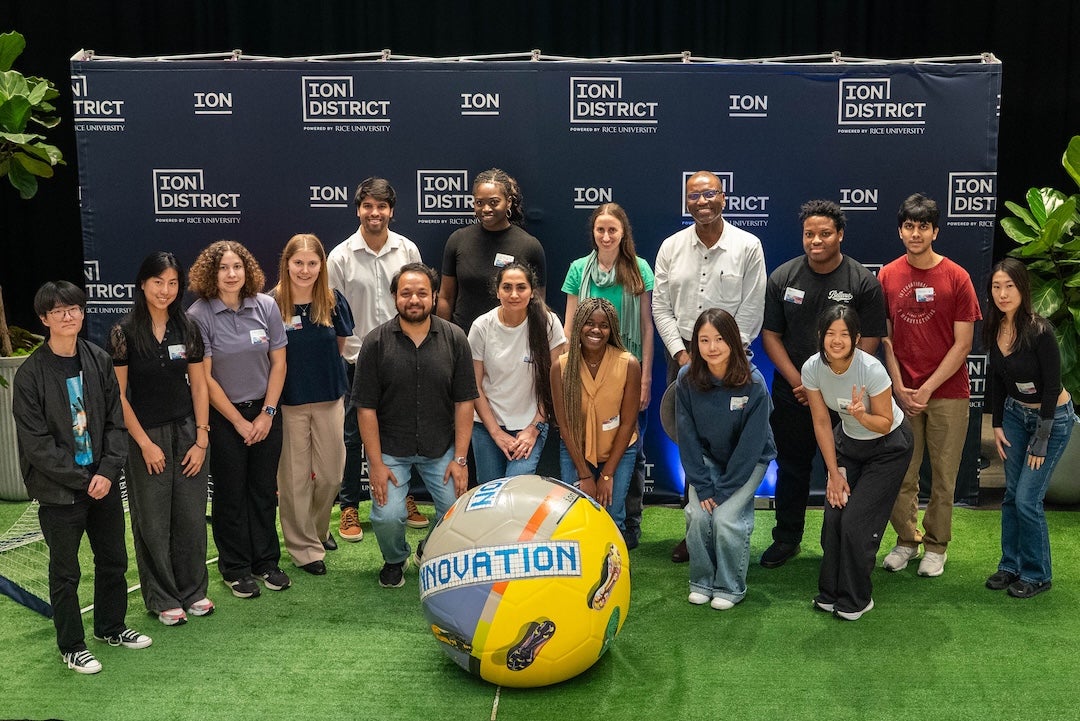
The two-day Urban Sustainability Innovation Sprint was convened in partnership with UNLEASH, the Copenhagen, Denmark-based global innovation organization.
“The goal is to move from inspiration to implementation,” Abraham said. “Houston’s World Cup moment gives us a unique opportunity to test ideas that can improve how cities plan for sustainability, measure impact and create public learning experiences. Rice is helping to connect research, students, civic partners and global expertise in ways that can leave a lasting legacy.”
This is happening alongside the newly opened Sustainable Ecologies outdoor campus exhibit, located in the live oak grove near Entrance 1, which blends science, art and ecological design.
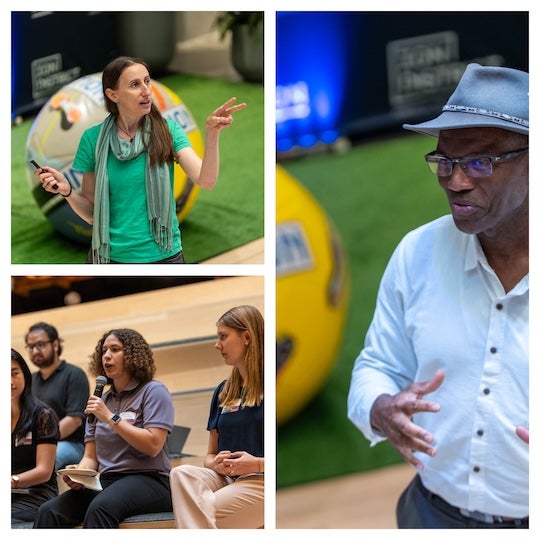
UNLEASH marks the start of the Urban Sustainability Virtual Hackathon, which is bringing together university students from across the country to develop concepts, data tools and implementation strategies for sustainable urban systems in all 11 U.S. World Cup host cities. The hackathon expands the Rice effort beyond campus and Houston, creating the foundation for a national urban sustainability predictive analytics lab focused on host cities, major sporting events and civic infrastructure.
Together, the projects respond to questions facing Houston and other U.S. cities: how to activate public spaces, protect biodiversity, reduce waste, measure performance and transform major events into long-term positive city investments.
The opening reception at the Ion brought together students, faculty, civic partners, sustainability professionals and community leaders to celebrate the portfolio and discuss next steps.
“For us, the World Cup is not only a global sporting event,” Abraham said. “It is a platform for sustainability communication, economic development and measurable impact. These projects show how universities can help cities think differently about placemaking, ecology, infrastructure and public engagement.”