
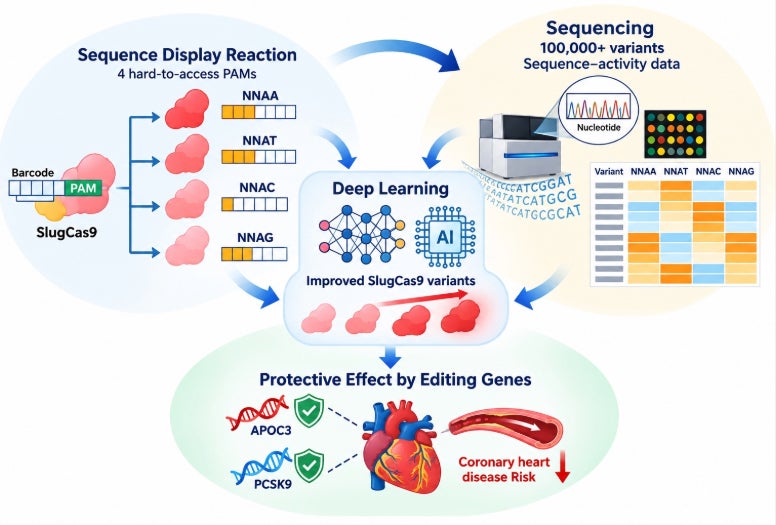
Rice University’s Han Xiao has used his AI-supported Sequence Display technology to expand the targeting abilities of CRISPR/Cas9. In a paper recently published in Nature Communications, Xiao evolved several variants of a compact Cas9 that could efficiently target stretches of DNA previously inaccessible for editing. The research included a proof-of-concept study in which the evolved Cas9s were successfully used to edit two genes found in coronary heart disease.
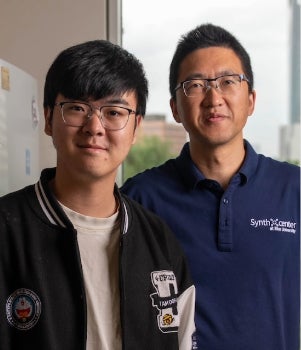
“My team used Sequence Display technology to evolve a compact Cas9 that can efficiently target priority areas of DNA,” said Xiao, a professor of chemistry and corresponding author on this paper. “This shows the power of our approach, which rapidly generates large datasets that AI can use to identify optimal protein sequences for a given function. In this case, it allowed us to evolve several new Cas9 variants with better activities.”
Cas9, the CRISPR enzyme, works by attaching to a protospacer adjacent motif, or PAM in DNA. This short stretch of DNA, which can be between two and six base pairs long, acts somewhat like a docking station for the enzyme. Once the Cas9 enzyme recognizes a suitable PAM, it can then edit the DNA as dictated by a guide, ultimately editing an adjacent target DNA sequence that matches the guide RNA.
Edits made by CRISPR, therefore, have to be made within a certain distance, measured in base pairs, of a PAM. While many Cas enzymes recognize multiple PAMs, most enzymes edit DNA more efficiently on some PAMs than others. That means genes with only slippery PAMs are difficult to edit with CRISPR, especially if the work requires a specific type of Cas enzyme.
“We cannot easily or precisely change the PAMs in a given gene,” says Linqi Cheng, a graduate student and first author on the paper. “But with Sequence Display technology, we could quickly evolve a Cas9 enzyme that would better recognize the PAMs already present in the gene.”
For this experiment, the researchers used a compact and popular Cas9 enzyme called SlugCas9. Though SlugCas9 could identify and bind many PAMs, there were four PAMs it struggled with that were of particular interest to researchers. SlugCas9 recognized these four but only weakly and would often slip off or fail to bind them.
Other researchers had attempted to evolve other Cas9 variants that could dock on these elusive PAMs but with little success. It was hard to direct the evolution in a way that increased the enzyme’s binding abilities so specifically. With Sequence Display, however, Xiao’s team was able to find promising candidates within a week. Then they used the evolved SlugCas9 to edit coronary heart disease genes which were previously not easily accessible.
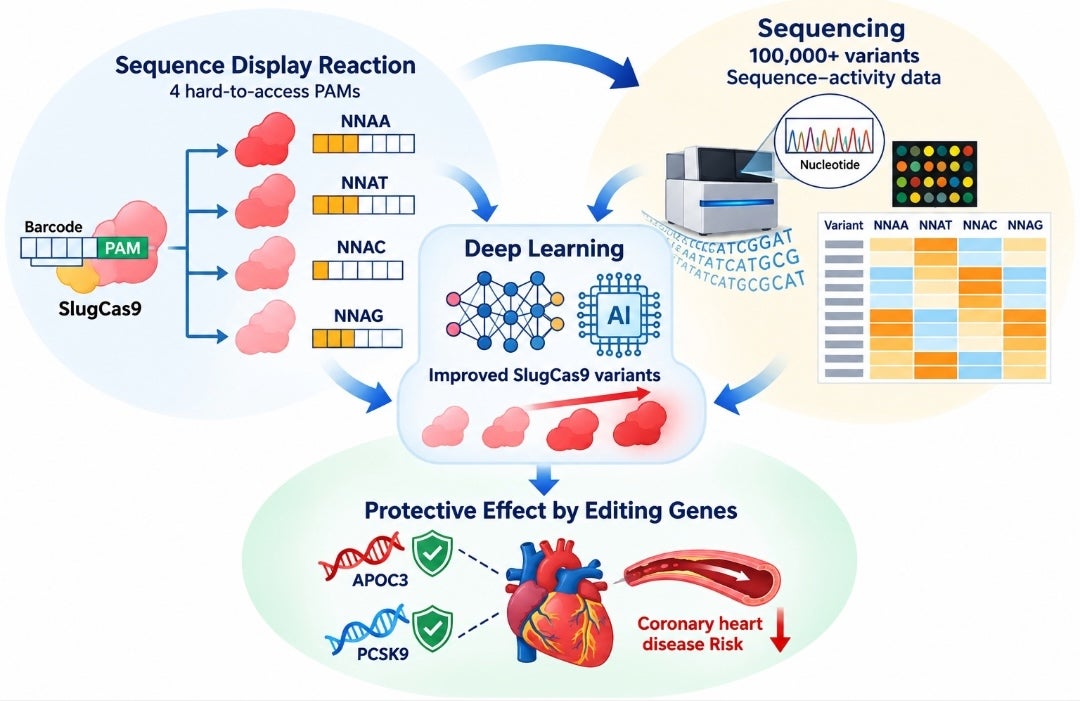
“The specific sites we wanted to edit in APOC3 and PCSK9 had the PAMs that prior versions of SlugCas9 couldn’t reliably bind to,” Cheng said. “With our evolved SlugCas9, we were able to easily and precisely edit these sites in cultured cells, introducing potentially protective genetic changes linked to a lower risk of coronary heart disease, unlocking the power and possibility of CRISPR.”
“CRISPR/Cas9 is one of the most promising technologies of the modern age in both research and medicine,” said Xiao, who is the director of the SynthX Center. “It relies on Cas9 enzymes that are optimized and evolved for each application. This finding shows that sequence display can be key to rapidly evolve Cas9, and other proteins, to address complex and pressing technical requirements essential for successful biomedical engineering.”
This work was funded by SynthX Seed Award (SYN-IN-2024-002), the National Institutes of Health (R35-GM133706, R01-CA277838 and R01-AI165079), the Robert A. Welch Foundation (C-1970), the U.S. Department of Defense (W81XWH-21-1-0789, HT9425-23-1-0494 and HT9425-25-1-0021), the 2024 Rice Synthetic Biology Institute Seed Grant and a Medical Research Award from the Robert J. Kleberg Jr. and Helen C. Kleberg Foundation.