
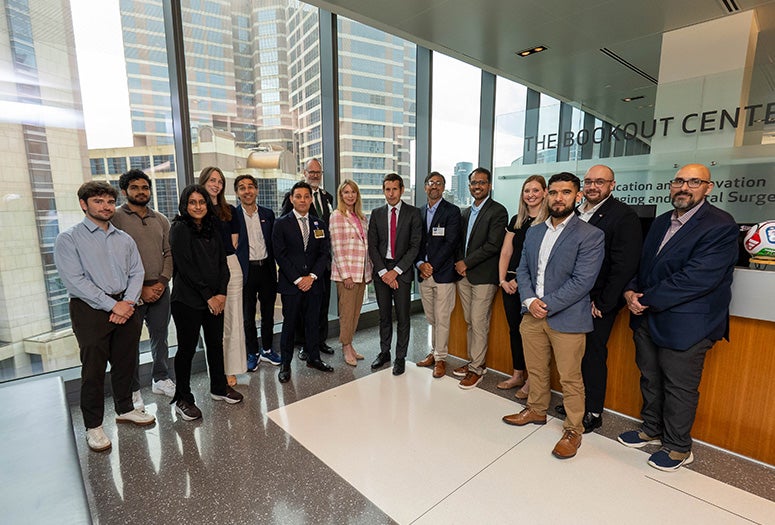
The Digital Health Institute, a joint initiative of Houston Methodist and Rice University, recently welcomed Frank Marchetti, Consul General of France in Houston, and his team to discuss health care innovation in the age of artificial intelligence and avenues for international collaboration.
The background for the visit was France’s NETVA, or New Technology Venture Accelerator, a French Embassy program helping early stage French deep-tech startups explore partnerships and opportunities in North American markets. NETVA recently brought XIMED, a French medtech company developing advanced early breast cancer detection solutions, into the Texas Medical Center for an immersion week.
For the DHI, the meeting was a prime opportunity to showcase its unique mission as a site of convergence connecting Houston Methodist’s large-scale, high-quality clinical data infrastructure with Rice’s strengths in engineering, imaging, computation and responsible AI. The visit also helped highlight the strategic position of both DHI parent institutions in the TMC, the world’s largest medical complex.
“It is a tremendous honor to welcome the consul general and his team to our Digital Health Institute,” said Pothik Chatterjee, executive director of the DHI. “We hope to pave the way for future exchange of ideas, expertise and medical R&D models between our two countries.”
The DHI was launched in 2024 to meet a moment of rapid change in health technology and to capitalize on the unique strengths of its parent institutions. Its mandate comprises three main thrusts ⎯ research; development and education, with work spanning areas such as AI for diagnostics; and imaging, digital therapeutics, remote monitoring, computational biology and population health. The institute has nearly 30 active research collaborations underway and is committed to sustained growth.
Chatterjee outlined the institute’s diversified approach to commercialization, including sponsored research, licensing and co-development with industry partners, and highlighted current DHI startups advancing AI-powered ophthalmic imaging, live biopsy cancer imaging and pediatric pulmonary feedback.
The DHI aims to connect its portfolio with French innovation platforms like VivaTech, while also helping establish Houston as the premier U.S. landing point for French health-tech firms.
Dr. Stephen Jones, who leads the Center for Health Data Science and Analytics at the Houston Methodist Academic Institute, noted that DHI’s work is grounded in rigorous data provisioning and computing environments built to support safe, effective AI development.
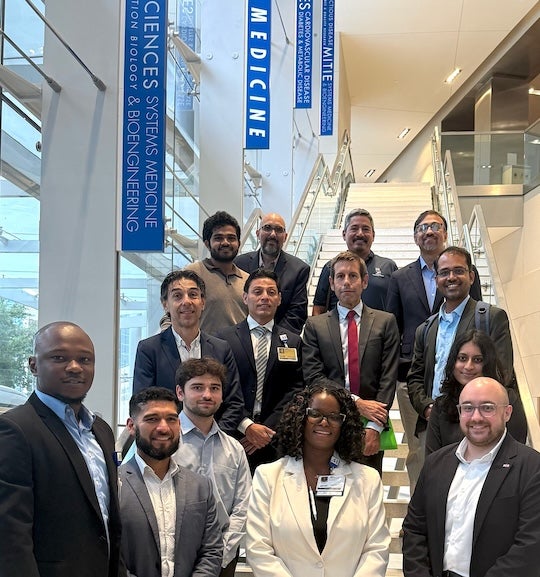
“The DHI partnership between Houston Methodist and Rice University unites leading clinicians, innovative engineers and data scientists — alongside global collaborators — to build a dynamic health care ecosystem powered by data and diverse expertise. The potential is extraordinary,” Jones said.
Following introductions, the delegation toured research and health care facilities at Houston Methodist’s Bookout Center, Center for Rapid Device Translation and the Virtual Intensive Care Unit.
The visit also points to a broader effort by Rice to grow its global footprint, a strategic priority outlined in the university’s 10-year strategic plan, Momentous. Caroline Levander, Rice’s vice president for global strategy, called out growing collaborations in France, including work with Université Paris Sciences & Lettres and the Paris Brain Institute, as examples of this strategic effort.
“Rice built its first international campus in Paris for a reason,” Levander said. “The Paris Center gave the university a real home in France, and that same foundation is what makes the DHI such a promising bridge. French health-tech companies are looking for a serious U.S. partner, and Rice is positioned to be the one already fluent in working with France.”
The delegation also heard from Rice’s technology transfer and STEM education leaders. Matthew Cushing, executive director of the Center for STEM Engagement, described digital health workforce development programs, including design challenges, research experiences and new AI-focused education initiatives supported by the U.S. National Science Foundation.
The visit underscored a shared interest in expanding the collaboration between France and the Houston health care innovation ecosystem. In the following Q&A, members of the French Consulate in Houston discuss how NETVA, Start in France and related programs can help turn that shared aspiration into real-world outcomes.
Q&A with Consul General Frank Marchetti and representatives from the French Consulate in Houston
The NETVA program operates across several major tech hubs in the United States, from Boston to San Francisco. When you look at the landscape here in Houston, what do you see as this ecosystem’s unique competitive advantage for French deep-tech entrepreneurs?
Houston is one of the nine U.S. ecosystems integrated into the NETVA immersion model under La Synapse, alongside hubs such as Boston, San Francisco and New York. Its value lies in being a high-intensity innovation environment where startups can confront their business models with leading U.S. stakeholders through structured meetings, institutional anchors and sector-relevant networks. Within NETVA, it functions as a place for targeted immersion and strategic connection-building rather than general exploration.
How have the priorities or demands of French startups looking at the Texas market evolved over the last few years?
Across recent NETVA cohorts, French deep-tech startups increasingly seek structured access to U.S. ecosystems, particularly through tailored meetings, partnerships and early international validation. The focus has shifted toward practical entry conditions: understanding market specificity, securing strategic partnerships and testing scalability in North American environments.
As the Office for Science and Technology expands its initiatives through La Synapse, how do you see Rice’s role evolving as a core institutional anchor for French-American scientific diplomacy here in the Southern U.S.?
Within the La Synapse framework, which aims to build structured bridges between French and U.S. deep-tech ecosystems, Rice can be seen as a potential institutional anchor in the Southern U.S. The NETVA program already operates through structured diplomatic networks and ecosystem partners; in this context, universities like Rice naturally strengthen the ability to connect research, entrepreneurship and international mobility.
If you were speaking directly to a French deep-tech entrepreneur or a researcher at an institution like CNRS or INSERM, how would you describe the specific environment and capabilities found at the Houston Methodist-Rice Digital Health Institute?
The Houston Methodist-Rice Digital Health Institute represents a type of environment the program seeks to expose French deep-tech entrepreneurs to: a structured interface between scientific research and technological application. It offers proximity between academic research, innovation pathways and applied health technologies, aligning with NETVA’s goal of helping startups confront their models with real-world institutional ecosystems.
True innovation thrives on mutual exchange. Seeing the digital health technologies being spun out by researchers here, where do you see the most natural touchpoints for the French scientific and innovation ecosystem to engage in co-development with DHI?
The French side clearly wants to emphasize partnerships between research-driven startups and international innovation ecosystems. The most natural interaction points lie in areas where French deep-tech startups, often originating from research institutions, can engage in applied validation, technological collaboration and early stage partnership building with U.S. research environments such as digital health platforms.
In light of your visit, what do you see as the next practical avenues for the French Consulate and La Synapse to continue building on this collaborative momentum with our institute?
Building on NETVA’s model of structured immersion and matchmaking, the next steps would typically involve deepening institutional linkages, increasing targeted interactions between French startups and Houston-based innovation actors and expanding the number of tailored meetings and collaborative formats within the Southern U.S. ecosystem.
Looking at the bigger picture, what kind of long-term global impact do you think can be achieved when French scientific talent and Houston’s research infrastructure team up?
Long-term impact comes from strengthening transatlantic deep-tech bridges that connect scientific research with entrepreneurship. When French research talent and Houston’s innovation infrastructure interact, the expected outcome is accelerated translation of science into global solutions addressing major challenges such as health or energy.
This month, Europe’s largest tech event, VivaTech, is taking place in Paris. This marks Rice’s second year sending a cohort of deep-tech startups. From a health and medical tech perspective, how crucial are these types of global platforms for helping innovators cross borders and access international investors, customers and clinical markets?
International platforms such as VivaTech play a critical role in enabling deep-tech startups to access global ecosystems. They complement structured immersion programs by providing visibility, investor exposure and market access opportunities. These platforms are essential for helping research-based startups transition from national ecosystems into international commercialization and partnership networks.
Rice’s participation in VivaTech is a natural extension of its deeply rooted presence in the French academic ecosystem. Through the Rice Global Paris center located in the historic Marais district, Rice has established a permanent home in Europe for research and teaching. This foundation has been further solidified by Rice’s recent strategic partnership with Université Paris Sciences & Lettres (PSL).
Rice’s expanding international footprint is a testament to its upward trajectory, mirrored by its rise to No.17 in the national U.S. university rankings. The French Consulate in Houston highly values its strong, ongoing partnership with Rice. This collaboration extends into multiple strategic domains, including the Consulate’s active participation in the Baker Institute’s DIPLO diplomatic immersion program, as well as joint initiatives with the Rice Space Institute to bridge the French and Houston space ecosystems. These institutional ties help strengthen a continuous, high-impact exchange of innovation and talent between France and the United States.
- Access associated media files: