
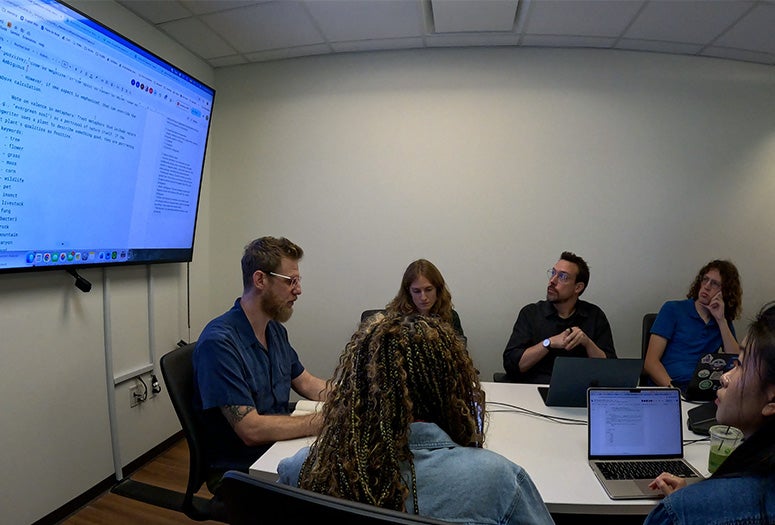
Students in Rice University’s newest research course spend their semester with pop songs. On a recent afternoon, they spent it teaching an artificial intelligence model to read lyrics the way they do.
The course Critical Media Lab launched this fall as the research arm of Rice’s Program in Media Studies. Under Matthew Schneider-Mayerson, associate professor of English and creative writing and director of the Program in Environmental Studies, students are coding lyrics from songs released since 1990 for environmental themes and related ideas — from plants and animals to consumerism, extreme wealth and excessive heat.

The work began with human readers. Students coded 200 songs by hand, testing each against 60 questions that could apply to any song, story, novel or film.
“Developing the codebook as human coders was the most mind-blowing part,” said Divya Saikumar, a senior majoring in environmental science who is also enrolled in Rice’s master’s program in environmental analysis. “Music is an art, and art is so difficult to interpret. We have to try to tap into the minds of songwriters, and when a single line has a double entendre or multiple meanings, we’ll sometimes spend 20 or 25 minutes asking, ‘What did he actually mean when he said that?’”
The codebook now doubles as a set of instructions. The class is customizing a large language model to extend its coding to more than 50,000 songs, building a representative snapshot of which environmental themes appear in contemporary popular music and which are missing.
“We sometimes talk about AI as if it were a disembodied thing, but it has many different aspects, and it’s a tool like any other technology,” Schneider-Mayerson said. “What’s particularly interesting for students who may not have taken classes in coding or AI is seeing all the ways you can adjust the instructions you give it and how those adjustments lead to different outcomes. Beyond our project, I think that teaches them broader lessons about what these technologies are and how they might use them for good in their own lives.”
The project grew out of a summer research internship Saikumar completed with Schneider-Mayerson, studying how media shapes people’s views of climate change. After weighing podcasts, short stories and film, they chose music because people listen to it constantly, often as background noise. They suspected climate change rarely surfaces in lyrics and wanted to measure how rarely.

“We know that song lyrics can affect our moods and our opinions, but we don’t really know what those lyrics depict or evoke when it comes to the environment and climate change because we’ve never bothered to collect that data,” said Julia Huggins, a media studies lecturer who supports the lab as a researcher. “That’s a gap in the scholarly literature, and these students are working together to fill it. It’s exciting for a group of undergraduates to be working with a professor toward a co-authored publication or a public-facing report that addresses that gap.”
Schneider-Mayerson has published research with previous classes, including studies of climate change in film and in short stories published in The New Yorker. Faculty propose the lab’s research projects, and it typically takes on a new one each semester. Michael Dango, director of the Program in Media Studies, will lead it in spring 2027, and Huggins said the rotation gives media studies majors and minors, as well as students across campus, a chance to take part.
Some students arrive from well outside environmental studies. Wenshi Chen, a senior majoring in musicology with a double minor in science and technology studies and medieval and early modern studies, has studied music and technology at Rice, especially how humans and machines interact. She had no environmental research background when Schneider-Mayerson introduced her to the course.

“During the coding process, I was surprised to find that many depictions of nature come through the emotional expressions people use in pop music, which I never paid attention to when I was just listening,” Chen said. “Something as simple as mentioning a plant in a lyric shows us the kind of relationship we have with nature every day, and we can take that to a larger scale to recognize our environmental impact.”
Discussions can turn comic too. The class has tried to work out how many references to flora in contemporary music are coded references to marijuana, Schneider-Mayerson said, before pausing to acknowledge how silly it is.
“Some people call this kind of analysis distant reading as opposed to close reading, because we’re looking broadly at the swath of culture being produced in music, film and literature,” Schneider-Mayerson said. “In some ways, what we’re doing is very new and technologically advanced. In other ways, it’s just poetics, which people have been doing for thousands of years: the close analysis of a line of poetry, except in this case it has some music attached.”
Learn more about the Program in Media Studies on its website.