
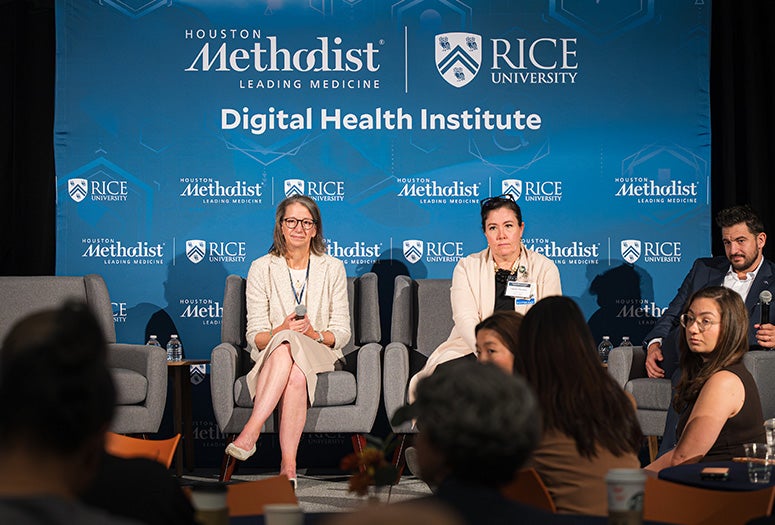
The Digital Health Institute, a joint initiative of Rice University and Houston Methodist, held its second annual symposium at Rice’s Baker Institute for Public Policy. The day brought together clinicians, engineers, innovators, policy and community health experts and leaders from industry and government to explore how health care innovation can achieve better health outcomes for people everywhere at lower costs and without exclusion or bias.
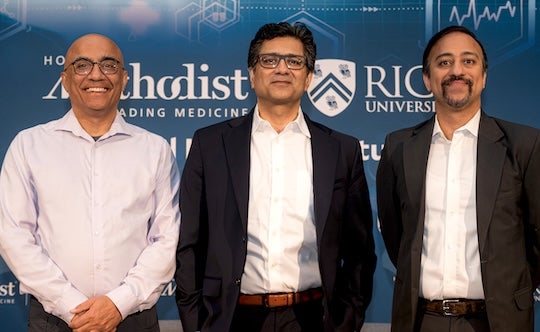
With its storied track record of hosting landmark events and global leaders, the Baker Institute setting was representative of the key themes of this year’s gathering – access, equity, affordability and global scale. This theme is representative of the mission of the institute, which was established in 2024 and is led by co-directors Dr. Khurram Nasir of Houston Methodist and Ashutosh Sabharwal of Rice, alongside executive director Pothik Chatterjee.
The daylong event last month kicked off with introductory remarks by David Sholl, executive vice president for research at Rice, and Edward Jones, president and CEO of the Research Institute at Houston Methodist Academic Institute (HMAI). Both leaders emphasized real-world impact as a strategic institutional objective, recognizing the collaboration between Rice and Houston Methodist as a vehicle to achieve concrete outcomes.
“The Digital Health Institute is really one of the key parts of what we are trying to do at Rice,” Sholl said, referencing the university’s strategic plan, Momentous, which identifies health innovations as a strategic goal for the next decade.
Jones said the progress achieved by the institute over the short timeline since its inception is “truly inspirational,” and highlighted impact, synergy and effectiveness as ongoing objectives for the collaboration.
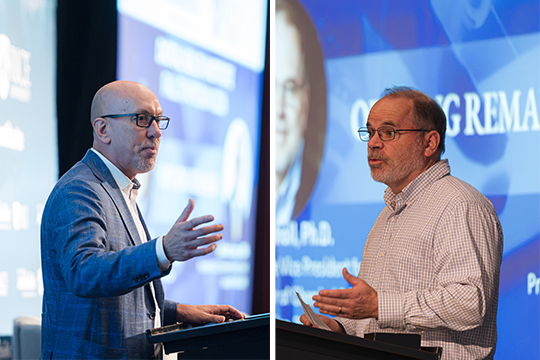
“We are doing this to improve the health of our community,” Jones said.
A new international partnership
British Consul General Richard Shackleton took the stage to announce in front of the live audience that Rice, HMAI and LSE Health at the London School of Economics and Political Science have signed a memorandum of understanding to explore the establishment of a Global Digital Health Scholars Program dedicated to training emerging global health care leaders.
“I am delighted to announce and celebrate a new partnership that will strengthen ties between the U.K. and Texas,” Shackleton said.
Shackleton prefaced the announcement by saying that “we are greater together,” citing the transatlantic partnership between the U.S. and the U.K. and emphasizing key areas such as trade, science and technology. Shackleton noted the “strong and growing economic partnership between Texas and the U.K., and acknowledged that in the realm of research, U.S.-U.K. collaboration and co-authorship “brings together complementary expertise to tackle challenges neither country can address as effectively on their own.”
Nasir, the William A. Zoghbi Centennial Chair in Cardiovascular Health and chief of cardiovascular disease prevention at Houston Methodist DeBakey Heart & Vascular Center, said the three-way partnership and joint mentorship program would aim to equip future health care leaders with the skills to navigate complex implementation challenges.
“We want our tools to work in an uninsured clinic, in rural hospitals and also in international settings where they may not have the resources we have in the U.S.,” Nasir said in an interview ahead of the symposium. “That is the core mission for digital health: We do not want to just create and advance technologies [but ensure they] will get to the people who need them the most.”
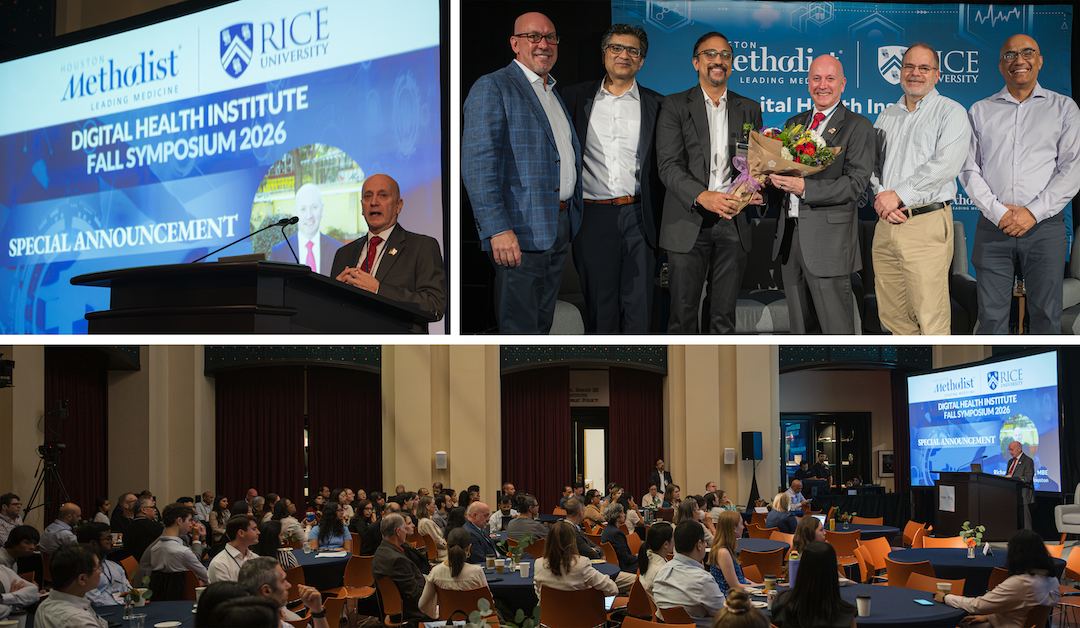
Nasir said the proposed global scholars program would develop leaders with expertise across the clinical, engineering, policy and implementation domains, allowing them to not only “develop an innovation, but make it useful in different systems and across the globe.”
How AI is transforming the doctor patient relationship
Elias Mossialos, the Cheng Yu Tung Chair in Global Health and director of LSE Health, delivered a prerecorded keynote in which he examined how AI is changing the doctor-patient relationship.
Medical ethics and economics have traditionally understood that encounter as a relationship between two people, “one holding the knowledge, one holding the values.” AI introduces additional actors whose interests and obligations may be less apparent to patients.
Mossialos called for transparency about how systems are trained and what they are designed to accomplish, alongside rigorous evaluation before and after deployment.
“Our task is to make sure the relationship at the center of medicine keeps at least one party in it whose duty is to the patient,” said Mossialos.
Making technology work in practice
Discussions throughout the day examined what it takes to make new technologies useful in hospitals and communities, exploring examples of, and relationships between, changing clinical workflows, technology adoption and the role of trust in the context of the clinical encounter.
Houston Methodist leaders described how decisions to implement innovations play out across the health system. Dr. Sarah Pletcher, chief digital health officer and system vice president for strategic innovation, discussed investments in wearable monitoring and virtual care that have allowed teams to reduce interruptions for patients and free staff for other responsibilities. Roberta Schwartz, executive vice president and chief innovation officer, emphasized the need to demonstrate financial returns and change workflows so that new tools justify their cost. Dr. Shlomit Schaal, executive vice president and chief physician executive, called for involving clinicians in design decisions so technology supports patient relationships and reduces administrative demands.
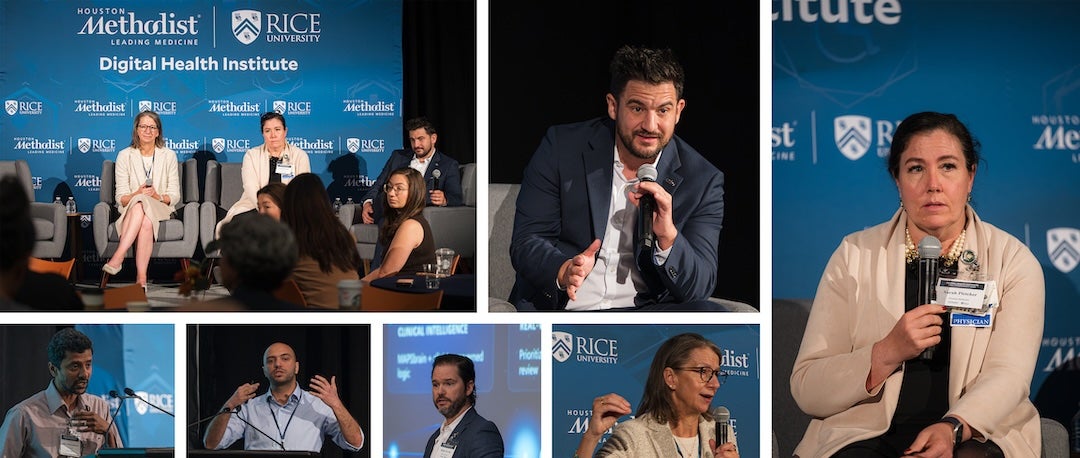
Elad Walach, CEO of Aidoc, brought an industry perspective on deploying AI in clinical practice. Aidoc’s CARE foundation model, designed to support analysis across multiple conditions, was named one of Time’s Best Inventions of 2026.
Rebecca Richards-Kortum, Rice’s Malcolm Gillis University Professor and co-director of the Rice360 Institute for Global Health Technologies, described how efforts to improve newborn care in African hospitals have grown beyond the development of a single device to establishing NEST360, an alliance driving country-led change in the region. She connected lessons derived from this journey to improving maternal health in underserved Texas communities.
A spotlight segment featuring Brian Parrish, cardiology pharmacotherapist at Houston Methodist; Farshid Alambeigi, director of surgical robotics and imaging at Houston Methodist’s Bookout Center and associate professor of mechanical engineering at Rice; and Ashok Veeraraghavan, chair of the Department of Electrical and Computer Engineering at Rice and professor of electrical and computer engineering and computer science, illustrated the range of clinical problems being addressed through collaborative research and development.
A lunchtime breakout panel, “Solving the Data Paradox,” examined how to turn health data into useful information without overwhelming patients and care teams. The panel was moderated by Muthukumar Krishnan of Infosys Consulting and featured Alyssa Sinclair, an assistant professor of psychological sciences at Rice; Dr. Hardeep Singh, director of the Safety, Quality and Well Being Institute at Houston Methodist; and Dr. Ngoc-Anh Nguyen, vice chair of the Center for Connected Care, Implementation and Innovation Research, an emergency medicine physician and medical director of virtual urgent care at Houston Methodist.
Exploring policy, community health and trust
Stephen Konya, chief of innovation and strategic partnerships at the Office of the National Coordinator for Health Information Technology within the U.S. Department of Health and Human Services, kicked off the second session of the symposium by showcasing federal efforts to improve data exchange and help promising technologies move beyond pilot projects.
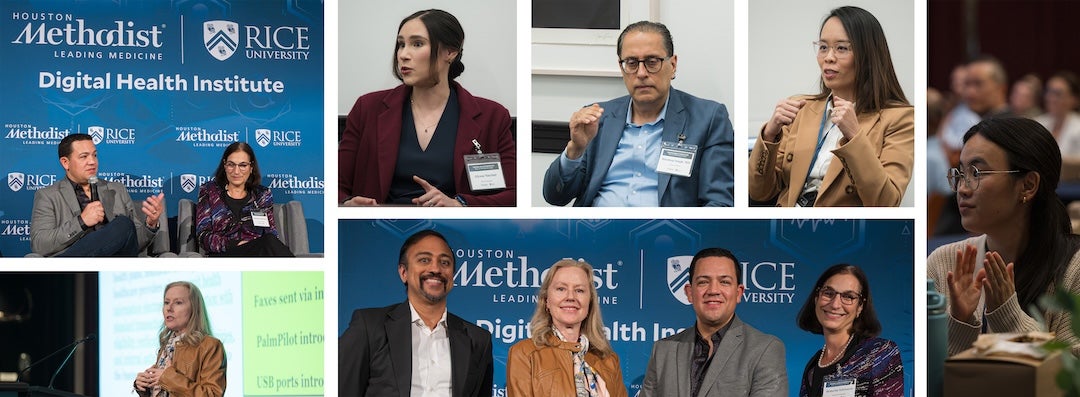
One of the recurring themes in policy discussions addressed the responsibilities that accompany greater use of patient data. Heidi Russell, director of the Baker Institute’s Center for Health Policy, examined the differences between protections for clinical records under the Health Insurance Portability and Accountability Act and those governing information shared through consumer technologies. Follow up discussion highlighted consensus around the inadequacies of the HIPAA framework.
Dr. Esmaeil Porsa, president and CEO of Harris Health, described the Harris Collaborative’s effort to coordinate health care and social services to prevent cardiovascular harm in Northeast Houston. Luz Garcini, director of the Center for Community and Public Health at Rice’s Kinder Institute for Urban Research, urged researchers to involve communities from the outset and to recognize the expertise that comes from lived experience.
Capping off the third session of the symposium, Konya joined DHI executive director Chatterjee for a closing conversation about responsible adoption and the work ahead.
“I think it is really important that we pause and ask questions from a healthcare perspective and from a build perspective as to how do we scale these solutions in a responsible manner,” Chatterjee said in an interview. “I hope we align clinical leaders, policymakers, engineering experts around the key priorities to take this moment from dialog into action.”
DHI’s growing collaborations
Since its launch in December 2024, the institute has grown to support more than 30 joint research projects, with more expected to begin within the following months. The DHI has worked to streamline processes for onboarding Rice researchers into Houston Methodist’s clinical data and computing ecosystem.
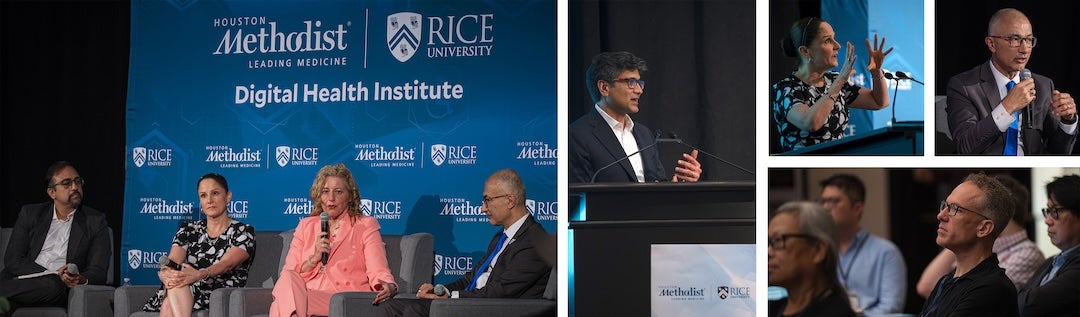
DHI education efforts include a new undergraduate minor at Rice and a master’s program in digital health that welcomed its first cohort this fall. DHI also supports the National Science Foundation-funded Digital Health Workforce Initiative, which provides hands-on training in biomedical hardware and AI for Houston-area high school and community college students and high school teachers. An online certificate program in health AI for physicians is planned for next year.
Industry collaborations have also expanded, with the institute helping match entrepreneurs with clinical and engineering collaborators.
Sabharwal, Rice’s Ernest D. Butcher Professor of Engineering, said in an interview that the institute was established to help leverage to the fullest both Rice’ and Houston Methodist’s “capacity to innovate.”
“We would like to see our innovations reach where the need is the highest,” Sabharwal said. “We also recognize we can’t do it alone. We need to build partnerships for all parts of this journey together, from education to innovation to translation to community adoption.”
Recorded sessions from the 2026 DHI Fall Symposium are available online at the institute’s YouTube channel.