

As artificial intelligence systems improve at performing complex analytical and creative tasks such as composing music, writing text, programming and diagnosing disease, scholars across disciplines are beginning to ask a deeper question: What does it mean for human beings to flourish in a world shaped by AI?
That will be the focus of an international conference hosted by Rice University June 3-5 at the Rice Global Paris Center. “Human Flourishing in the Age of AI” will bring together scholars from philosophy, engineering, public policy and the arts to examine how emerging technologies may reshape human life, agency and creativity.
“The central question is how these technologies might help humans thrive rather than undermine the things we value most about being human,” said Robert Howell, the Yasser El-Sayed Professor of Philosophy and chair of the Department of Philosophy.
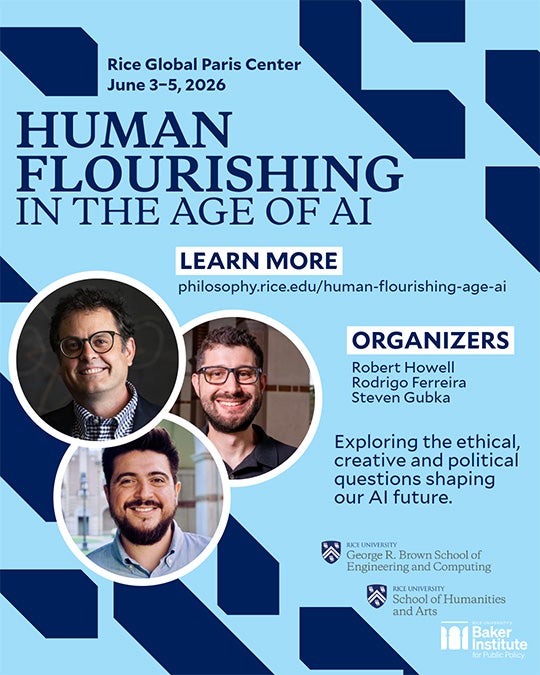
The conference is a collaboration between the George R. Brown School of Engineering and Computing and the Department of Philosophy in Rice’s School of Humanities and Arts with additional support from the Baker Institute for Public Policy. It is co-organized by Howell; Rodrigo Ferreira, assistant teaching professor in computer science; and Steven Gubka, postdoctoral associate in philosophy and the Humanities Research Center. Participants are also traveling from institutions including New York University; University of California, Berkeley; Florida Atlantic University; University of Twente and University of Lausanne.
Discussions will explore how the rapid expansion of AI capabilities may affect the ways people work, create and think. As automated systems take on more tasks once reserved for human intelligence, researchers are increasingly examining how those shifts could influence human agency and satisfaction.
“There’s a dystopian picture in which AI leads people to work more while thinking less and where art and creativity increasingly come from nonhumans,” Howell said. “But there’s also a more hopeful vision in which technology removes burdens and gives people more freedom to shape meaningful lives.”
Rather than treating those outcomes as predetermined, the conference aims to examine how choices made today in research, policy and design could influence the trajectory of emerging technologies. Panels will address topics including AI and creativity, the ethical responsibilities of designers and institutions and the broader political and regulatory questions raised by powerful new technologies. Scholars from across disciplines will present research and engage in discussion about how AI might alter core human activities such as reasoning, artistic creation and moral decision-making.
The conference will also mark the launch of a broader initiative of collaboration between the schools of engineering and humanities.
“In thinking about the relationship between AI and society in this and other developing projects, multidisciplinary collaboration is key,” said Ferreira, who also has an appointment in the philosophy department. “To think of ‘artificiality’ or ‘intelligence’ means engaging with the rich sociotechnical history of these terms, both from humanities-based and computational perspectives. You cannot have one without the other.”
The conference will feature panel discussions, research presentations and a performance exploring the relationship between AI and artistic creation. Organizers say the goal is not only to analyze technological change but to frame the values that should guide it.
“Human flourishing going back to Aristotle is about more than pleasure or convenience,” Howell said. “It’s about realizing our capacities and living lives that are genuinely fulfilling for human beings.”
Learn more about the “Human Flourishing in the Age of AI” conference here.