
Rice University has received a $19.9 million award from the National Science Foundation to lead a four-year project aimed at using artificial intelligence, robotics and cloud-based laboratories to accelerate the manufacturing of electronic and quantum materials.

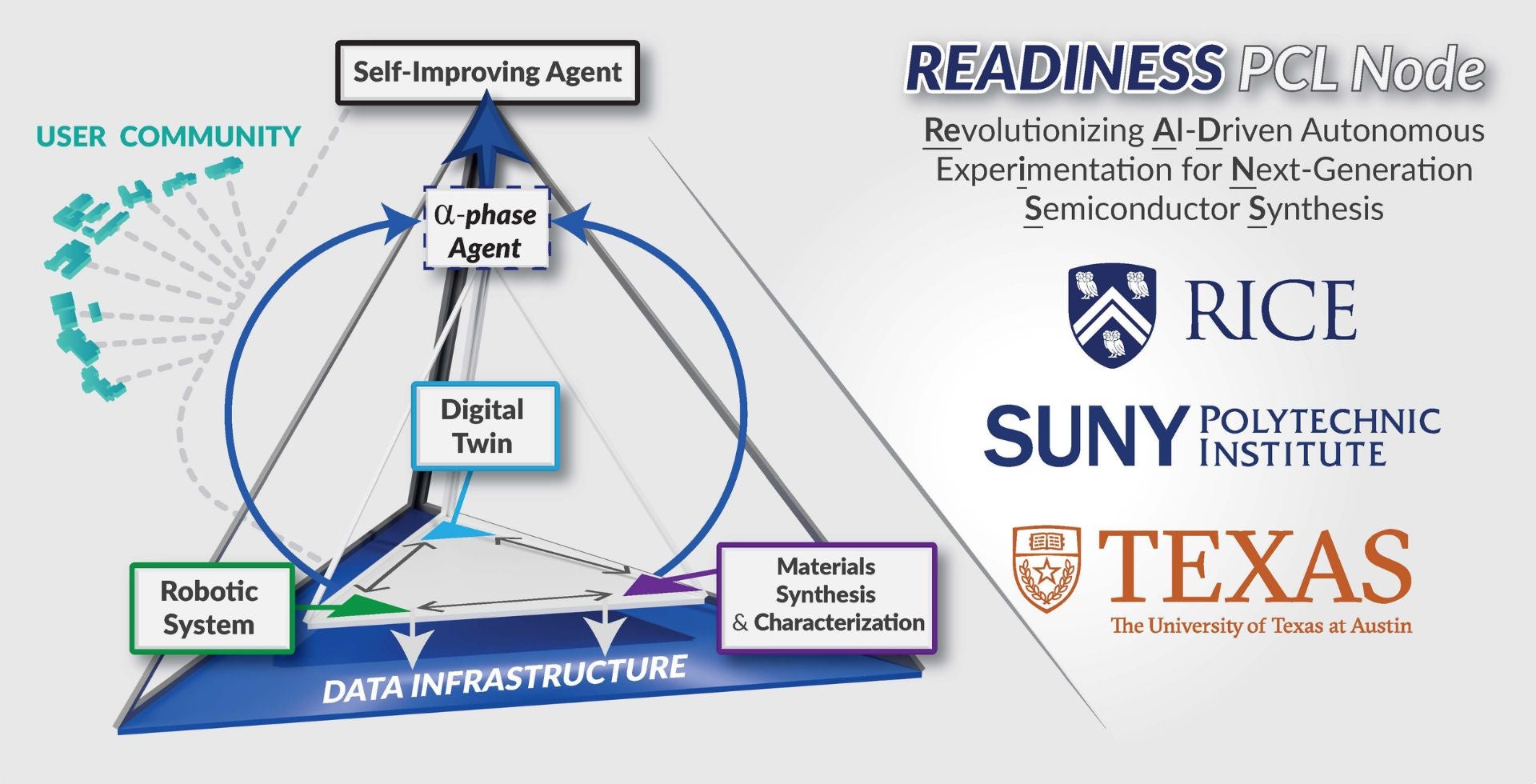
The project, titled “Revolutionizing AI-Driven Autonomous Experimentation for Next-Generation Semiconductor Synthesis” (READINESS), seeks to create a remote research platform that minimizes trial-and-error experimentation and enhances access to advanced research infrastructure for electronic and quantum materials synthesis.
“This project will give researchers access to capabilities that have traditionally been available only in a handful of laboratories,” said David Sholl, executive vice president for research. “By lowering those barriers, READINESS can accelerate discovery and expand who can participate in cutting-edge materials research.”
Rice is heading the project with materials scientist Jun Lou serving as principal investigator. Collaborators include SUNY Polytechnic Institute and the University of Texas at Austin. The Astera Institute is supporting the broader initiative through philanthropic funding focused on open science, reusable research methods and faster sharing of data and results.
Building an autonomous laboratory
Developing electronic and quantum materials can require researchers to adjust variables such as temperature, pressure, gas flow and chemical composition. Even small changes in those conditions can affect a material’s properties.
The READINESS project will integrate automated synthesis equipment, robotic systems, materials characterization tools and a digital twin, a virtual model of the laboratory. This setup will allow researchers to simulate experiments in the digital twin before conducting them with physical equipment.
The system will learn from both successful and unsuccessful experiments. Its AI agent will recommend new tests, analyze results and enhance future recommendations while adhering to safety limits and consulting researchers when uncertainties arise.
“Responsible AI should complement researchers’ capabilities rather than replace their judgment,” said Luay Nakhleh, the William and Stephanie Sick Dean of Rice’s George R. Brown School of Engineering and Computing. “READINESS embodies this principle by combining automated systems with transparency, safeguards and human oversight at critical decision points.”
Initially, the laboratory will focus on two-dimensional materials, oxide semiconductors and diamond thin films, which have the potential to support faster electronics, lower-power computing, quantum devices and other emerging technologies.
Expanding access to advanced equipment
Emerging research institutions, startups and small to midsize companies often lack the expensive equipment and specialized staff necessary for producing advanced electronic and quantum materials. READINESS aims to provide remote access to sophisticated laboratory systems through a cloud-based interface.
Users will be able to propose experiments, simulate them in the digital twin then carry out approved projects using physical equipment. The platform will gather data from each step, helping researchers link processing conditions with a material’s structure and performance.
The project will be based at Rice’s Ralph S. O’Connor Building for Engineering and Science, using existing shared facilities alongside additional laboratory space designated for this research initiative. Partner sites will contribute equipment, technical expertise and workforce development programs.
“Our goal is to create a laboratory that researchers from across the country can use to produce advanced electronic and quantum materials on demand,” said Lou, the Karl F. Hasselmann Professor of Materials Science and Nanoengineering. “By integrating robotics, AI and digital twins, we aim to learn from every experiment and shorten the pathway from scientific discovery to practical technology.”
Training the next workforce
READINESS will also support graduate-level research, undergraduate experience, teacher training, K-12 outreach and professional education. Students will gain hands-on experience in materials science, robotics, data management and AI.
As part of the initiative, SUNY Polytechnic Institute will help develop short courses and stackable credentials for workers in semiconductor manufacturing, laboratory automation and related fields. The University of Texas at Austin will contribute expertise in digital twins, autonomous experimentation and AI training.
The effort also draws support from Rice’s Ken Kennedy Institute, Advanced Materials Institute, AI and Machine Learning Initiative, Engineering Initiative for Energy Transition and Sustainability and the departments of computer science and materials science and nanoengineering.
The work aligns with Rice's Momentous strategic plan by promoting interdisciplinary research, responsible AI and partnerships that bridge scientific discovery with national and economic needs.
“This award highlights Rice’s ability to combine engineering and computing to tackle challenges of national significance,” said Amy Dittmar, the Howard R. Hughes Provost and executive vice president for academic affairs. “READINESS will enable researchers to transition from ideas to discoveries more rapidly, while also preparing students to excel in AI, advanced materials and manufacturing.”
READINESS is one of 20 projects selected for the NSF’s Programmable Cloud Laboratories Test Bed initiative, part of a $380 million investment in a national network, with up to $20 million available in matching funds. The project aims to provide more U.S. researchers with access to automated scientific tools, enhancing the speed, reliability and reproducibility of experiments.
The work is in alignment with the Department of Energy’s Genesis Mission, a national initiative using AI and advanced computing to accelerate scientific discovery. Two Rice research teams received funding to explore how AI can address fundamental challenges in quantum computing and help engineer microbes to sustainably produce strategically important fuels, chemicals and materials.