

Queen Dube, Newborn Health Program lead at the World Health Organization, delivered the third and final lecture in the Rice360 Institute for Global Health Technologies Seminar Series Dec. 3, offering a global perspective on the future of newborn health and the urgent need to rethink how care systems are designed and delivered worldwide.
In her seminar, Dube spoke about the global agenda for newborn health and the work she leads at WHO, emphasizing the need to innovate and rebuild the global architecture for neonatal care. Drawing on her experience as both a clinician and a policymaker, she addressed the global burden of neonatal disease, the limitations of current systems and the importance of reimagining innovation as a tool for equity rather than an end in itself.
“We need to make our systems more resilient. We need to make sure that whatever is being done now is country led, country driven and not donor driven,” Dube said. “It helps address the equity issue and breaks the silos. Remember, when we get out of this room, innovation is not an end, it’s a means to equity and survival.”
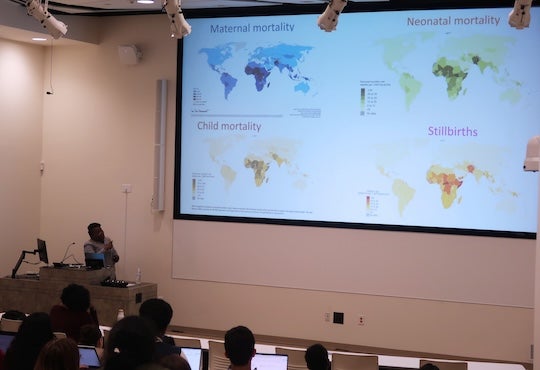
Dube also highlighted accountability and resilience as central pillars of the next phase of global health work. “We’re here to rebuild the global health architecture around resilience and accountability, and we’ll do it right as innovators,” she said.
A consultant pediatrician and clinical epidemiologist, Dube currently works with global partners to support Ministries of Health in improving the quality of care for newborns and children through the development of national policies, standards and strategies as well as the implementation of high-impact interventions.
Before joining WHO, Dube served as chief of health services for Malawi’s Ministry of Health and as head of the Department of Pediatrics and Child Health at Queen Elizabeth Central Hospital, the largest tertiary hospital in Malawi. Her work has spanned collaborations with the Ministry of Health, Saving Newborn Lives, WHO, UNICEF and the Pediatrics and Child Health Association of Malawi to strengthen newborn care in district hospitals and improve outcomes for small and sick newborns.
Dube also played a leading role in the development and implementation of the Every Newborn Action Plan for Malawi, identifying critical gaps in neonatal care and introducing new technical solutions across hospitals nationwide. She has led multiple research studies focused on vulnerable newborn populations and previously served as a co-principal investigator on NEST360, a multi-institutional initiative aimed at halving inpatient neonatal mortality in Africa. She continues to contribute to several technical advisory panels for neonatal research trials.
Rice360 launched the seminar series to engage campus and community audiences in conversations with experts working at the intersection of medicine, technology and policy to improve health outcomes worldwide. Earlier lectures in the series featured Sonali Korde, MD Anderson Visiting Fellow at Rice’s Baker Institute for Public Policy, and Maria Elena Bottazzi, an internationally recognized vaccine scientist and advocate for equitable access to global health innovations.
Through the series’ final lecture of the year, Dube reinforced a central message echoed throughout the program: Lasting improvements in global health depend on resilient systems, local leadership and innovations designed to serve those most at risk.