
Rice University’s Shepherd School of Music and Medical Humanities Research Institute (MHRI) are launching the Music, Mind and Body Lab, a new interdisciplinary hub that brings artists and scientists together to explore how music and creativity shape human life. Led by composer and professor Anthony Brandt, the lab highlights a growing area of study at the intersection of the arts, neuroscience and the medical humanities.
The Music, Mind and Body Lab draws on the Shepherd School’s culture of innovation and collaboration, connecting music making with emerging research on neuroplasticity, brain dynamics and the ways everyday creative engagement affects well-being. Instead of focusing on therapeutic or clinical applications alone, the lab emphasizes open-ended inquiry. Its projects ask broad questions about how music stimulates attention, challenges perception and activates the brain in ways that extend far beyond the concert hall.
“Science has learned more about the brain than any other human activity, and increasingly involving musicians is going to extend those discoveries,” Brandt said.
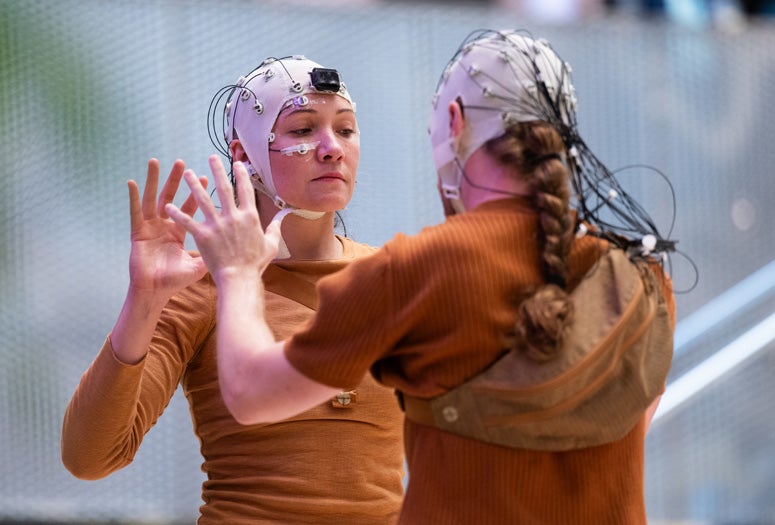
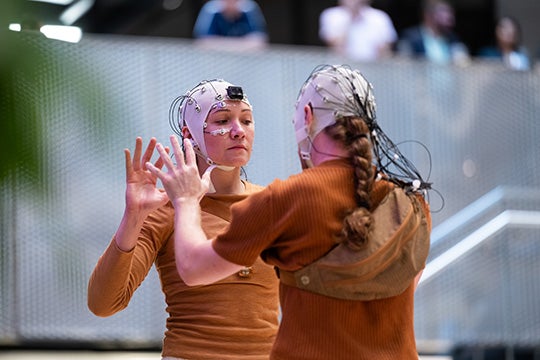
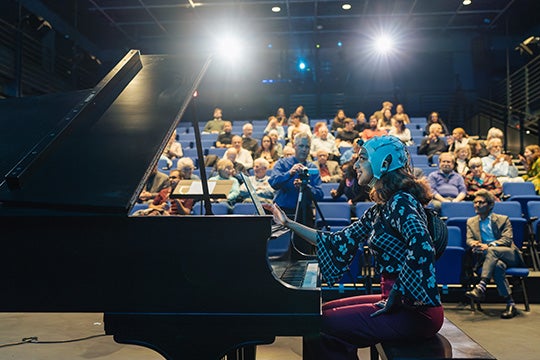
Many of the lab’s investigations take place outside traditional scientific environments. Rather than confining performers to controlled laboratory conditions, the Music, Mind and Body Lab studies creativity in real-world settings by combining live performance with mobile brain-imaging technology. These tools allow researchers to capture neural activity as musicians and dancers rehearse, improvise and respond to one another in authentic artistic contexts.
That approach has already led to notable projects. In “LiveWire,” dancers wearing wireless brain-imaging caps revealed how their neural patterns shifted as they mastered new choreography. In “Meeting of Minds,” which was performed at the United Nations’ AI for Good global summit, two dancers performing a work about conflict and cooperation showed evolving levels of neural synchrony, providing insight into how social connection takes shape both physically and cognitively. These collaborations have allowed researchers to observe the brain’s flexibility and coordination during complex, expressive movement and music.
Brandt’s work on music and aging also informs the lab’s mission. In a recent study involving seniors participating in a six-week music composition workshop, researchers found that individuals with higher neural flexibility at the start of the program showed the greatest cognitive gains afterward. The findings suggest that creativity-based interventions may interact with underlying brain dynamics, highlighting the importance of studying individual differences.
“There are wonderful uses of music for palliative and soothing purposes, but I think there’s a lot of potential for music to be used for cognitive stimulation,” Brandt said. “That’s something you can pursue at a music school such as Shepherd.”
The Music, Mind and Body Lab is structured as a unifying framework rather than a physical space. Brandt and his collaborators work across disciplines and institutions, engaging students and faculty from music, engineering, psychology and the humanities. The lab also welcomes new artistic partners and research collaborators with several additional projects already underway.
For the Shepherd School, the launch signals a broader commitment to championing creativity as a vital form of inquiry. The lab’s emphasis on imagination, cognition and lived experience reflects the school’s belief that music offers distinct contributions to understanding the human mind.
“The Music, Mind and Body Lab grows out of our community’s interest in exploring how creativity and inquiry support one another,” said Matthew Loden, the Lynette S. Autrey Dean of Music. “It creates space for our students and faculty, who are increasingly interested in collaborations that push past traditional boundaries, to pursue larger questions about the brain, imagination and the role music plays in shaping life.”
MHRI leaders also expressed excitement that the lab embraces medical humanities’ emphasis on how culture affects experiences of health and illness. MHRI provided support for Brandt to work with Gamelan musicians and dancers in Bali.
For more information about the Music, Mind and Body Lab, click here. To schedule an interview with Brandt, contact Rice media relations specialist Brandi Smith.