
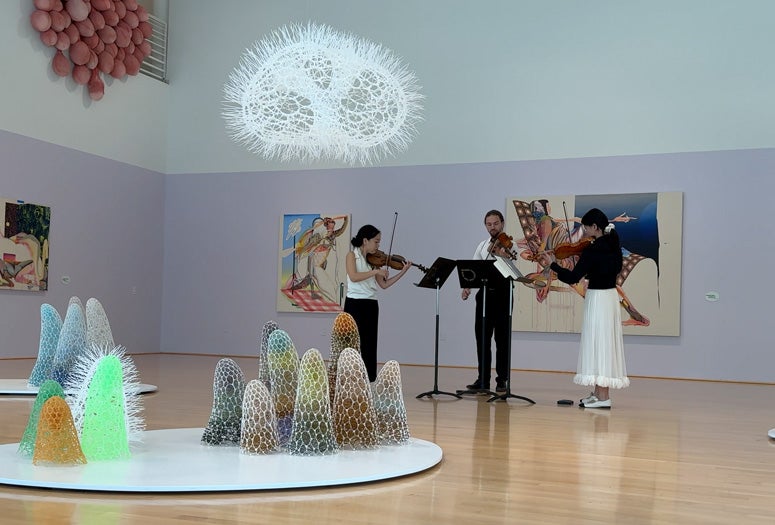
Rice University’s Shepherd School of Music and Moody Center for the Arts once again joined creative forces for New Art / New Music, a performance series pairing student compositions with visual art on view at the Moody. This latest installment drew inspiration from “Bio Morphe,” the current exhibition exploring organic forms, hybrid structures and the interplay between art and science.
Guests gathered at the Moody for an afternoon of original works by Shepherd School student composers, each piece reflecting the visual and thematic energy of “Bio Morphe.” The event was organized by graduate students Angela Ortiz and Victor Cui.
“The collaboration between the Moody and the Shepherd School has always been, in my opinion, the highlight of each semester,” Ortiz said. “It is an opportunity for live dialogues between contemporary artists, and the staff at the Moody remain supportive of each individual creative vision. As a composer, interdisciplinary collaborations are incredibly valuable because they give us a chance to see the common ground between different artistic mediums. To be involved in organizing these kinds of collaborations is a passion of mine, and so New Art / New Music was the best of both worlds.”
The program featured “Neon Landscape” composed by Shane Cook and performed by Jasmine Lin and Qian Chang on violin with Gabriel Galley on viola; “Aithér” composed by Asher Lurie and performed by mezzo-soprano Isabelle Kosempa and cellist Claire Druffner; “Evaristo” composed and performed on mbira by Ethan Resnik; and “Interlocking Space” composed by William Jae and performed by bassoonists Austin Struble, Kenny Ford, Jack Bernal and Bridget Bruno.
“It is always nice for living composers like us to work with nontraditional venues,” Cui said. “It compels us to interrogate the concert hall listening that we take for granted and find ways to reinvigorate live music consumption. The staff at the Moody Center has been nothing but staunchly supportive of the composers’ visions.”
Ortiz said programs like this are vital for both composition and performance students, offering creative challenges that mirror the realities of today’s music world.
“As we see the musical landscape evolve, there are more avenues being explored than just the traditional concert hall experience,” Ortiz said. “It’s valuable for students to work in less traditional settings and to learn how to adapt their music to different acoustics and spaces.”
Cui said the collaboration helps students develop professionally by expanding their sense of performance spaces and artistic possibilities.
“Music cannot exist without space,” Cui said. “New Art / New Music prepares composers and performers alike to widen their career path beyond traditional concert halls.”
Supported by the Moody Experience, a universitywide initiative funded by the Moody Foundation, New Art / New Music invites students to learn beyond the classroom and apply their talents in real-world, interdisciplinary contexts. By connecting the Shepherd School and the Moody, the series continues to nurture experimentation, collaboration and the spirit of artistic discovery at Rice.
The next New Art / New Music event is scheduled for April 18 at 3 p.m.