
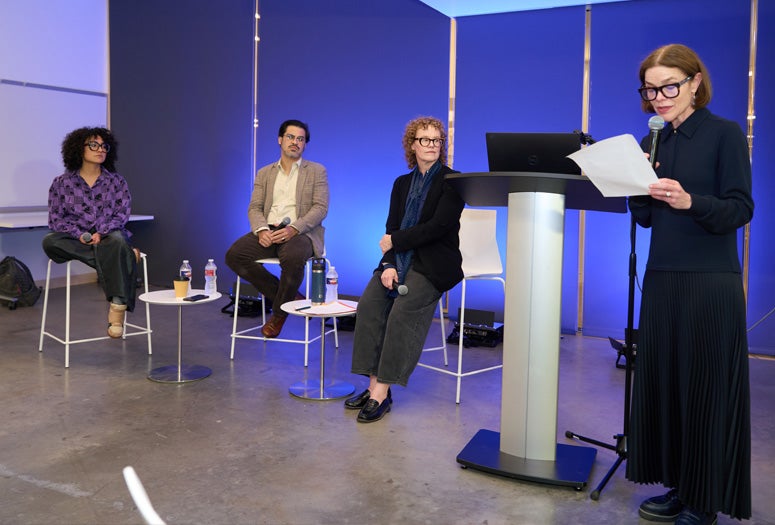
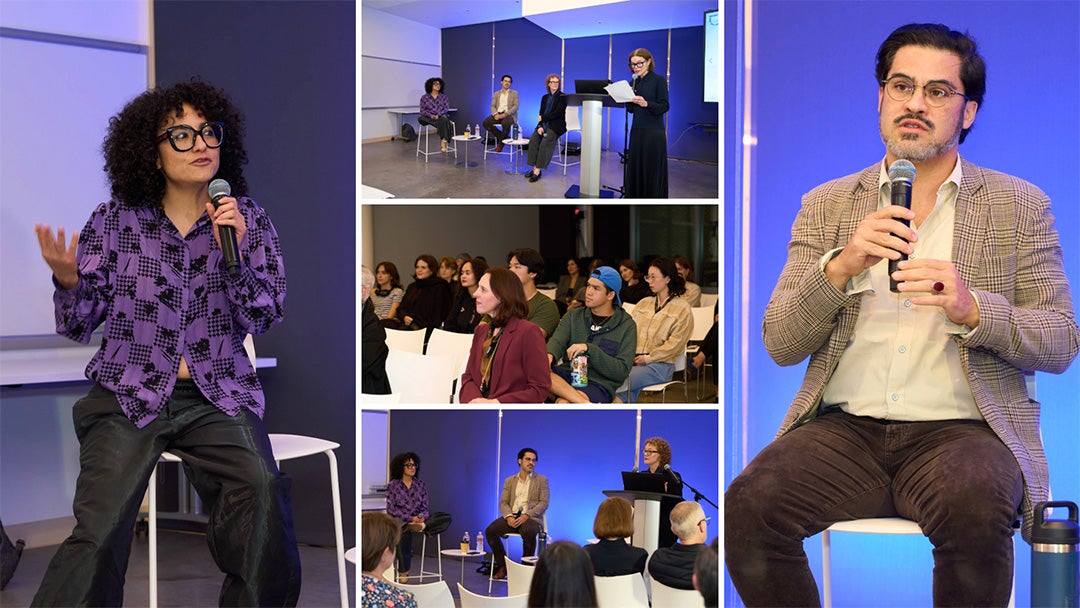
Rice University’s Moody Center for the Arts hosted an Artists-in-Dialogue conversation Nov. 12 that brought together exhibiting artist Berenice Olmedo and physician-writer Dr. Ricardo Nuila for a discussion on how art and medicine continually reshape one another. Moderated by Medical Humanities Research Institute director Kirsten Ostherr and presented in partnership with Rice’s Medical Humanities Program and ENRICH, the event was organized in conjunction with “Bio Morphe,” the Moody’s current exhibition exploring how select contemporary artists evoke biomorphism — the aesthetics of organic material and forms — in their work.
With a specific concern for disability, care and the mutable boundaries of the human body, Omeldo opened the conversation by describing her sculptural work on view in the exhibition, which integrates discarded prosthetic materials and orthotic devices while drawing shapes from medical imaging and equipment. She noted that this practice, influenced by her direct work with amputees in Mexico, is guided by a belief that we should embrace the variety of human forms in the same way we champion ecological biodiversity.
“I was thinking how the border of the human can border Mother Nature or can be closer with other forms of organization of life,” Olmedo said. “In this case, I was thinking how we can cross satellite forms or molecular forms coming from a part of the human body.”
Connecting the empathic power of Olmedo’s artwork to the writings of Nulia, Ostherr extended the interplay between creative expression and medical advancements into a broader cultural context.
“Science and technology alone cannot solve our most pressing social, cultural and ethical problems in health,” Ostherr said. “We saw this really acutely during the pandemic when we managed to invent a vaccine in less than a year and then people wouldn’t take it because they didn’t trust it. That’s not a medical problem; that’s a human problem.”
Those issues and questions, Ostherr said, are the kinds of topics the Medical Humanities Program likes to address, often extending the approach beyond multidisciplinary to multimedia.
“This is really key to making sure the voices and experiences of a really diverse range of people can be expressed in the ways that make the most sense to them and that capture things that maybe you can’t capture in a narrowly medical way,” Ostherr said.
Nuila, author of “The People’s Hospital: Hope and Peril in American Medicine,” reflected on how literature has shifted his medical practice away from a transactional interaction into one of deep observation. Literature, he said, shapes how he listens, how he notices and how he interprets what a patient’s body communicates.
“Whenever I go and see patients, like I did this morning at Ben Taub, I am constantly thinking about words and sentences and scenes and how to write,” Nuila said. “It’s the same thing when I’m writing; I’m thinking about the body and I’m thinking about physiology and I’m thinking about some of the scientific laws and how that influences the prose.”
The conversation also touched on the emotional textures of “Bio Morphe,” including audience observations of joy and familiarity in Olmedo’s forms. When asked about the presence of humor or approachability in work shaped by trauma, disability or medical intervention, the speakers emphasized the importance of openness — both in how bodies adapt and how care practitioners, artists and teachers meet people where they are.
Together, the three explored how art can reveal hidden systems of the body and health care, how medical encounters carry profound aesthetic and ethical dimensions and how interdisciplinary collaboration expands the possibilities of both fields.