

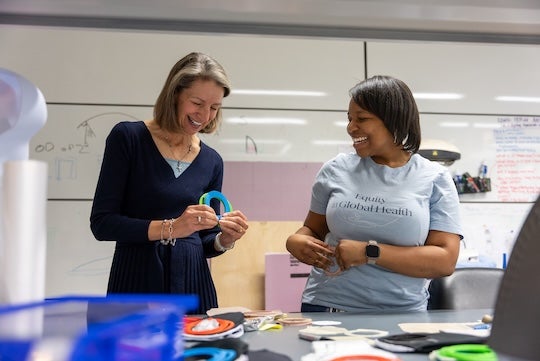
Rebecca Richards-Kortum, co-director of the Rice360 Institute for Global Health Technologies, has spent her career breaking barriers between innovation and impact. A trailblazer in global health engineering, she leads with a whole-systems approach, developing not only groundbreaking medical technologies but also the sustainable networks that ensure those tools save lives in real-world settings. Her pioneering work has led to low-cost imaging and diagnostic tools that improve care for conditions ranging from cancer to sickle-cell disease and has advanced technologies that enhance maternal and newborn health worldwide. Recently elected to the National Academy of Medicine, one of the nation’s highest honors in health and medicine, Richards-Kortum continues to expand her focus on health innovation and access. Ahead of the Innovation for Healthcare Access Conference Oct. 27-28 hosted by Rice360, she shares insights on advancing equitable health care solutions across Texas and the United States.
Q: What is your vision for this conference? What do you hope participants will take away or see as its long-term impact?
I have a few key goals for this conference. First, I hope participants leave feeling inspired about how they can work together — how clinicians, policymakers and innovators can collaborate to develop and implement technologies that make health care more accessible across Texas and the United States. In Texas, we’re looking at a broad range of medically underserved settings, from rural communities to urban populations that may be uninsured or underinsured. We want to explore the best opportunities for innovation and how to build teams capable of meeting those needs. There’s also a lot we can learn from global health, particularly from work in low- and middle-income countries, about how to innovate and scale solutions quickly. I think Texas and the U.S. can apply many of those lessons to accelerate progress here at home.
Q: One of the conference’s priority areas is maternal and newborn health. What do you see as some of the most critical unmet needs in that space, especially in Texas and the U.S.?
Maternal mortality is a major issue in Texas, and while the causes differ somewhat from those in low-income countries, there are important similarities. Here, we’re focused not only on what happens during labor and delivery but also on the postpartum period, especially managing chronic health conditions that can lead to complications after birth. Even something as basic as keeping newborns warm remains a challenge, both globally and locally. So while the specific technologies and infrastructure may differ, the underlying problems — and opportunities for innovation — have more in common than we might expect.
Q: How about chronic disease care? What gaps in innovation or implementation do you hope this conference will address?
I think one of the most promising areas is prevention. With diseases like diabetes, hypertension and cancer, we’re asking: How can technology — and its integration into strong health systems — help us prevent complications or detect conditions earlier? It’s an opportunity that benefits everyone: patients, providers and payers. By aligning around prevention, we can improve outcomes while reducing overall costs. Those are the kinds of opportunities this conference is designed to explore.
Q: Moving from concept to implementation is often the hardest step. What are some of the key barriers to that “last mile” of deploying technology?
One of the biggest lessons we’ve learned at Rice360 and through our global health work is that technologies are not magic bullets — they only make a difference when they’re effectively integrated into a health system. Too often developers think their job is done once a device is built and commercialized. But real impact requires a systems-level approach that includes implementation research and quality improvement. At this conference, we’re bringing together experts in implementation science with technology developers. The goal is to begin forming teams that take that full-circle approach, from invention to implementation with measurable impact.
Q: How do public-private partnerships and nongovernmental and community organizations fit into this vision of implementation?
I’ll use cervical cancer as an example. It’s a cancer that could be prevented, but it still claims far too many lives because the technologies that are needed aren’t always available or aren’t used where they are needed. Two of our speakers, Kathleen Schmeler and Isabel Scarinci, are deeply involved in this area. Isabel is helping lead Alabama’s statewide cervical cancer elimination plan, and Kathleen is part of the team developing Texas’ plan. Their work shows how innovation can only succeed when supported by comprehensive strategies for rollout, financing and measurable goals like vaccination and screening rates. It’s naive to think a new technology will simply “find its way” into use. Developers, policymakers and implementers all have to be part of the same conversation from the beginning. The same principle applies to maternal and newborn health: Innovation must be integrated into broader efforts to improve quality and access.
Q: Are there any policy or systemic reforms that could help scale these types of innovations in the U.S.?
Ultimately, scaling innovation depends on data — on demonstrating impact and cost-effectiveness. We need research that clearly shows what works and what provides the best value for money. In our global health work, projects like NEST360 (Newborn Essential Solutions and Technologies) have helped generate this kind of evidence. Now we’re beginning to apply a similar approach in Texas, building teams and tools to measure impact in our own communities.
The U.S. system is complex, which can make progress harder. But unlike many low-resource settings, we do have established payers, including Medicare, Medicaid and private insurers, that can support effective interventions once the evidence is there. That’s an advantage we should leverage.
Q: Do you have any “moonshot” or aspirational goals connected to this work?
That’s a question I’d love for conference participants themselves to answer. But for me, I’d like to look back in five years and say, “Here’s a team that came together because of this conference, developed a road map for a particular issue and started to address that issue.” That’s the kind of lasting impact we hope to spark.
Q: If you could leave participants with one call to action, what would it be?
Be part of a team that gets across the finish line. At Rice360, we often say, “This is the problem we’re solving, and we’re going to get there — together.” Biomedical innovation requires multidisciplinary collaboration. Engineers, clinicians, social scientists and community leaders all have a role to play in making sure everyone has access to quality care.
Q: Anything else you’d like to add?
Just gratitude to everyone taking time out of busy clinical and academic schedules to join us, share their expertise and dream big together. That collective energy is what makes this conference special.
To schedule an interview with Richards-Kortum, contact Alex Becker, media relations specialist in Rice’s Office of Public Affairs, at alex.becker@rice.edu.