

Rice has announced the launch of the Rice AI Venture Accelerator, designed to drive early stage artificial intelligence innovation and commercialization.
Rice has announced the launch of the Rice AI Venture Accelerator, designed to drive early stage artificial intelligence innovation and commercialization.
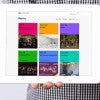
Dedicated arts calendar showcases Rice’s cultural offerings
It’s designed for anyone curious about what’s happening in the arts at Rice, from students and faculty to Houston-area residents and visitors.
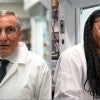
Rice scientists pioneer method to tackle ‘forever chemicals’
A new study unveils a method that eliminates PFAS from water systems and also transforms waste into high-value graphene.

Bioelectronic devices, neural interfaces, biosensors and AI hardware are now easier to make thanks to a streamlined method for fabricating a key material.
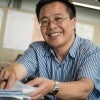
Rice physicists use quantum entanglement to crack mystery of strange metals
Led by Qimiao Si, a research team has shown that electron entanglement peaks at a quantum critical point.

Houstonʼs audit shows ongoing financial challenges, Baker Institute experts say
A recent audit of Houston’s finances reveals ongoing challenges, with experts warning that without major structural reforms the city could face financial instability that affects essential services.

Energy-efficient power amplifier could speed up wireless networks for 5G and beyond, cut energy use
A team of Rice electrical engineers led by Taiyun Chi developed a new kind of power amplifier that combines cutting-edge design in both circuitry and electromagnetics, delivering unprecedented efficiency even under demanding, high-speed conditions.

Rice announces Dr. Huda Zoghbi as commencement speaker for 112th ceremony
Dr. Huda Zoghbi, an internationally renowned neurogeneticist and pioneer in the field of brain research, will serve as the speaker at Rice’s 112th commencement ceremony May 10 at Rice Stadium.

Rice Biotech Launch Pad and RBL LLC to celebrate official launch and lab opening
The Rice Biotech Launch Pad and RBL LLC will hold an event to celebrate the official launch and lab opening of RBL LLC May 5, following a Rice presidential lecture delivered by Robert Langer Jr. The launch event, held at Helix Park, will also feature a keynote a keynote presentation by Robert Ruffolo Jr.
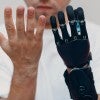
Revolutionizing touch: Researchers explore the future of wearable multisensory haptic technology
Recently, a team of experts, including Rice’s Marcia O’Malley and Daniel Preston, published an in-depth review in Nature Reviews Bioengineering analyzing the current state of wearable multisensory haptic technology, outlining its challenges, advancements and real-world applications.

Symposium to explore intersections of STEM, arts and Black life in Houston
With the theme Dark Matter: STEM and the Arts in Black Houston, this year’s convening invites participants to consider the role of Black communities in shaping Houston’s past, present and speculative futures.
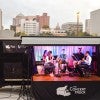
Shepherd School students bringing mobile concert to Eldorado Ballroom
The Concert Truck is a mobile stage designed to bring classical music into everyday spaces.
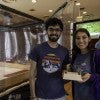
Rice Robo-Rumble features epic competition between battlebots
Campus buzzed with excitement March 9 as Rice hosted its inaugural battlebots competition, the Rice Robo-Rumble.
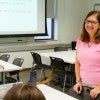
Beason-Abmayr honored with Arthur C. Guyton Distinguished Educator Award
Beth Beason-Abmayr has been awarded the Arthur C. Guyton Distinguished Educator Award by the American Physiological Society.

‘The goal is to play for championships’: Rice welcomes back David Pierce as head baseball coach
Rice formally introduced David Pierce as its Bixby Family Head Baseball Coach in front of a packed crowd at the Brian Patterson Sports Performance Center during a press conference March 19.