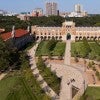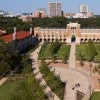
Rice has unveiled the Gateway Project, a transformative initiative on university-owned land in Rice Village that will create a seamless, pedestrian-friendly corridor linking the campus to the heart of the Village, while reimagining the west side of campus anchored by the renovation of Rice Stadium.
Rice President Reginald DesRoches emphasized the university’s ambitious, collaborative approach to transforming health and medicine during a panel discussion hosted by the Greater Houston Partnership. Joined by leaders from the Cancer Prevention and Research Institute of Texas and Harris Health, DesRoches outlined Rice’s vision for becoming a world leader in health innovation — a key component of the university’s strategic plan.
One year after launching its ambitious 10-year strategic plan, Momentous: Personalized Scale for Global Impact, Rice is already seeing the transformative results of its bold vision.
Rice has named David Sholl, an internationally recognized expert in research strategy, clean energy and scientific leadership, as its new executive vice president for research.
Rice has released two new editions of its flagship publications — Rice Magazine and R3: Rice Research Review — offering readers a look at the university’s rapidly growing global presence and research efforts aligned with major societal challenges and opportunities.
Douglas Brinkley, the Katherine Tsanoff Brown Professor in Humanities and professor of history at Rice, has been selected to deliver the 2025 National Heritage Lecture in Washington, D.C., a prestigious annual event hosted by the White House Historical Association in partnership with the U.S. Capitol Historical Society and the Supreme Court Historical Society.
Rice continues its upward trajectory in national and international rankings, earning the No. 17 spot in the 2026 U.S. News & World Report Best Colleges rankings.
With the 2025–26 academic year underway, Rice is taking bold steps to harness the transformative potential of artificial intelligence in teaching, research and operations. Guided by Momentous, the university’s 10-year strategic plan, Rice is positioning itself as a global leader in the responsible development and application of AI, computing and other disruptive technologies.
An expert in drug policy from Rice’s Baker Institute for Public Policy is available to explain and comment on today’s executive order from Texas Gov. Greg Abbott on hemp-derived THC products.
Houston Energy and Climate Startup Week begins Sept. 15 and exemplifies how Houston is developing and scaling real solutions for the challenge of meeting growing global energy demand while reducing carbon emissions.
At Rice Business, the Center for Customer-Based Execution and Strategy — better known as C-CUBES — helps scholars excel in rigorous, peer-reviewed research focused on customer-based strategy.
As workplaces continue to grow more diverse and dynamic, many workers are thinking more deeply about how to stay true to their spiritual values while actively contributing to their organizations. A new book by a Rice University expert explores this growing need and offers a thoughtful framework for navigating faith at work.
Inflation-adjusted CEO pay in nonprofit hospitals increased from roughly $1 million to $1.3 million between 2012 and 2019, and the greatest pay increases went to CEOs who grew the profits and size of their health care organizations the most, according to new research from Rice University’s Baker Institute for Public Policy.