
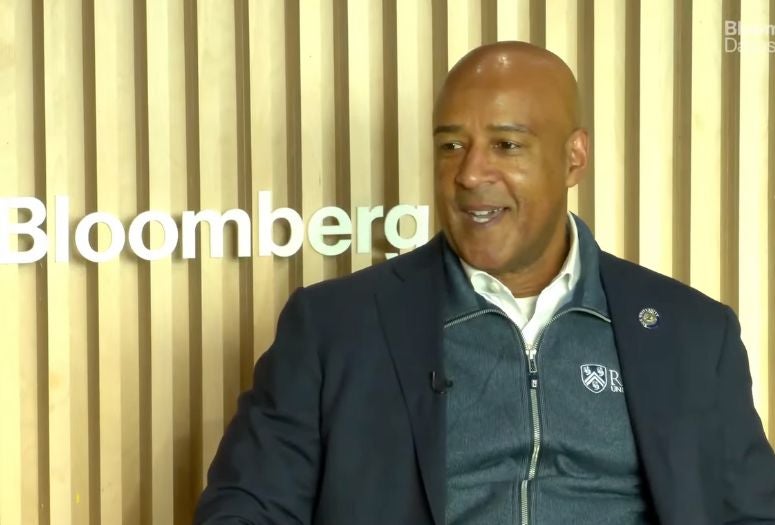
(Note: Scroll to 41:30 of the video to watch Reginald DesRoches's Bloomberg interview)
As global leaders gathered at the World Economic Forum Annual Meeting in Davos, Switzerland, Rice University President Reginald DesRoches used a one-on-one interview with Bloomberg Media to make the case for research universities as essential drivers of economic growth, innovation and societal impact.
Speaking with Bloomberg’s Lauren Kiel at Bloomberg House Jan. 22, DesRoches discussed Texas’ economic momentum, Rice’s role in Houston’s innovation ecosystem, the evolving demands of the workforce, and higher education’s growing responsibilities globally.
Texas’ growth and the university-industry connection
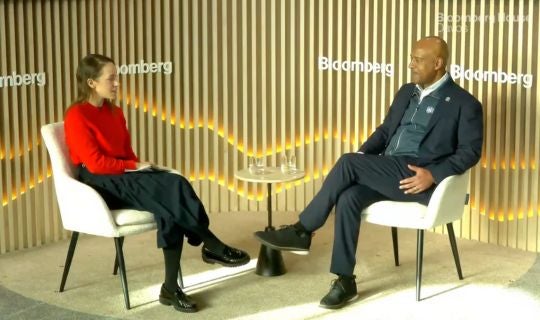
“Texas is a very business-friendly state, and we’re seeing tons of companies move there because of the business-friendly nature,” DesRoches said. “It’s a very affordable place to live, and in fact, that’s helped us recruit faculty to the university, because they want to come to a place where there’s lots of industry, and there’s a lot of talent in Texas.”
He pointed to the state’s investments in emerging areas such as artificial intelligence, brain health, digital health and clean technology as catalysts for collaboration.
“It’s a growing state. It’s a dynamic state,” DesRoches said. “It’s a very friendly state in terms of the partnerships that take place between industries, universities as well as nonprofits. And we certainly benefit from that.”
Houston as a living laboratory
Rice’s physical and civic proximity to Houston’s major institutions shapes nearly every aspect of its teaching and research. The university sits beside the world’s largest medical center, minutes from downtown Houston, near one of the nation’s highest concentrations of Fortune 500 companies and within close reach of NASA’s Johnson Space Center. That dense ecosystem allows Rice to test ideas, translate research and educate students in real-world conditions — a “living laboratory” that few universities can replicate.
As an example, DesRoches pointed to Rice’s Severe Storm Prediction, Education and Evacuation from Disasters (SSPEED) Center, which develops flood prediction tools that help communities prepare for extreme weather.
“They developed a technology to be able to predict the flooding using topology information and climate models prior to a storm happening,” he said, noting the work has helped protect critical infrastructure in Houston and is now being used elsewhere in Texas. “We get guests from all over the world trying to understand how we’re implementing that system so that they can replicate it in their areas.”
Research, innovation and economic impact
DesRoches emphasized that research universities deliver measurable economic value to their regions.
“For every dollar of federal research that comes into a university, two to three dollars of economic value is generated in the community through the jobs that are created,” he said.
Innovation extends that impact even further. Rice faculty have launched hundreds of companies based on university research, many of which remain in Houston or Texas and have raised billions of dollars in startup funding.
Preparing students for a changing workforce
Staying aligned with workforce needs, DesRoches said, requires constant dialogue with industry.
“They’re always on campus every day,” he said. “We constantly hear from them what they’re looking for from undergraduates as well as our graduate students.”
Beyond technical expertise, employers consistently emphasize communication, adaptability and teamwork.
“People call them soft skills. I don’t call them soft skills because they’re very hard,” DesRoches said.
Rice has responded by expanding experiential learning and by creating customized degree programs, certificates and short courses tailored to industry needs, including programs in AI, data science and health care finance.
Teaching and learning in the age of AI
As AI reshapes education, DesRoches said Rice’s focus is on responsible integration.
“Our approach has been to ensure that our faculty are as fluent as possible in AI so that they can understand how they best use it in the classroom,” he said. “We want to make sure that they’re enhancing the critical thinking skills and not replacing the learning that we know needs to take place.”
Faculty development programs, boot camps and experimentation — including in first-year writing courses — have led to what DesRoches described as broad acceptance of AI as a tool to deepen learning and creativity.
Access, affordability and global engagement
Addressing international perceptions of U.S. higher education, DesRoches said affordability remains a priority.
“There’s a sticker price, and then there’s a real price,” he said, pointing to The Rice Investment, which provides free tuition to students from families earning up to $150,000, with additional support beyond that level. Even as Rice expands enrollment, he said the university remains committed to small class sizes and a low student-to-faculty ratio.
Global engagement is another pillar of Rice’s strategy. The university has expanded its presence in Paris and Bengaluru, India, to deepen research partnerships and provide immersive study-abroad opportunities.
“People don’t realize just how life changing it is,” DesRoches said. “I hear this directly from the students. It is truly life changing.”
Engineering leadership on a global stage
As Rice’s first president with an engineering background, DesRoches said his training influences how he leads.
“I always break down problems into bite-sized pieces,” he said, citing his research in resilience as particularly relevant amid rapid change in higher education.
Asked what message he hoped global leaders would take away from Rice’s presence in Davos, DesRoches expressed optimism.
“It’s an exciting time for higher education,” he said. “What gives me the most hope as a university president is working with the students. Despite all the challenges we’re facing in the world, I know we’re in a good place, because we have incredible students.”