
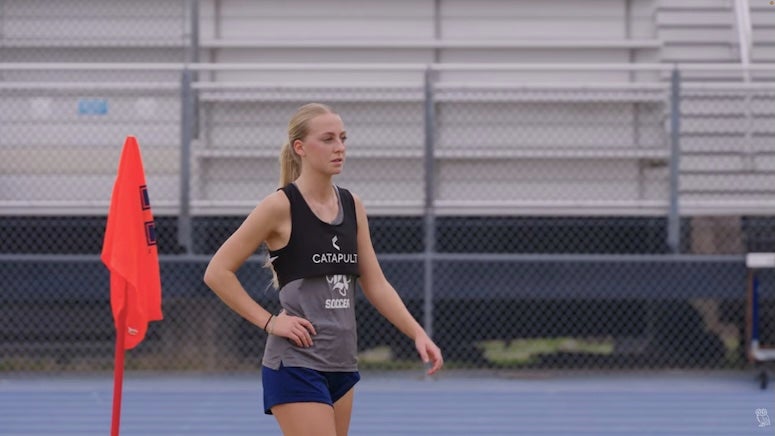
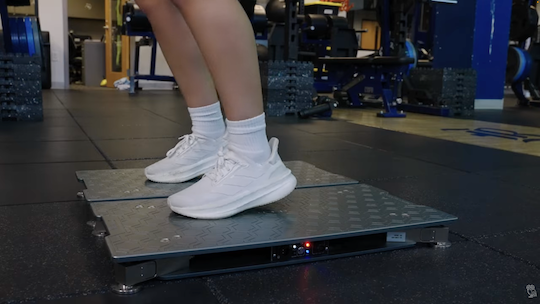
At practice, the technology is easy to miss — slim GPS vests under jerseys, a pair of metal plates on the weight room floor, a laptop glowing with charts on the sideline. But at Rice University, those quiet tools are powering a growing sports science operation that doubles as a classroom, giving students hands-on analytics experience while helping coaches make faster, smarter decisions.
Led by John DeWitt, director of applied sports science, the effort blends research, data and daily training. On a busy fall day, his group collects GPS workload metrics, hydration data and force plate testing results across teams — a continuous stream of information.
“Two years ago, we did an audit and found we were collecting 111 million pieces of information per day during the fall season, from sensors, tests and assessments across all athletes,” DeWitt said. “The challenge is turning that data into something meaningful and actionable, and that’s exactly what we’re doing.”
The solution: put students to work on real problems.
“These projects aren’t busywork,” he said. “Every student project serves an actual need for one of our teams. We’re giving students hands-on experience that most people won’t get unless they’re in a specialized analytics program. They’re learning how to turn real data into real impact.”
Data to act on
For Anwesha Parida, a junior majoring in sports medicine and exercise physiology and sport management with a data science minor, that impact came through a class project that quickly became a tool for the women’s soccer staff.
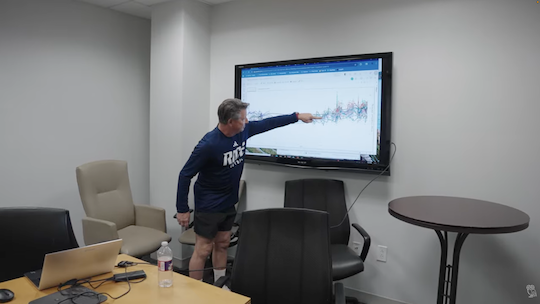
“When I got to Rice, I wanted to make sure that whatever I do in the health space is always rooted in data, evidence and research and not just anecdotal evidence that we see on social media,” Parida said. “How do we use what’s real to make decisions on the field?”
Her answer was a centralized performance dashboard that consolidates GPS, hydration and force plate data into one place for coaches.
“The need was basically to consolidate all these different data inputs into one place that would allow coaches to make decisions quickly from all the data sources,” she said.
The GPS units combine an accelerometer, gyroscope and satellite tracking to measure total distance, sprint distance, acceleration, deceleration and “player load,” a measure of overall stress.
“All these three sensors come together to give you a lot of information on how players are moving on the field,” she said.
The goal isn’t to override coaching instincts, she added.
“It’s never like a prescription. It’s mostly a suggestion — we’re not here to replace coaches’ decisions but sort of give them more evidence.”
For Parida, the mission is simple: “Work smarter, not harder. At the end of the day, we’re trying to prevent injuries.”
Predicting what comes next
Graduate student Saara Orav is taking the next step: forecasting performance before problems appear.
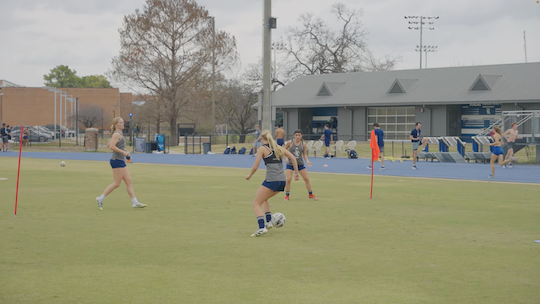
A former four-year member of the Rice women’s tennis team with a background in computer science, Orav is building a machine learning model that uses years of force plate jump data and GPS workloads to predict future performance.
“Using human performance data, biometric data, we’re trying to predict what an athlete’s future performance will look like,” she said. “We’re basically trying to predict the future counter movement jumps.”
Those jumps correlate closely with speed, endurance and fatigue. If the model detects a drop, it could flag elevated injury risk.
“This tool will not be used singularly … rather, this tool will be used as a helper, like just another tool in a coach’s toolbox,” Orav said.
She’s piloting it with football, which has the largest dataset, with plans to expand to other sports.
“I feel like now, if this project actually works out and it’s beneficial for the coaches, that would be my way of giving back to Rice,” she said.
From charts to coaching
For Bailey Deering, assistant strength and conditioning coach for women’s soccer, the students’ work shows up in her daily routine.
“She’s given me a big catalog of graphs that I’m able to look at, and it’ll tell me day to day how much distance, how much sprint distance, how much acceleration, deceleration did each player get,” Deering said. “Honestly, it’s made my job so much easier.”
Rather than spending hours processing spreadsheets, she can quickly adjust workloads, protect high-minute players and ramp up those returning from injury.
“Instead of me having to be at my desk digesting the data, I’m able to just read it and act on it with the girls hands on,” she said.
For DeWitt, that immediate payoff is the point.
“We’re not just producing code or reports, we’re producing people who can turn data into better athletic performance,” he said. “Rice has the talent, the expertise and the collaboration between athletics and academics to lead in applied sports science. We’re just getting started.”