

David Satterfield, director of Rice University’s Baker Institute for Public Policy, sat down Jan. 12 with Ted Deutch, CEO of the American Jewish Committee (AJC) and former chair of the House Foreign Affairs Subcommittee on the Middle East, for a wide-ranging discussion on U.S. engagement in the Middle East. Drawing on decades of diplomatic and policy experience, the two explored the evolving dynamics shaping the region today.
The conversation marked the opening event of the Baker Institute’s 2026 speaker series and touched on the complexities of U.S.-Israel relations, the impact of the Abraham Accords and the ongoing challenges of regional normalization. Throughout the discussion, both speakers stressed the importance of approaching these issues thoughtfully, with balance and a commitment to nonpartisan analysis.
“It’s difficult, hour by hour, to assess whether the opportunities outweigh the challenges,” Satterfield said. “What’s clear is that these issues matter deeply — for the United States, for our allies and partners, for Israel and for Jewish communities around the world. There’s intense debate on virtually every front, both here and abroad. Our goal at the institute and through conversations like this one is to bring clarity, to present the issues in a structured, calm, fact-based and nonpartisan way. These aren’t abstract questions. They affect global stability, U.S. national interests and the lives of millions of people.”
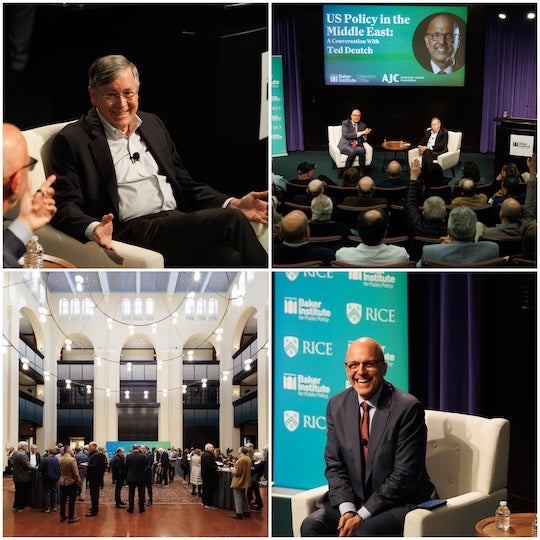
Deutch, who has also chaired the House Ethics Committee and served on the House Judiciary Committee, is a longtime leader in the Jewish community. He has been a vocal opponent of antisemitism and played a key role in launching an international coalition to combat online hate.
“The American Jewish Committee has been around for nearly 120 years,” Deutch said. “We work with leaders in education, business, government, diplomacy and civil society as well as with interfaith partners to help build a world where Jews can thrive and where Israel is fully accepted as part of the international community.”
With 40 offices around the world, AJC operates as a global, nonpartisan organization focused on advancing democratic values. Deutch emphasized that meaningful progress often comes when communities work together across differences.
Satterfield, who also holds the Janice and Robert McNair Chair in Public Policy and previously served as U.S. ambassador to Lebanon and Turkey, later shifted the conversation to recent protests in Iran, a topic that will be explored further in an upcoming Baker Briefing.
“In 2009, we saw mass protests focused on electoral fraud. In 2022, demonstrations centered on women’s rights and freedom after the death of a young woman in police custody,” Satterfield said. “What we’re seeing now is different. This isn’t about culture, and it’s not even directly about the political system. It’s about a regime marked by corruption, dysfunction and mismanagement.”
He pointed to severe economic conditions, including electricity and water shortages and a rapidly devaluing currency, that are affecting not only the poorest Iranians but also the middle and upper-middle classes. “If the issue is cultural, a regime might loosen social restrictions,” he said. “But when the problem is fundamental economics, where does the flexibility come from to respond?”
In a December 2025 Baker Briefing, Satterfield discussed these growing issues with Mohammad Ayatollahi Tabaar, a Middle East fellow at the Baker Institute. Their conversation examined Iran’s domestic and currency crises, the factors leading up to the recent uprising and the aftermath of the June 2025 conflict involving Israel and the U.S.
To learn more about the Baker Institute’s work on political, economic and societal developments in the Middle East, explore the research and policy briefs produced by experts at the institute’s Edward P. Djerejian Center for the Middle East.