
April is Earth Month, a time to celebrate and uplift efforts to create a more sustainable present and future. At the start of the month, Rice University celebrated ongoing sustainability work through the Earth Month festival. While these efforts focus on everyday changes that are currently implemented or supported by the university, a big part of Rice’s sustainability work is in its labs. Sustainability research helps Rice and the world build a brighter future, one that is more resilient, less carbon-dependent, more eco-friendly and more prepared.
Much of the sustainability research done at the university is under the umbrella of the Rice Sustainability Institute, which works to support and connect efforts through a series of centers and hubs. These include the Carbon Hub, which advances industrial decarbonization, electrification and hydrogen production; the Center for Energy Studies at the Baker Institute for Public Policy, which provides critical insight into how economics, policy and regulation influence energy markets; REINVENTS, which develops solutions to support the shift into clean weather; and the SSPEED Center, which predicts and prepares for extreme weather and disasters.
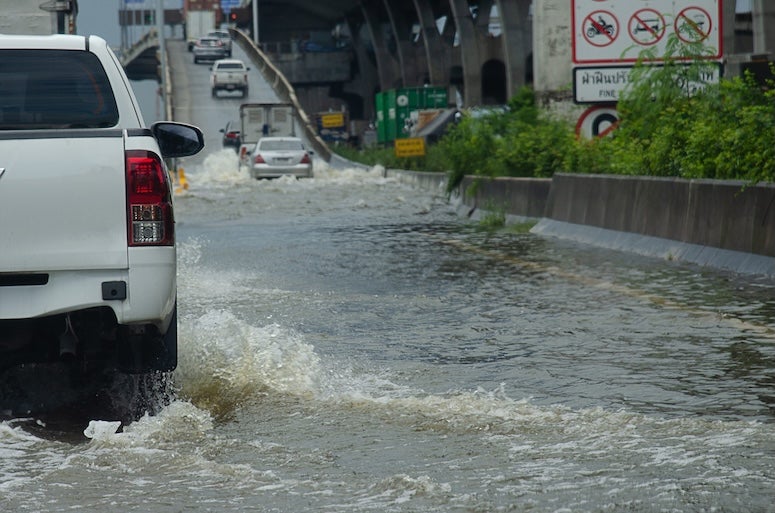
This Earth Month, Rice is highlighting a selection of research projects that seek to better understand and build resiliency for extreme water events like flooding.
The Center for Coastal Futures and Adaptive Resilience, working with Rice’s SSPEED Center and Spatial Studies Lab, recently released a high-resolution online model that shows flood risks of extreme flood events, like the 2016 Tax Day flood, for local Houston communities. James Elliott, Dominic Boyer and Yilei Yu, researchers on the project, wrote a piece about the map in The Conversation.
“In today’s world of increasingly extreme downpours, preparing for flood disasters means preparing for more than just what’s probable — it means also preparing for extreme situations that are less likely but could be far more dangerous,” the authors write.
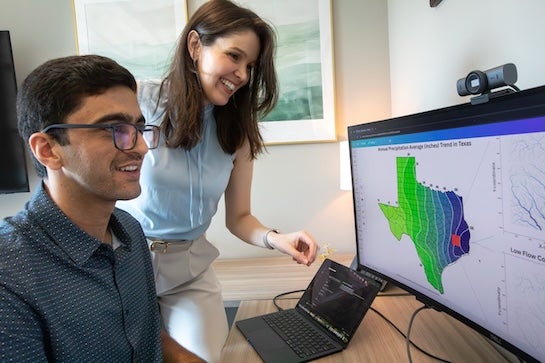
Noemi Vergopolan, an assistant professor of Earth, environmental and planetary sciences, studies hydrological processes with a focus on scales that are relevant for decisions about water resource management. Her team uses both satellite images and artificial intelligence to build high-resolution models at 30-meter spatial resolution. She is using this technique to examine the recent Central Texas floods, correlating it with other data to ensure accuracy of the model for flood prediction.
“Being at Rice has been great for developing this project,” Vergopolan said. “I have been able to collaborate with colleagues across various disciplines. I have access to some of the best students out there, who are tackling these challenges and pushing the research forward.”
Avantika Gori, an assistant professor of civil and environmental engineering, uses physics, statistical and machine learning/AI approaches to better understand hurricane storm surge hazards and coastal-urban flood dynamics with the goal of improving the preparedness and resilience of coastal communities like Houston. In a NASA-funded collaboration with Vergopolan and Jamie Padgett, Gori is seeking to develop high-resolution models of transportation risk across Houston and Galveston during hurricanes.
“Many institutes and centers across Rice, such as the Ken Kennedy Institute, Sustainability Institute and SSPEED Center, have facilitated meaningful and high-impact interdisciplinary collaborations that have led to creative research ideas,” Gori said. “The model we are building will be used by the Houston-Galveston Area Council to better plan for hurricane hazards and road damages.”
These projects, though vitally important to understanding and adjusting to a changing world, are just a small selection of the sustainability research done at Rice. Within the study of water alone, there are many different approaches and challenges being addressed. For example, the Water Technologies Entrepreneurship and Research (WaTER) Institute looks at water with the goal of building accessible clean water technologies.
While making sustainable choices today is critical for building a better future, the research done at Rice shows that the possibilities for a more sustainable future are ever-growing, increasing the resilience, options and effective planning of both Houston and the world, while decreasing reliance on carbon and offering alternative solutions for energy, water and other needs of the growing global population.