
When Rice University joined Venice International University in 2025, it opened a distinctive set of opportunities for faculty across disciplines. From semester-long teaching appointments to intensive graduate seminars to hosting international conferences, VIU offers Rice faculty multiple pathways to extend their scholarship, teaching and collaborations into one of the most internationally integrated academic settings in the world.
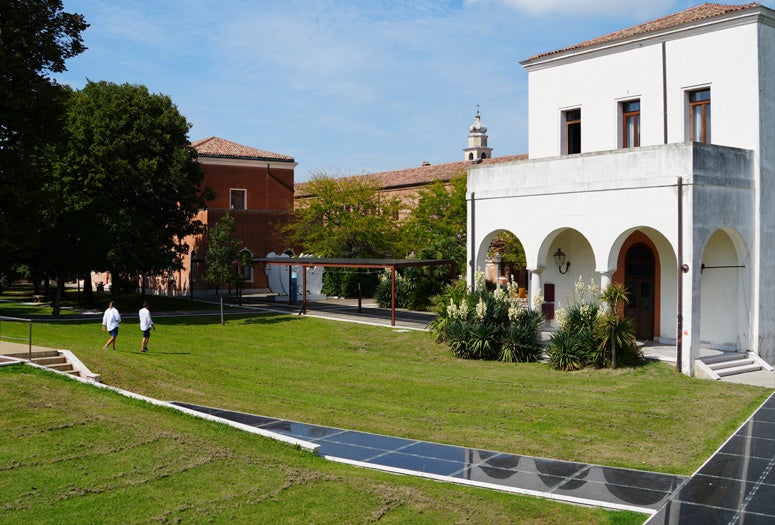
VIU is a consortium of more than 20 universities and research institutions that share an autonomous campus on the island of San Servolo in the Venetian lagoon. Its flagship Globalization Program brings together 120 to 140 students and faculty representing more than 20 nationalities each semester with all courses taught in English. Rice was only the third university in the Americas to be admitted to the consortium, a distinction that reflects both the strength of the university's global strategy and the depth of its academic offerings.
“The unanimous approval of Rice's application by VIU's Board and General Assembly was a significant moment for our global strategy,” said Caroline Levander, Rice’s vice president for global strategy. “More than 20 institutions share this academic platform and their faculty teach, research and convene alongside one another every semester. That's the kind of environment that changes how scholars approach their work.”
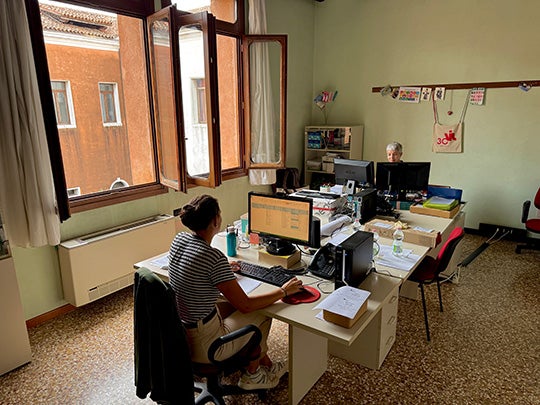
Rice faculty are already making the most of the partnership. Anthropology professor Nia Georges is currently teaching in VIU's Globalization Program this spring and Luis Campos, the Baker College Associate Professor for History of Science, Technology, and Innovation, will teach in the program this fall. Each semester, Rice can nominate faculty to teach two courses within the program's core themes or within rotating specialization tracks that range from Science and Society to History and Memory to Environmental Management and Sustainable Development.
The classroom experience itself is unlike anything available on a single-institution campus. With students from Italy, the United States, China, Japan, Israel and beyond, class sizes are capped at 25 to encourage the kind of sustained, cross-cultural dialogue that larger lecture formats cannot support.
“Venice International University offers a rare environment where teaching becomes a catalyst for global collaboration, enabling ideas to evolve across disciplines, cultures, and institutions,” said Aditya Mohite, William M. Rice Trustee Professor in Chemical and Biomolecular Engineering.
Mohite experienced VIU firsthand in September 2025 when he attended a nanoscience workshop on San Servolo organized by Ludwig Maximilian University of Munich, one of VIU's member institutions.
“Rice Global's partnership with VIU will enable exciting new opportunities for Rice students and faculty and build foundational collaborations with top schools in Europe,” Mohite said.
Those collaborative possibilities extend well beyond the Globalization Program. Faculty can also partner with colleagues from at least two other VIU member institutions to propose and co-lead graduate seminars, PhD academies and summer or winter schools on the San Servolo campus. VIU provides the logistical framework, classroom space and administrative support while funding often covers faculty travel and on-island accommodation.
Kirsten Ostherr, the Gladys Louise Fox Professor of English and founding director of the Medical Humanities Research Institute, is doing exactly that. In 2027, she will co-teach a graduate seminar titled "Critical Interrogations of Health Inequalities: an Interdisciplinary Practical Exploration of Different Forms of Injustice in Healthcare" that was developed in collaboration with colleagues at the University of Exeter and Duke University.
“We will interrogate how the advent and ubiquity of AI, large language models and other digitally disruptive technologies are informing and reshaping our understanding of what constitutes the human body, health and healthcare,” Ostherr said. “We will explore the ways that artificial intelligence technologies can have unintended consequences that reproduce existing health disparities, especially racial and intersectional health disparities. Students will learn how concepts like narrative, emotion, representation, and differential histories of access or exclusion from healthcare can inform critical engagement with emerging health technologies such as AI.”
The seminar illustrates the kind of programming VIU was designed to foster: interdisciplinary, international and rooted in pressing global challenges. Faculty from six institutions across three countries will lead sessions and the cohort will draw graduate students from across VIU's member network.
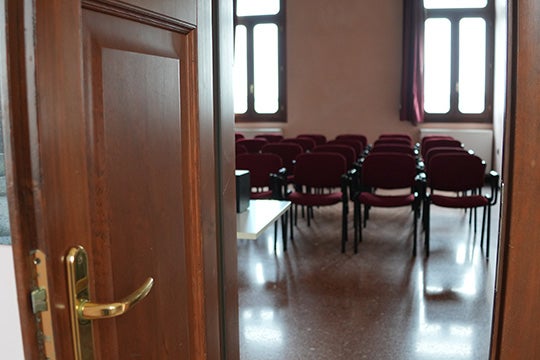
For faculty interested in convening rather than teaching, VIU also serves as a conference venue. Member universities have priority access to the island's facilities, which include auditoriums seating up to 240, breakout rooms, residential accommodations and administrative support for catering, AV and interpreting services. Rice faculty receive guidance from both Rice Global and VIU staff to navigate the planning process.
Applications to teach in the Globalization Program are accepted twice a year with calls issued in March and September. Faculty interested in teaching through Spring 2029 should note the next deadline: Sept. 11, 2026. Proposals for graduate seminars and PhD academies for 2028 are due Sept. 15, 2026 and proposals for summer and winter schools are due in March 2027.
Faculty interested in learning more can contact global@rice.edu or visit the Rice Global VIU partnership page.