
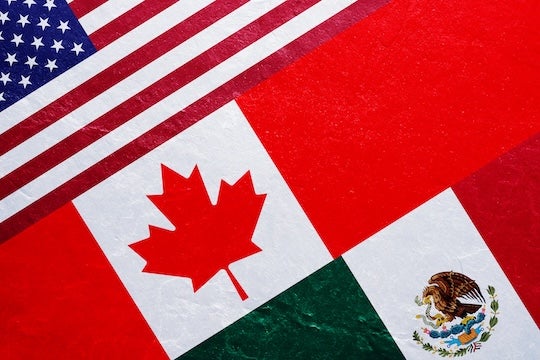
The Claudio X. González Center for the United States and Mexico at Rice University’s Baker Institute for Public Policy convened leading trade experts to examine the implications of the U.S. decision not to renew the U.S.-Mexico-Canada Agreement (USMCA) on July 1, and what the prolonged negotiations could mean for North American businesses.
“The current standoff is driven by deep-seated frictions,” said Tony Payan, director of the Claudio X. González Center. “The U.S. remains focused on reducing its trade deficits and preventing economic circumvention, particularly by China through North American supply chains. But there are also disputes over automotive content requirements, Mexico’s energy policies and labor enforcement. All of this is contributing to the current impasse.”
The webinar explored the state of the negotiations, the implications for businesses and investors, the future of North American supply chains and the region’s evolving trade relationship.
“We didn’t get renewal at this moment,” said Simon Lester, a nonresident scholar at the Baker Institute. “We’re going to have continued negotiations about whether we can get there, and in the meantime there are going to be U.S. government decisions on tariffs that will apply broadly, including to Canada and Mexico. So we’re going to keep talking.”
Meredith Lilly, a Canadian panelist and nonresident scholar at the Baker Institute, said tariff relief has become one of Ottawa’s top priorities in the ongoing negotiations. Although roughly 95% of USMCA-compliant goods continue to cross the border duty-free, Section 232 tariffs on steel, aluminum and products affecting the automotive sector remain in place, creating significant challenges for manufacturers.
Lilly noted that Canada’s overall effective tariff rate remains relatively low compared with many other countries, but the remaining tariffs continue to weigh heavily on key industries, particularly automotive manufacturing. She suggested there may be room for progress on aluminum because the United States depends on Canadian imports and American importers ultimately bear the cost of those tariffs. Steel and automotive-related tariffs, however, remain far more difficult issues to resolve.
The automotive industry occupies a unique position in the current trade environment, said David Gantz, the Will Clayton Fellow in Trade and International Economics at the Baker Institute.
“We’ve had Stellantis, we’ve had Ford and now Toyota moving production — in the first couple of cases from Canada and now from Mexico — to the U.S.,” Gantz said. “This doesn’t necessarily mean they’re building new factories. In many cases they’re taking advantage of existing capacity. New auto plants require investments that have to pay off over 15 or 20 years, and right now no one can predict U.S. tariff policy more than a few months ahead.”
Gantz added that because automakers assemble vehicles from thousands of parts sourced throughout North America, relocating assembly lines does not necessarily represent a fundamental reshoring of manufacturing.
Panelists also discussed how the approaching U.S. midterm elections could shape the future of the negotiations. Lilly said there is bipartisan interest in strengthening and better enforcing the agreement rather than abandoning it altogether.
“There’s a big difference there,” Lilly said. “There is a real focus on trying to maintain some baseline within the trading relationship to ensure there is a rules-based outcome from all of this.”
The discussion also examined whether the Trump administration’s broader trade objectives could complicate negotiations. Lester argued that President Trump’s primary objective remains reducing U.S. trade deficits, particularly with Canada and Mexico, by renegotiating the terms of trade in the United States’ favor.
“What he’s asking for,” Lester said, “is to rebalance the current terms to favor the U.S. That makes a deal very difficult because if Canada and Mexico want an agreement, they essentially have to accept terms that are politically very difficult, particularly for Canada.”
Payan also questioned whether one of the administration’s key policy tools — the USMCA’s labor response mechanism — has achieved its intended goal of strengthening Mexico’s labor standards and reducing competitive advantages. He noted that recent Baker Institute research found the mechanism has produced only limited results, with little measurable impact on labor organizing or wages in Mexico.
The Claudio X. González Center for the United States and Mexico seeks to have a meaningful impact on the U.S.-Mexico relationship through original research, relevant solutions to binational policy issues, and the advancement of mutual understanding by convening leaders who can bridge the world of ideas and the world of action.
The center’s research agenda focuses primarily on issues such as trade and economic integration, immigration, rule of law, security and organized crime, the U.S.-Mexico border, politics and democracy in Mexico, and AI policy and governance . Find future expert panel events here .