

Rice University is launching a new master’s degree in digital health, an interdisciplinary graduate program designed to train the next generation of engineer-leaders to invent the future of health care. Visit the program website for more information, including admissions and scholarships.
As one of the first graduate programs in the U.S. focused specifically on artificial intelligence for health and medicine, the degree gives structure to a growing area of practice that spans engineering, data science, clinical care and venture creation. Graduates will be prepared for roles across hospitals, health systems, insurers, startups and medical technology companies.
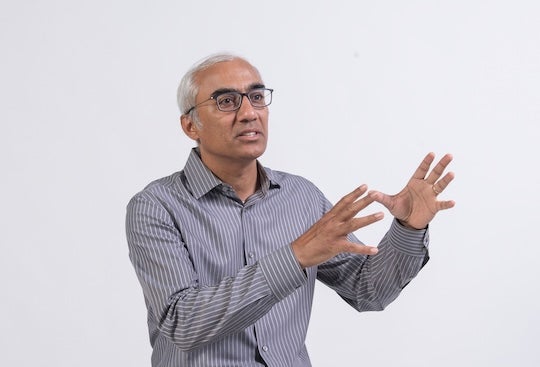
“We designed the MDH program around the kinds of problems students will actually encounter across the whole spectrum of health care environments, from hospital systems to autonomous, personalized health care solutions untethered from traditional care delivery settings,” said Ashutosh Sabharwal, Rice’s Ernest D. Butcher Professor of Engineering, professor of electrical and computer engineering and computer science and co-director of the Houston Methodist-Rice Digital Health Institute.
An interdisciplinary curriculum for future health care leaders
Led by the Rice Digital Health Initiative, the new degree track builds on the critical mass of the university’s faculty whose expertise informs innovative solutions to existing and emergent challenges in medicine and health care.
The program brings together coursework in statistics, machine learning and AI with hands-on work alongside clinicians, engineers and industry partners. Students will learn how technical choices shape real clinical workflows, data systems and care models and how those choices affect patients and providers alike.

“We are seeing a growing demand for graduates who can apply strong technical training in health care contexts, and this program brings together faculty, methods and partnerships that already exist across the university into a coherent graduate pathway,” said Ashok Veeraraghavan, professor of electrical and computer engineering and computer science and chair of the Department of Electrical and Computer Engineering in Rice’s George R. Brown School of Engineering and Computing.
The new master’s program is open to students from a wide range of engineering and science backgrounds, including electrical and computer engineering, bioengineering, computer science, data science, mathematics, physics and statistics.
Experiential learning in real-world settings
The program is anchored by a yearlong capstone project and offers access to a unique collaborative ecosystem forged by long-standing partnerships with institutions in the Texas Medical Center and Houston-based medical innovation startups. Students will work on a defined digital health challenge, gaining hands-on experience across all stages of technology development from problem definition to testing and evaluation in realistic settings.
The MDH capstone builds on lessons and partnerships from Rice’s professional masters in electrical and computer engineering, which include capstone projects such as Cairdio, a low-profile portable device that combines AI and advanced acoustic signal detection to analyze heart activity with higher definition than standard stethoscopes.
Previous projects through the professional master’s program include developing a machine learning system to improve diagnostics and treatment for urinary tract infections, building a novel blood flow measurement device, applying computer vision to dermatology and creating an affordable wearable system for collecting lactate and glucose measurements noninvasively.
“Over the years, we have worked with partners across the TMC and beyond and have a strong basis to build on for the MDH,” said Joseph Young, assistant teaching professor of electrical and computer engineering and director of the department’s professional master’s degree program. “The feedback we have received from partners has been overwhelmingly positive, and students have witnessed firsthand how their efforts can translate into projects that improve lives.”
Scholarship support
To support access to the new program, Rice will offer tuition scholarships for admitted students. These include automatic tuition awards for early applicants during the program’s inaugural year as well as competitive merit-based scholarships for which all applicants are considered. Applications are reviewed monthly and early application is encouraged.