
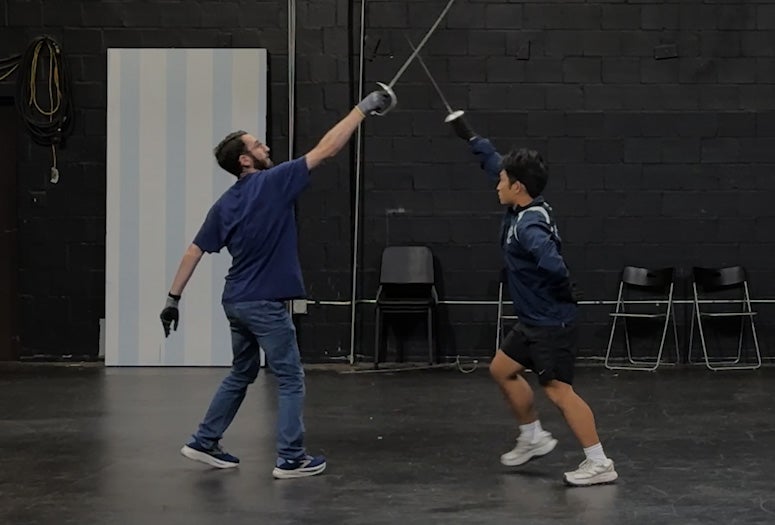
Steel blades caught the stage lights as Rice University students squared off against their partners, footwork measured, timing rehearsed, choreography committed to memory. The final exam was not written. It was fought. Combat and Movement for the Stage, a 300-level course in the Program in Theatre, asks students to spend a semester learning how to throw a punch, take a fall and cross swords without anyone getting hurt. Taught by lecturer Kyle Clark, the class is housed in the Department of Art within the School of Humanities and Arts and is open to any Rice student regardless of major.
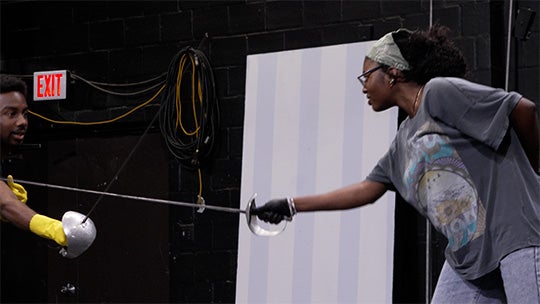
Over the semester, students work through at least two disciplines recognized by the Society of American Fight Directors. The first half of the semester focuses on unarmed combat. The second half shifts to a weapon of Clark’s choosing. This year, he selected the single sword, a lightweight steel blade wielded with one hand.
“These students are tackling in half the time what I have students at other institutions do,” Clark said, explaining that he teaches one “weapon” per semester at the University of Houston. “It’s even more impressive because most UH students I teach are pursuing a bachelor of fine arts. Those are students who are thinking, ‘I want to be a performer.’ At Rice, I have biochem and engineering majors doing the same work in half the time.”
Jonathan Goldfeder, a sophomore majoring in electrical and computer engineering, signed up because he said he’s loved theater since high school and wanted a class that would get him on his feet. The contrast with his engineering coursework was immediate with full class periods spent moving through choreography rather than sitting at a desk.
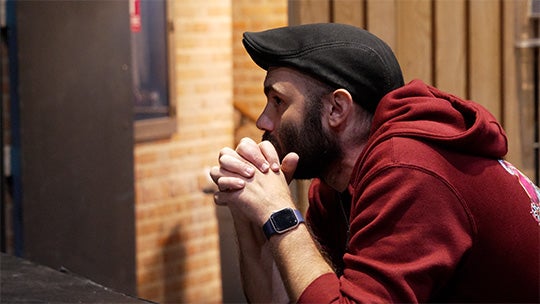
“This is the most fun class I’ve ever taken,” Goldfeder said.
By the end of the semester, students were adding their own stamp to the choreography. Goldfeder described receiving the sequence from Clark, drilling each beat until it was clean, then layering in personal flourishes before bringing it to the stage.
“Throughout the course, we’re learning different kinds of moves, hand-to-hand, different kinds of punches and blocks,” said Chioma Modilim, a senior majoring in psychology and theater. “Then with a single sword, different kinds of parries and attack moves. You see how they come together and how the offense meets the defense once you start actually doing choreo with a partner.”
Selling the illusion is its own discipline. A stage fight only works if the audience believes the contact while the performers ensure none of it actually lands. That requires constant nonverbal negotiation between partners.
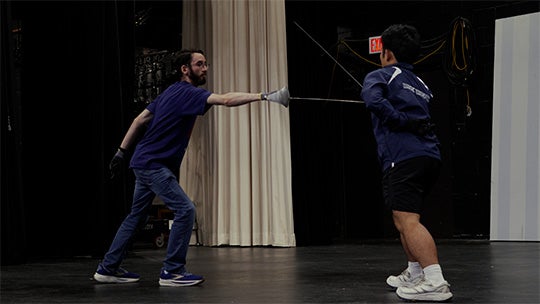
“The thing about stage combat is that it’s all fake,” Modilim said. “I don’t want to actually hit you, but you have to sell it so that we look like we’re fighting. There’s a lot of communicating and reading body language.”
When grading, Clark watches for safety first, then technique. He looks at whether partners are working together, targets and angles are clear, footwork holds up and students can deliver the sequence he assigned without losing the thread.
“I was actually really, really impressed,” Clark said of the students after their final.
Learn more about the Rice theatre program on its website.