
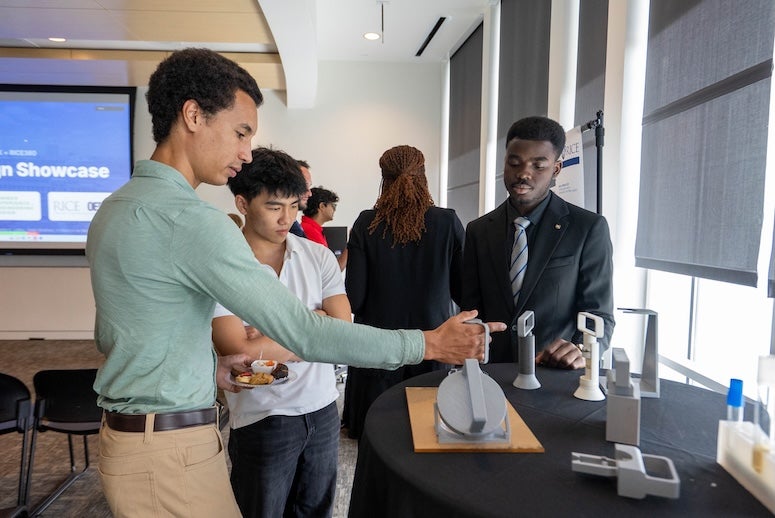
Undergraduate students from Rice University and Kenyatta University in Kenya gathered at Rice’s Bioscience Research Collaborative July 22 to showcase the results of seven weeks spent designing solutions to real-world engineering challenges.
The students participated in the Summer Experience in Engineering Design, or SEED, a full-time internship hosted by Rice’s Oshman Engineering Design Kitchen (OEDK) and the Rice360 Institute for Global Health Technologies.
Working in small, interdisciplinary teams, students moved through the full engineering design process — identifying user needs, brainstorming solutions, building and testing prototypes and refining their designs in collaboration with clients.
“This program gives students the space to experience engineering design the way it happens in industry,” said Deirdre Hunter, assistant teaching professor for the OEDK and director of SEED. “They have to work through ambiguity, make decisions as a team and respond to the needs of an actual client. By the end of the summer, they’ve built not only a prototype but also confidence in their ability to tackle open-ended problems.”
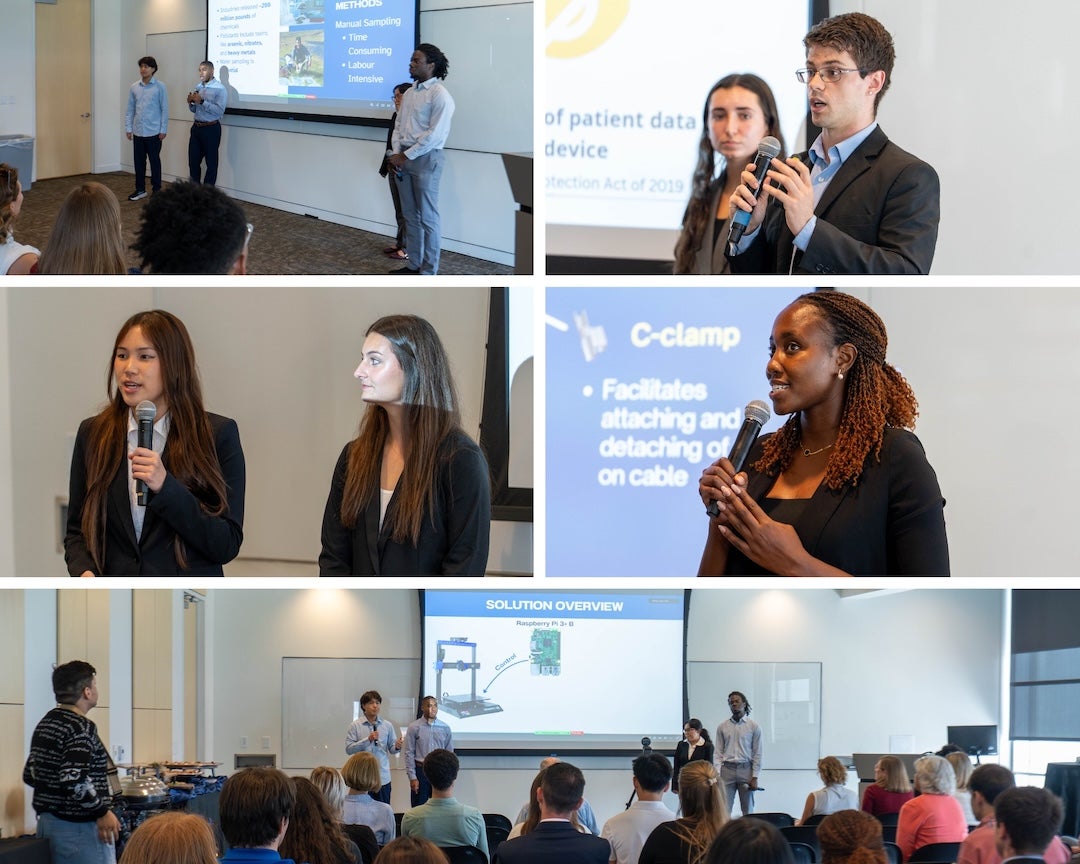
This summer’s cohort included 12 Rice undergraduates and two students from Kenyatta. Alice Owens, an engineering design technician at the OEDK, served as the program coordinator and design mentor. Participants worked full time in the OEDK on eight projects spanning health care, research, conservation and campus infrastructure.
Projects included devices to inspect Rice’s underground steam tunnels, prototypes to help researchers with mobility or dexterity limitations work more easily in laboratories, an automated system for sampling water from rivers and bayous, tools to support health screening in Kenya, a device to monitor opioid use and an artificial egg designed to collect incubation data for the endangered Attwater’s prairie chicken in collaboration with the Houston Zoo.
For sophomore Aiden Hwang, a mechanical engineering student at Rice, SEED offered the chance to take on unfamiliar technical challenges while determining what his projects required.
“I think the program was set up really well because we were given the freedom to go out and learn what we needed for our projects,” Hwang said. “They supported us, but they also gave us the trust and resources to figure things out on our own.”
That independence is a central part of the program. Students receive help when needed, but teams are responsible for managing their own progress, deadlines and client relationships.
“The leads offered mentorship and guidance when you asked for it, but it really came down to your team — how you managed your time, met deadlines and made sure you were on track,” said sophomore Jooheon Lee, an electrical and computer engineering student at Rice. “You had to be proactive, and I think that was a really valuable experience in being independent and responsible for your product.”
For junior Lily Secord, a mechanical engineering student at Rice, SEED also provided a chance to apply classroom concepts to the practical details of building a working prototype.
“I think the most valuable part was the freedom to do the research but also how hands-on it is,” Secord said. “You start thinking about things you might not otherwise — which rivets am I choosing? How long do they need to be? How am I going to attach these pieces without creating weak points? You learn so much by actually having to make those decisions.”
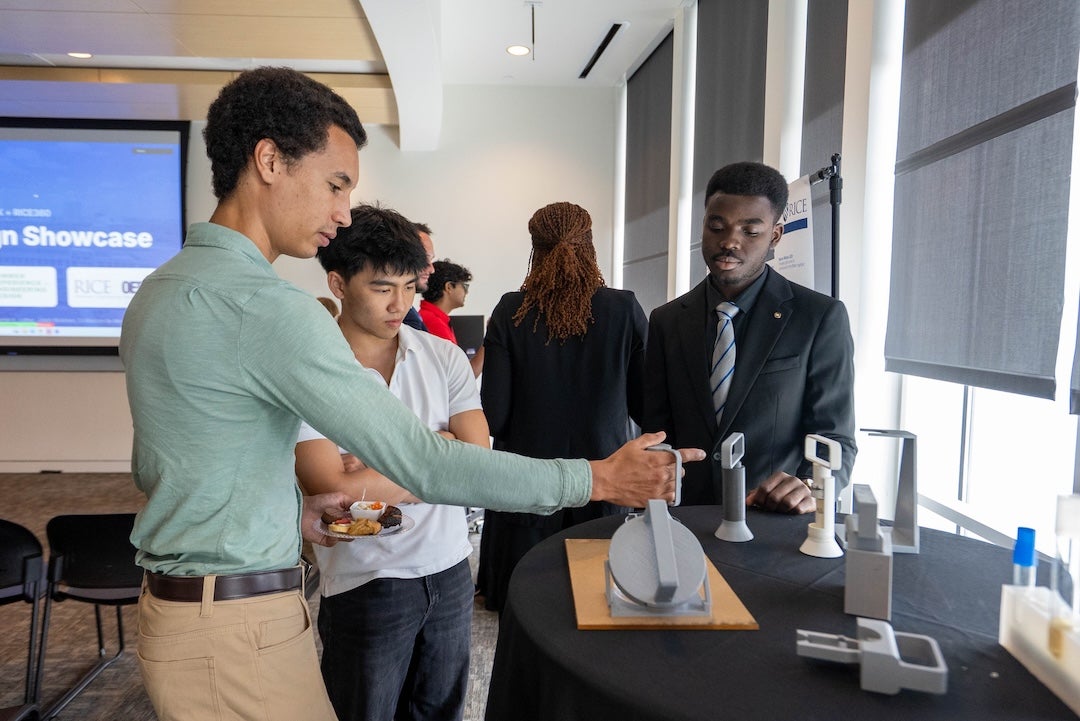
The program also brings together students from different academic and cultural backgrounds, including participants from Kenyatta through Rice360’s global health collaborations.
Sandra Natasha, a recent biomedical engineering graduate of Kenyatta, said the experience allowed her to work directly on the kind of health care challenges she hopes to address in her career.
“The entire program has been very fulfilling for me because biomedical engineering and engineering design are things I’m very passionate about,” Natasha said. “Being able to develop devices that could help solve real health care problems is a goal that I have, and it was very meaningful to be able to do that here.”
By the end of seven weeks, the students had more than prototypes to show for their work. They had experience navigating uncertainty, responding to real client needs and making the countless decisions required to move an idea from concept to something tangible — skills that will carry into future coursework, capstone projects and engineering careers. That, ultimately, is what SEED is designed to provide: a place for students to test not only their designs but themselves as engineers.