
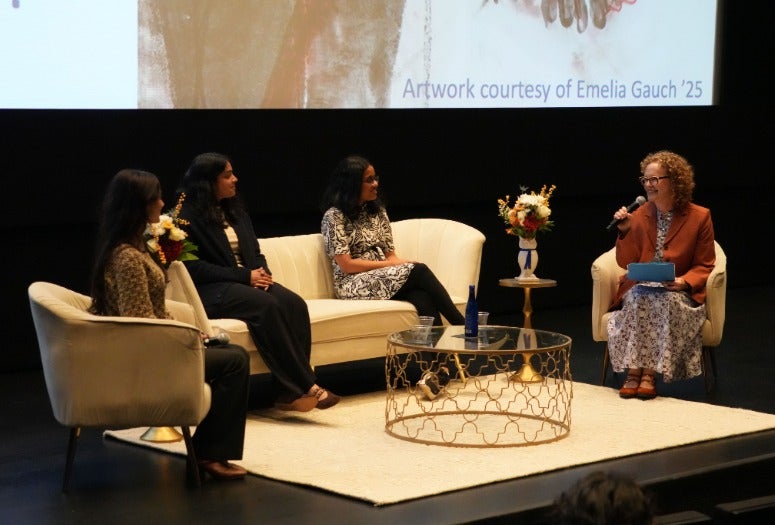
Annika Nambiar ’23 says her patients tell her things they haven’t told their own primary care doctors.
Nambiar, now a third-year student at the University of Texas Medical Branch in Galveston, traces that trust to her Rice University medical humanities practicum, where she recorded oral histories with people who helped rebuild Kazakhstan’s health care system after the Soviet Union dissolved.
“Every interview made me ask what this person contributed, what I wanted to learn from them and how to adjust as we talked,” Nambiar said. “I do the same thing every day with patients in clinic and in the hospital. It’s how I figure out what they want from a visit and how I build rapport.”
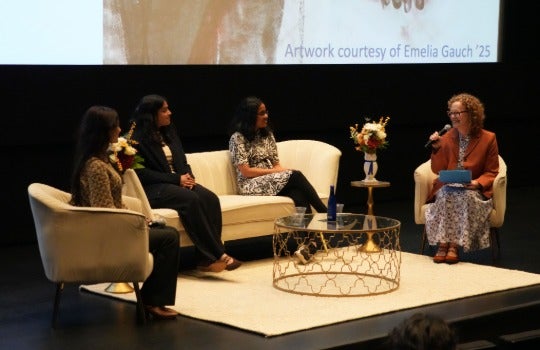
Nambiar was one of three alumni who returned to campus Oct. 28 to celebrate 10 years of medical humanities at Rice, a program that brings literature, history, ethics and other humanities disciplines to bear on health and medicine. In 2016-17, 44 students enrolled in its core courses. Last academic year, that number hit 398.
Kirsten Ostherr, the Gladys Louise Fox Professor of English and Creative Writing and the program’s founding director, said students at the Orientation Week academic fair once stopped by mainly to ask what medical humanities was.
“If you’re premed, you learn about everything inside the body,” Ostherr said. “But what we address is all the things outside the body that help you really make sense and make meaning of what’s going on inside the body.”
Now students arrive at the fair ready to sign up, and some tell her the minor is why they chose Rice. A student medical humanities club founded before the minor existed pushed for it, and the Faculty Senate approved the minor in 2016. Declared minors have since grown from single digits to more than 100, and 50 students graduated with the minor last academic year. Ostherr said it is now the third-largest minor at Rice. Asked at the celebration what they would add to the program with a magic wand, all three of the alumni named a major.
Each student in the minor completes a practicum with partners in the Texas Medical Center, across Houston or abroad. Ostherr said the work targets questions that matter to patients but can’t be answered through biomedical research methods alone.
Sriya Kakarla ’24 did her practicum with Día de la Mujer Latina, a Houston nonprofit focused on Latina women’s health, and she still works with the organization as a third-year student at McGovern Medical School at UTHealth Houston.
“In medical school, there isn’t much time to stop and work out the barriers a patient is facing,” Kakarla said. “But if you go in already understanding that patients are people with experiences and barriers you can’t possibly see, the things you might miss become things you can approach. Medical humanities helped me see my patients’ experiences behind the curtain.”
Kakarla called the practicum the most important thing she did before medical school.
Annesha Dey ’26 arrived at Rice as a biology major, took a medical humanities course her first fall and switched her major to philosophy. For much of college, she said, she felt she didn’t fully belong in either the humanities or premed. In 2025, she became the first recipient of the Janice G. Doty Medical Humanities Future Leader Award.
“I never saw my research as leadership,” said Dey, who is now pursuing a master’s degree in public health at UTHealth Houston School of Public Health through Rice’s 4+1 partnership. “The award helped me see that research in medical humanities is a form of leadership because it’s patient advocacy. I’ve been a philosophy major, premed and a public health student, but I see myself as a patient advocate and a leader first.”
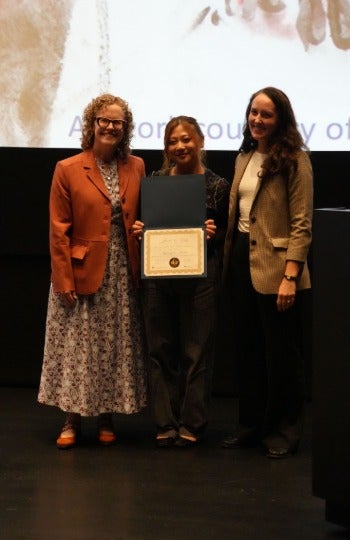
This year’s award, named for Janice Doty ’60, went to senior Nayounghee Teutkin. For research on women’s wellness in rural West Africa, Teutkin paired a rigorous academic paper with a photo book that let the women they interviewed tell their own stories, said Katherine Shwetz, the Janice G. Doty Lecturer in Medical Humanities.
Rice launched the Medical Humanities Research Institute in 2023 to build on and expand the work research students were doing in their practica. Melissa Bailar, the institute’s executive director and the program’s associate director, said the conversation has shifted from what research outside a lab looks like to why medical humanities research belongs at the core of training for medicine, public health, nursing and other health professions.
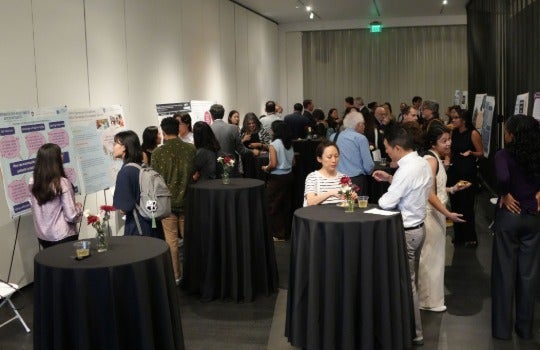
Ten student posters at the evening’s reception showed where that research reaches now, from how wearable fitness trackers stir cultural anxieties about health to how language barriers shape families’ understanding of a child’s condition.
Nicole Waligora-Davis, associate dean of undergraduate programs and special projects in the School of Humanities and Arts, opened and closed her remarks with lines from “Hurt,” a poem written by junior Elise Cho and published in the Rice Medical Humanities Review, the program’s student journal. In it, someone in pain can only say that it hurts.
“The speaker asks how and then waits for an answer that language struggles to give,” Waligora-Davis said. “For 10 years, this program has taught students to ask the questions and to stay for the answer.”
Learn more about the medical humanities program on its website.