
Researchers at Rice University have found that gently squeezing a crystal of iron sulfide can change two of its unusual properties at the same time: its tiny magnetic signal and the way electricity moves through it. The result gives scientists a clearer picture of how a newly recognized class of magnetic materials works and suggests a simple way to control their behavior.
The material belongs to a group known as altermagnets. These materials are attracting growing interest because they combine useful features of two familiar kinds of magnets. Like antiferromagnets, their internal magnetic moments mostly cancel one another, so they do not produce the strong outside magnetic field of an ordinary magnet. At the same time, they can still affect moving electrons in ways that could be useful for future electronic devices.
The Rice team studied a hexagonal form of iron sulfide. Although most of its magnetism cancels out, the material has a very small leftover magnetic moment. It also produces an unusual electrical signal known as the anomalous Hall effect: When current flows through the material, a small voltage appears sideways even when no external magnetic field is applied.

“The interesting thing about this material is that we can watch the tiny magnetic signal and the electrical signal at the same time,” said Pengcheng Dai, Rice’s Sam and Helen Worden Professor of Physics and Astronomy and a corresponding author of the study. “When we squeeze the crystal in one direction, both become smaller together. That tells us the two effects are closely connected.”
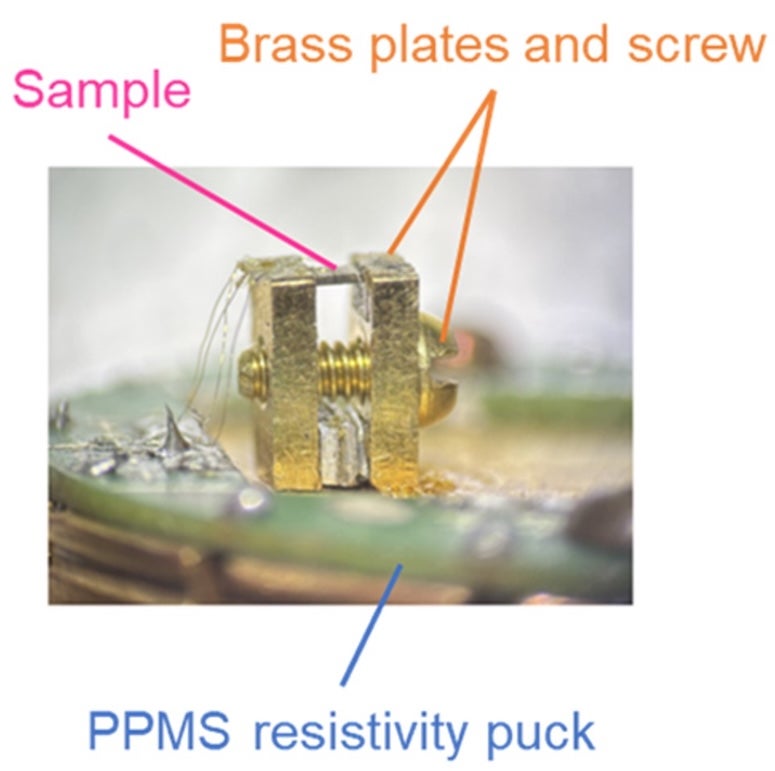
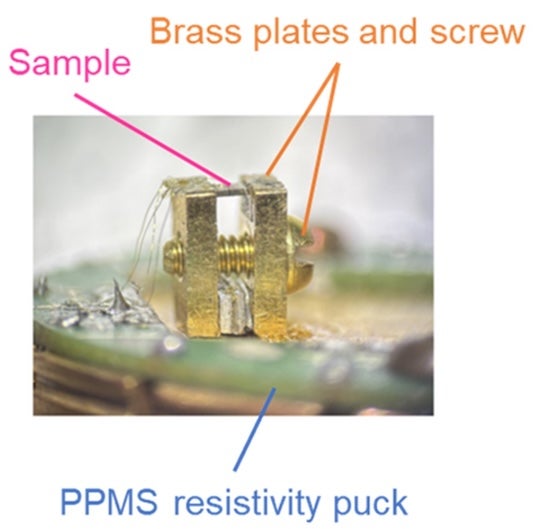
To perform the experiment, the researchers built a device that gently compresses the crystal from one direction. As the pressure increased, the small magnetic moment became weaker and so did the unusual sideways voltage. The much larger underlying magnetic order, however, remained essentially unchanged.
The team then used neutron beams at Oak Ridge National Laboratory to look inside the material and determine what the pressure was doing to its magnetic arrangement. The neutron measurements showed that the basic magnetic structure stays the same, but the squeeze changes which magnetic orientations are most common inside the crystal.
In simple terms, the crystal contains several nearly equivalent ways for its magnetic moments to point. Because the energy difference between these choices is very small, even modest pressure can favor some directions over others. That makes iron sulfide unusually easy to tune mechanically.
The findings also address an important question about why the material produces its unusual electrical signal. One common explanation involves the way electrons move through the crystal’s electronic structure, an effect described by physicists using the term “Berry curvature.” The Rice experiments do not rule out that explanation. But they show that the electrical signal changes in step with the material’s tiny magnetic moment, suggesting that the two are tied to the same underlying physics.

“We are not saying that the electronic explanation is wrong,” said Weiliang Yao, first author of the study. “What our measurements show is that the tiny magnetic moment and the anomalous Hall effect are strongly linked in this material. Understanding exactly why they are linked is now an important question.”
The ability to control such effects with a small mechanical strain could eventually be useful in spintronics, a field that aims to use the magnetic properties of electrons to store or process information. Devices based on this idea could potentially operate with less unwanted magnetic interference and lower energy use than some conventional technologies.
“For possible applications, control is essential,” Dai said. “This experiment shows that a relatively simple mechanical squeeze can change important magnetic and electrical properties at the same time. It also gives us a new way to understand what is happening inside these unusual magnets.”
The study was published in Advanced Materials. The work combined crystal growth, electrical measurements, magnetization measurements and neutron scattering experiments, in collaboration with Qimiao Si and Emilia Morosan’s groups at the Rice Laboratory for Emergent Magnetic Materials.
The research was supported in part by the U.S. Department of Energy, the Robert A. Welch Foundation and the Rice Laboratory for Emergent Magnetic Materials.