
Should human organs be bought and sold? Can a market on citizenship solve global poverty? What — if anything — is wrong with selling your vote?
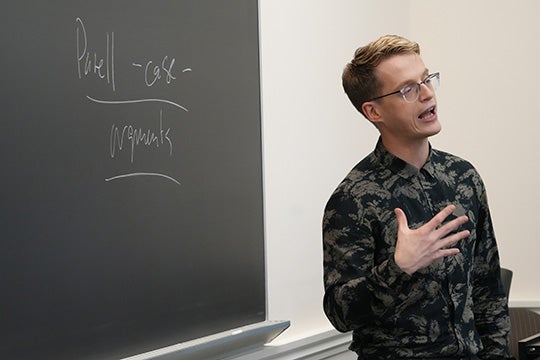
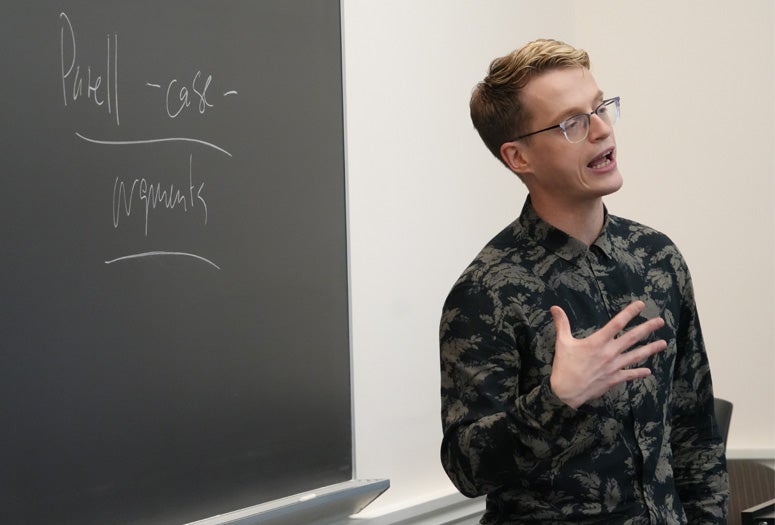
These questions aren’t thought experiments. They are live policy debates and part of the syllabus of Markets and Morality, a course taught by Thimo Heisenberg, assistant professor of philosophy at Rice University and recipient of a prestigious Humboldt Research Fellowship.
“We are now living in an economic system where large parts of our exchange and production are governed by the laws of supply and demand,” Heisenberg said. “And that raises questions about the limits — but also about the value — of economic freedom.”
The course, which Heisenberg has taught since 2020 and refined each semester, walks students through centuries of philosophical thought on markets from Friedrich Hayek’s defense of economic liberty to G.A. Cohen’s arguments that deregulation breeds inequality incompatible with political equality. Students read Elizabeth Anderson on private government in the workplace, debate whether votes should be for sale and examine a scholarly case for distributing citizenship through market mechanisms.
That last topic has taken on striking urgency. Immigration policy dominates national headlines in 2026 with congressional debates over the Dignity Act, mass deportation operations and competing visions for a path to citizenship. Heisenberg updated his syllabus specifically to include scholarship proposing that market-based immigration could address global poverty, a philosophical argument now colliding with political reality.

“Even though the underlying ethical issues have similarities, they take on new forms under different political circumstances,” Heisenberg said.
Heisenberg pointed to an earlier iteration of the course that devoted a session to a Cato Institute proposal to distribute COVID-19 vaccines through a market rather than government allocation. Each semester, the philosophical questions around topics such as the organ trade, the gig economy or living wages stay constant while the stakes shift.
“I designed the syllabus very purposefully so as to feature a great diversity of viewpoints,” Heisenberg said. “Especially with topics that are so timely, you don’t want viewpoints to come just from one part of the political spectrum.”
The reading list deliberately spans the ideological spectrum: Milton Friedman alongside Angela Davis, libertarian think tank proposals next to egalitarian critiques of capitalism. Students encounter arguments defending economic deregulation as essential to individual freedom right alongside arguments that it produces morally intolerable inequality.
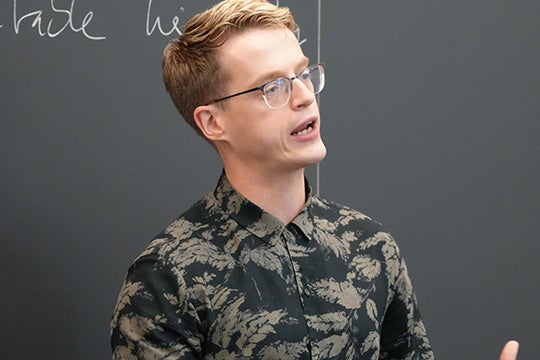
The approach has resonated with an audience Heisenberg didn’t have at his previous institution: business majors. Rice’s growing business program has sent a wave of students into the philosophy seminar, and Heisenberg said the dynamic has enriched the course in both directions.
“I love them being in this class for what the class might do to them but also for what they do to the class, because a lot of them bring to our discussion a level of empirical knowledge that’s actually helpful in grounding our discussion more concretely,” Heisenberg said.
That cross-pollination between philosophical inquiry and real-world market experience is the engine of the course. As the semester closes, students will debate whether employers have a moral duty to pay a living wage. It’s a question with no shortage of empirical data, no consensus on the ethics and no sign of leaving the national conversation before Heisenberg next teaches the course.