
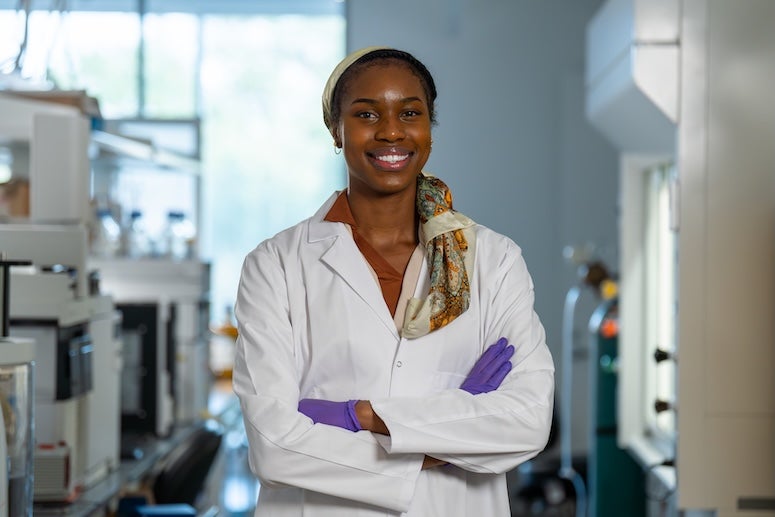
Johanna Bangala grew up surrounded by fields. In a small agricultural town in central Zambia, where gardens fed households and acres of crops fed the nation, she learned early what it meant for effort to yield results.
That lesson has carried her across continents and disciplines, from elite track competitions to environmental engineering research at Rice University. Today, it shapes how she approaches one of the world’s most urgent challenges: reducing agricultural greenhouse gas emissions while protecting food security.
Bangala was born in the Democratic Republic of Congo, but her family relocated when she was young, seeking stability amid political and economic uncertainty. Her father, John, a physician frequently posted to rural communities with limited access to care, became one of her earliest role models.
“He was deeply loved by the communities he served,” Bangala said. “People appreciated his sacrifice and genuine care. I wanted to grow up to be like him.”
There was another influence that quietly shaped her resolve. As a child, Bangala learned that before she was born, her father had hoped for a son — and that she had been named after him anyway.
“That triggered something in me,” she said. “I thought, I’m going to prove that girls can be just as good.”
Bangala says she tried to excel at everything she put her mind to and was always at the top of her class, but it was running track that gave her a language for discipline.
“Better is not good enough; the best is always yet to come,” she said, recalling a mantra that has stuck with her.
Alongside her sister, Bangala helped create a competitive athletics program at her high school, training daily and racing against older, professional-level athletes. Her drive quickly paid off, and she was selected to represent her country at the under-17 world championships and later held a national record in the 400 meters (one her sister would ultimately break).
Track opened doors beyond Zambia, eventually bringing Bangala to the United States. After starting at a small college, however, she realized she didn’t want to choose between athletics and academics.
“I really wanted to do more,” she said.
Bangala transferred to Rice in the fall of 2020 on a full athletic scholarship, arriving during the height of the COVID-19 pandemic. The move was difficult at first, made worse by the social isolation requirements at the time, and it marked the first time she had ever lived so far from her family and sister. Still, she knew Rice would provide her with the academic rigor she craved.
She attended classes online, and despite being naturally shy, she made an effort to answer questions over Zoom. Then months later, one of her professors, Pedro Alvarez, the George R. Brown Professor of Civil and Environmental Engineering, recognized her during one of her shifts as an attendant at the Rice Recreation Center.
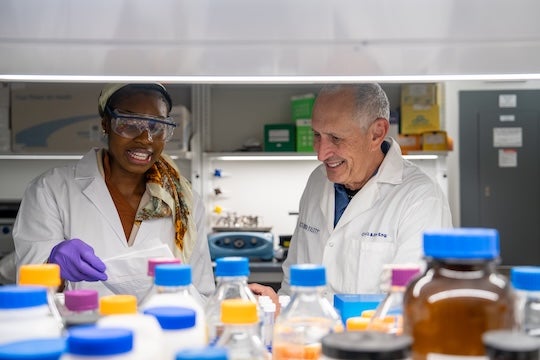
A conversation that day led to a research role in Alvarez’s lab, where Bangala soon took ownership of a project that led to her first publication. By the time her senior year arrived, she had already been accepted into Rice’s doctoral program to continue her studies.
From 2020 through the spring of 2025, Bangala also competed for Rice’s track and field team in the 400, 800 and 4x400 relay, balancing Division I athletics with her rigorous coursework and research.
“I’m a sprinter at heart, and I grew up with an efficiency mindset,” she said. “Striving is normal for me.”
Today, Bangala’s research sits at the intersection of food security, air quality and climate stability. Working in Alvarez’s lab, she studies how solid carbon by-products from green hydrogen production can be repurposed as soil amendments to reduce nitrous oxide emissions — a greenhouse gas nearly 300 times more potent than carbon dioxide. By targeting nitrification in agricultural soils, her work shows promise for cutting emissions by nearly half while improving fertilizer efficiency and reducing nitrate runoff. She is also designing experiments to measure unintended consequences, ensuring that these solutions don’t disrupt ecosystems in unexpected ways. That careful approach earned her a Chevron Energy Graduate Fellowship and has drawn interest from industry partners seeking scalable, sustainable farming practices.
Just two years into her doctoral studies, Bangala has already passed her candidacy exam, published additional research and is on track to finish early — a surprise to no one.
“I am a product of big systems but also of small things: my parents’ prayers, my mom’s cooking, my communities,” Bangala said. “Remembering what it took to get here, that’s what keeps me grounded.”