
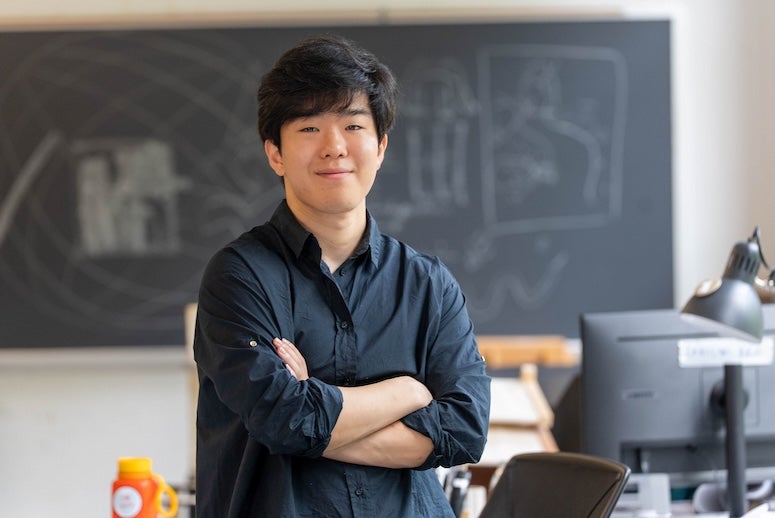
For Sean Choi, architecture has never been about finding the right answer — it’s about asking better questions.
“Architecture lets you pursue something that has no fixed answers to it,” said Choi, a senior at Rice University. “You get to build on top of your belief systems or artistic creativity.”
That mindset has shaped Choi’s journey at Rice, where he will graduate with a Bachelor of Arts from the School of Architecture and continue toward his professional Bachelor of Architecture degree.
Building a foundation at Rice
Drawn to Rice for its close-knit academic environment, Choi found a program that emphasizes both rigor and collaboration.
“Rice offered a tight-knit relationship between professors and students, along with a rich infrastructure and built-in studio environment,” he said.
That studio-centric culture quickly became central to his experience. Each semester, students develop original projects alongside faculty, gradually refining ideas into fully realized designs.
“You can see how the resolution becomes apparent as it consolidates to a project that feels real,” Choi said.
Just as important is the peer dynamic within the studio, where constant dialogue pushes ideas further.
“We talk to each other a lot,” Choi said. “Even dialogues as casual and basic as, ‘Why can’t it be yellow? Why can’t it have a puncture in the middle?’ can make you come up with the right reasons for every aspect of the project.”
Designing through exploration and experience
Choi’s interest in architecture was shaped early by travel and exposure to the built environment.
“A lot of my best memories were tied to physical sites such as museums or landmarks,” he said.
One moment stands out: seeing the Eiffel Tower for the first time.
“I can’t forget the moment I saw the Eiffel Tower,” he said. “I was mesmerized by its form, curvature, color and how it strikes the Parisian landscape.”
That fascination has evolved into a broader design philosophy grounded in exploration — something reinforced through global opportunities at Rice. Each summer, Choi pursued experiences abroad, supported by university funding.
He studied French culture and language in Toulouse, France, while living with a host family, participated in a global urban design workshop in Singapore, interned in Tokyo and conducted research in Switzerland on postpetroculture architecture.
“Exposure to cultures is extremely crucial,” he said. “It expands your possibilities of ideas and imaginations.”
A human-centered approach to design
That global perspective came into focus in one of Choi’s most meaningful studio projects: a proposal for rebuilding communities after wildfire destruction in Altadena, California.
“I was pursuing an ideal of reconciling systemic resilience with the existing suburban vernacular that residents were originally very fond of,” he said.
His concept centered on a modular unit that allows custom homes to develop over time around it while maintaining neighborhood character. Rather than prioritizing density or large-scale development, the project focused on residents’ immediate, postdisaster needs.
“Both the studio’s site visit to L.A. and visiting critics from the area made me realize that we are working on a real problem,” Choi said, noting that visiting professionals engaged deeply with the proposal, even inquiring how it could be implemented in practice.
Finding community on campus
Outside the studio, Choi says he found balance in Rice’s residential college system and campus environment — often drawing inspiration from the building designs on campus.
“Rice has a fascinating campus … a lot of oak trees,” he said. “Each (college) is very unique in typology and also in culture.”
Whether working in studio or spending time with friends, he describes daily life as both productive and restorative.
“It feels like I’m on a retreat whenever I go spend time with my friends,” he said. “It’s a huge privilege to be in this environment where just so many people are friendly.”
Looking ahead
After graduation, Choi will join the renowned architectural firm Skidmore, Owings & Merrill in San Francisco as a part of the Rice Preceptorship Program. He aspires to gain exposure to large-scale design skills while completing the remainder of his professional degree at Rice.
Long term, he says he hopes to start his own firm — one that blends technological innovation with a deeply human sensibility.
“I want to design environments where people can feel less strained and more relaxed,” he said. “When they enter my building, (I wish) that could be the place where they can really rest and find their peace of mind.”