
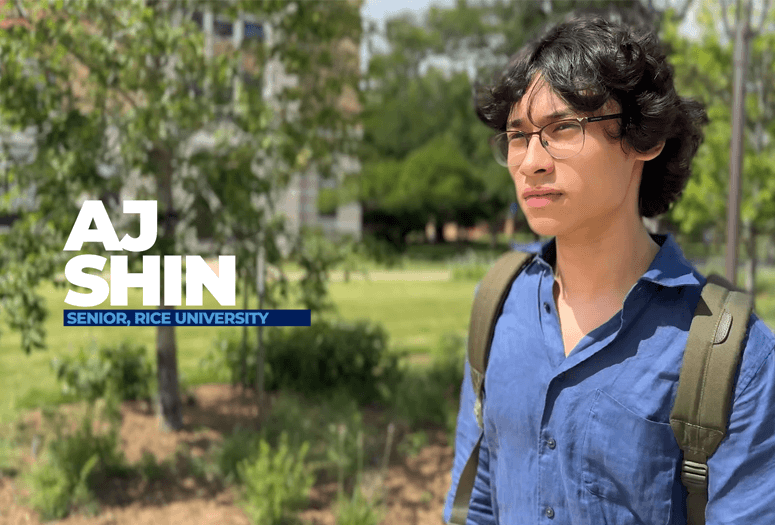
Before he walks across the stage at commencement, Rice University senior AJ Shin has lived in a monastery in Nepal, conducted independent philosophy research and helped lead weekly salon-style discussions in Houston. A philosophy major with minors in art history, Asian studies and French, Shin’s academic path did not follow a predefined structure.
“I think I kind of ended up collecting minors as I took more and more classes and found more and more things that I was interested in,” Shin said. “There are a lot of things that I just ended up falling in love with.”
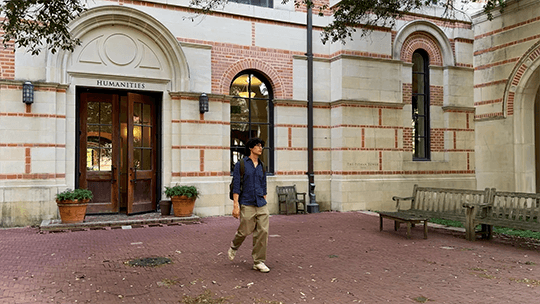
Shin arrived from New York City with a clear sense of what he wanted from college: a place that would challenge him academically while still feeling like somewhere he could actually enjoy being.
“Rice had the best balance between a school that had very serious, very rigorous academics that would set me up very well for my future, but at the same time, it took a lot of effort to make sure that you’re going to have an enjoyable time here,” Shin said.
That balance shaped his experience on a campus where flexibility is built in, making it possible to move across disciplines without having to lock into just one field of study.
“It’s such a supportive environment to branch out and learn things that you might just be curious or interested in,” Shin said.
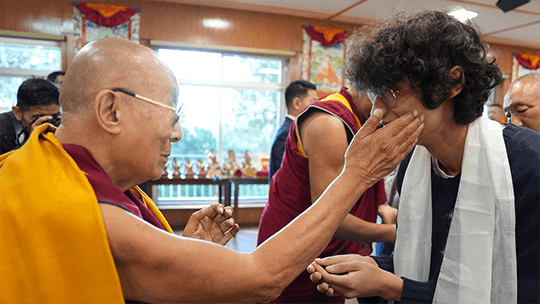
Much of Shin’s time at Rice happened beyond the hedges, shaped by opportunities that allowed him to pursue independent research and follow his academic interests across borders. Through the Elizabeth Lee Moody Undergraduate Research Fellowship in the Humanities and the Arts, he traveled to Nepal.
“I was able to interview monks, scholars and other experts on Buddhist philosophy to do my own independent research and to eventually get that published,” Shin said.
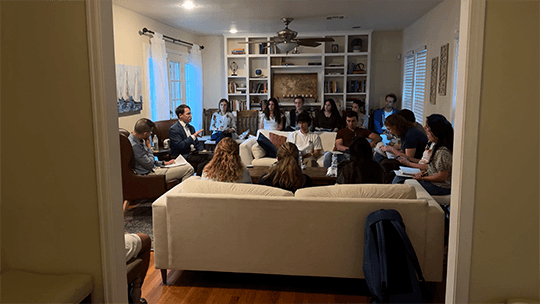
That same impulse toward exploration shaped his life on campus. As president of the Houston Institute student club, Shin leads a weekly gathering with Rice alumnus Victor Saenz ’18 that pulls academic conversation out of the classroom and into a more intimate setting.
“We have dinner together, talk about philosophy, talk about literature and learn together in a really fun, welcoming community,” Shin said.
Across all of it, Shin says one thing stands out: the people. In small, discussion-based humanities courses, he found sustained mentorship and intellectual exchange that carried well beyond the classroom.
“I met so many incredible people,” Shin said. “I value the friendships, which I feel are honestly going to last a lifetime, but also professors, mentors and advisers who have done so much work to help me grow intellectually, personally and academically.”
Next, that trajectory takes him to Paris where Shin will attend Sorbonne University.
“Then I’ll come back to the U.S. to study international and comparative law at Harvard,” Shin said.
For Shin, the path forward feels less like a departure than a continuation of the same instinct that guided him at Rice: to follow the question, see where it leads and trust what unfolds next.
“I’ve become a person that I could have never expected,” Shin said.