
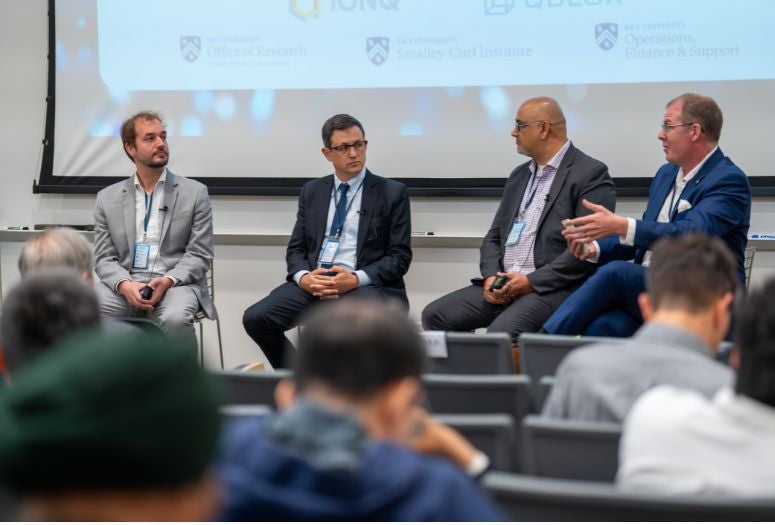
Rice University’s Defense Research Advancement initiative and the Smalley-Curl Institute recently hosted the inaugural Quantum Frontiers Summit, a first-of-its-kind gathering that brought together leaders from industry, academia and government to build a collaborative future vision for the rapid evolution of cutting-edge quantum technologies.
“Quantum technology has reached a critical moment,” Rice President Reginald DesRoches said. “We must think critically about how discoveries move from the laboratory into the world, how to protect the technologies we develop and how we build trusted partnerships amongst universities, government and industry.”
The summit built on Rice’s history of leadership in driving complex technical advancements, as evidenced in the nanomaterials field. A groundbreaking breakthrough in the buckyball discovery in 1985 enabled Rice to serve as a nanotechnology nexus for collaboration, thought leadership and partnerships between academic, industry and government.
Vinod Veedu, assistant vice president in the Office of Research who heads Defense Research Advancement, is drawing on this history to create the quantum leadership of the future.
“Rice has a legacy of turning fundamental science into industrial reality. Our historical leadership in nanotechnology is a perfect example of how we helped shape the national narrative,” said Veedu, who organized the summit. “Today, defense research efforts at Rice are applying that same blueprint to quantum technology to ensure the United States leads in national security, and that’s why we are assembling this ecosystem on campus.”
Rice is also looking toward the infrastructure necessary to support this work as it plans expansions such as the new Arc building.
“In November, Rice will break ground on The Arc in Houston’s Ion District, a nearly 200,000-square-foot research and innovation hub focused on accelerating cutting-edge research collaboration, discovery and enterprise,” said David Sholl, executive vice president for research.
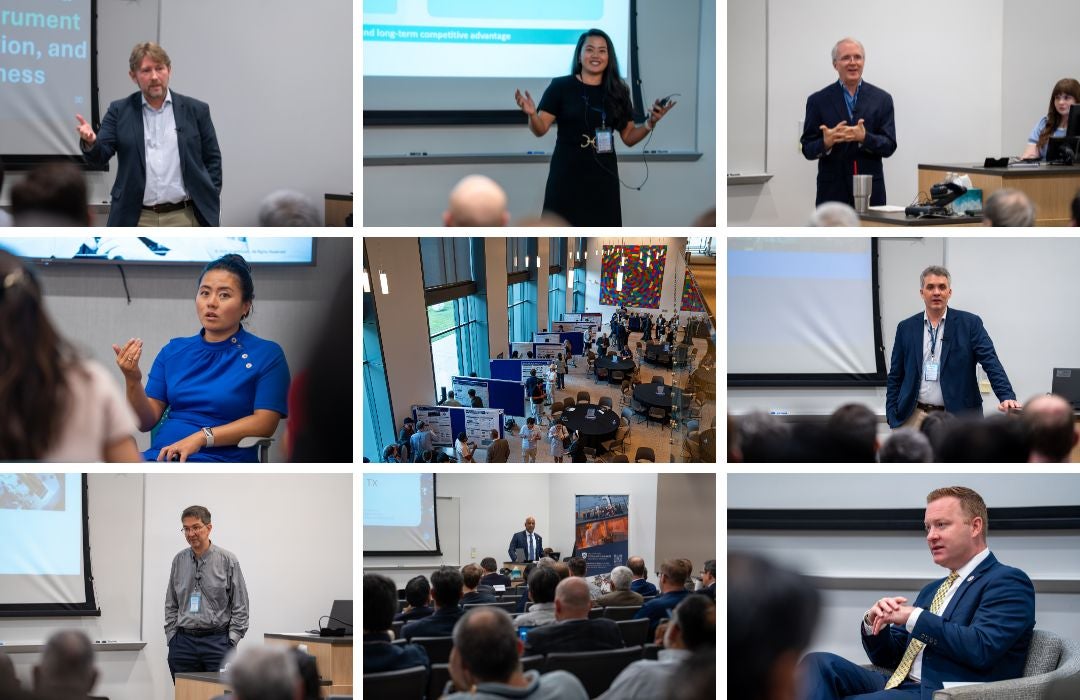
The three themes of the summit — quantum computing, sensing and networking — were tied together by a shared value of collaboration that emerged throughout the presentations.
“Quantum science has the potential to transform our world, from the materials we use to the medicines that save lives,” said Connor Prochaska, director of the Department of Energy’s Advanced Research Projects Agency-Energy. “This summit brings us together around a shared goal: turning groundbreaking ideas into technologies that make a meaningful improvement in people’s lives.”
Presenters included Adam Black, director of the Quantum Science Institute at the U.S. Naval Research Laboratory; Patty Lee, chief scientist of Quantinuum; Fredrik Fatemi and Henry Everitt, senior technologists with the U.S. Army; Roahn Wynar and Lorenzo Vilanova Pérez of the FBI’s Quantum Counterintelligence Protection Team; Joseph Broz, vice president for quantum growth and market development at IBM; Travis Humble, director of Oakridge National Laboratory’s Quantum Science Center; and Daniel Rodan Legrain, quantum science and engineering lead at Qblox.
“We believe that the most effective path is both accretive and collaborative,” Broz said.
Collaboration is a key building block of Rice’s quantum physics program, housed in the Smalley-Curl Institute.
“From the outset, our quantum program was very interdisciplinary. That culture is the foundation of the quantum ecosystem we have today,” said Junichiro Kono, director of the Smalley-Curl Institute. “Rice offers scientific expertise, government and national labs bring real-world problems and industry translates laboratory discoveries into real-world technologies.”