
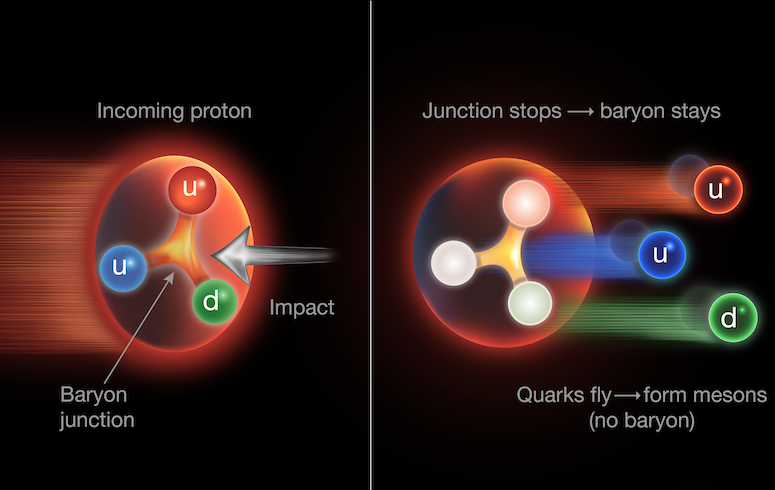
New results from the STAR detector at the Relativistic Heavy Ion Collider (RHIC) suggest that gluons, the gluelike particles that hold quarks together inside protons, play a central role in the conservation of baryon number, an essential part of a particle’s quantum identity. The findings, published in the journal Science, suggest that baryon number is carried by a Y-shaped “junction” of gluons connecting the proton’s three main quarks, challenging a long-held view that baryon number is solely carried by those three quarks.

“We started this project simply trying to adapt a new method to the STAR detector,” said Nicole Lewis, a STAR physicist at Rice University who started the project as a postdoctoral associate at Brookhaven National Laboratory in 2020. “Unexpectedly, the data we generated with the new method didn’t align with the predictions based on the conventional baryon number carrier model. So we designed experiments to interrogate this and found that they supported this alternative gluon junction model instead.”
Rice is one of the founding members of the STAR collaboration, with many researchers who have contributed to both this work and to the detectors used for analysis of the study, including Rice authors Geary Eppley, Frank Geurts, Chenliang Jin, Wei Li, Tonko Ljubicic and Daniel Torres Valdares. The STAR detector itself, which weighs 1,200 tons, can track the thousands of particles produced by ion collisions at RHIC.
Identifying the carrier of baryon number has important implications. At the level of RHIC collisions, baryon number conservation ensures that the total number of baryons — three-quark particles such as protons and neutrons — remains the same before and after a collision. But the idea of baryon number conservation extends to the entire universe.
“Since the big bang, the number of protons and neutrons all together never changes as a function of time,” Lewis said. “The reasons for this conservation are not well understood. It’s one of the mysteries of the universe, related to why we have more matter than antimatter.”
The idea that gluons carry baryon number challenges the conventional picture of how this quantum property is conserved.
“Traditionally, scientists have assumed that each of the three main ‘valence’ quarks inside a proton or neutron carries one-third of the baryon number,” said Zhangbu Xu, a professor at Kent State University with a joint appointment at Brookhaven Lab. “Our findings strongly support the idea that baryon number is more favorably carried and transported by gluons, the particles that hold quarks together, when arranged in this special configuration.”
Baryon junction transformation and transportation
According to the STAR team’s study, when the protons that make up nuclei collide at RHIC, the quark-connecting “gluon junction” or “baryon junction” can be stopped much more easily than the three quarks; all its energy is transformed into new baryons that spray out in perpendicular directions while the quarks it usually connects continue to fly down the beampipe.
The observation that so many of the baryons produced emerge perpendicular to the beamline provides compelling support for the existence of the baryon junction.
“Our research challenges the long-held idea that baryon number is simply divided among and carried by the three quarks,” said Rongrong Ma, a Brookhaven Lab physicist. “This new understanding reshapes how we think about the structure of matter and deepens our knowledge of the most fundamental element that is responsible for the universe in its current form.”
This work was supported by the Department of Energy’s Office of Science, the U.S. National Science Foundation (NSF) and a range of international agencies and organizations listed in the scientific paper. In addition to using the Open Science Grid, supported directly by NSF, the researchers made use of computing resources in the Scientific Computing and Data Facilities at Brookhaven Lab and the National Energy Research Scientific Computing Center, which is another DOE Office of Science user facility at Lawrence Berkeley National Laboratory.