
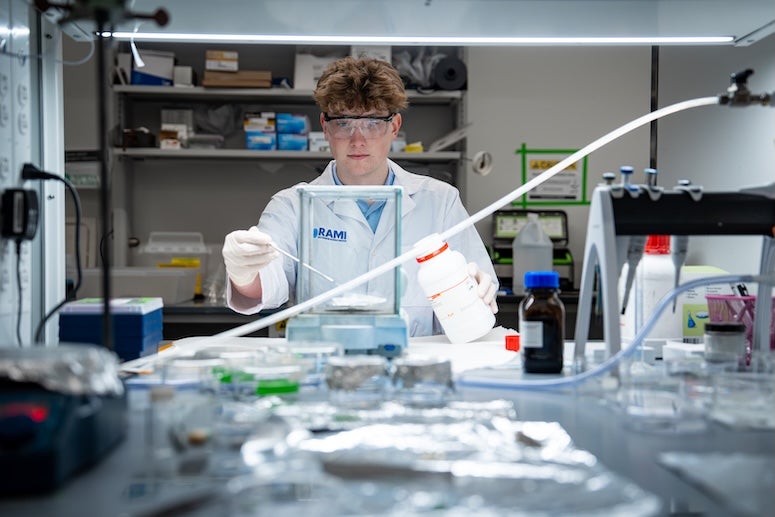
As global demand for lithium-ion batteries continues to surge, a team of Rice University researchers has developed a faster, more energy-efficient way to recover critical minerals from spent batteries, potentially easing supply chain pressures and reducing environmental harm.
In a new study published in Small, researchers from Rice’s Department of Materials Science and Nanoengineering introduce a class of water-based solutions that can extract valuable metals from battery waste in minutes rather than hours. The work centers on aqueous solutions of “amino chlorides,” which mimic the performance of commonly studied green solvents like deep eutectics, while avoiding their key limitations.
“Traditional recycling methods often rely on harsh acids or slow, energy-intensive processes,” said the study’s first author, Simon M. King, a sophomore studying chemical and biomolecular engineering who completed this work as a summer research fellow at the Rice Advanced Materials Institute. “What we’ve shown is that you can achieve rapid, high-efficiency metal recovery using a much simpler, water-based system.”
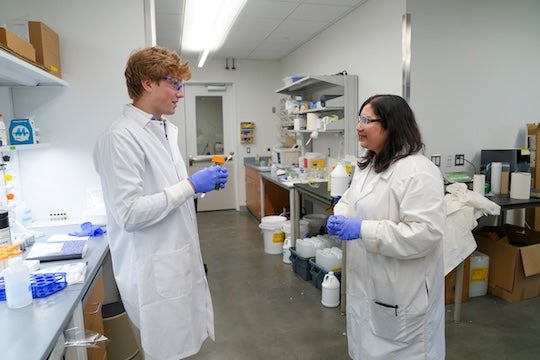
King worked closely with corresponding authors Pulickel Ajayan, the Benjamin M. and Mary Greenwood Anderson Professor of Engineering, and Sohini Bhattacharyya, a research scientist in Ajayan’s lab.
Lithium-ion batteries power everything from smartphones to electric vehicles, but recycling them remains a major challenge. Only a small fraction of battery materials, including lithium, cobalt, nickel and manganese, are typically recovered during the recycling process, despite growing demand and limited global reserves.
Hydrometallurgical recycling, which dissolves metals into solution followed by their chemical precipitation, is considered one of the most scalable approaches. However, commonly used solvents can be toxic and proposed green alternatives (DESs) can be inefficient. To address this, the Rice team explored aqueous amino chloride salts as alternative “lixiviants,” or leaching agents. Among the candidates tested, a solution based on hydroxylammonium chloride (HACl) delivered standout performance.
“We were surprised by just how fast the reaction occurs, especially without the involvement of high temperatures,” King said. “Within the first minute, we’re already seeing the majority of the metal extraction take place.”
The HACl-based solution achieved roughly 65% extraction of key battery metals in just one minute at room temperature with efficiencies climbing above 75% for several metals under slightly longer processing times. And unlike many existing approaches, the process does not require high temperatures or long reaction times — two major drivers of cost and environmental impact.
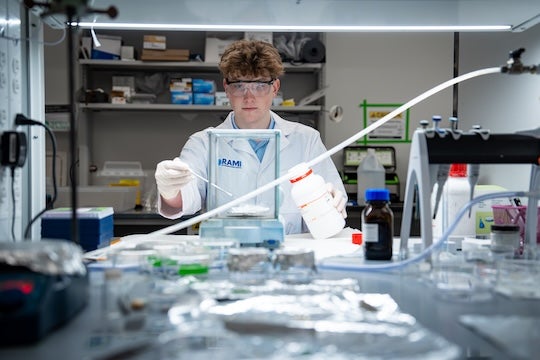
“A big advantage of this system is that it works under relatively mild conditions,” Ajayan said. “That opens the door to more sustainable and scalable recycling technologies.”
The team found that replacing traditional organic solvents with water significantly reduced viscosity, allowing faster movement of molecules and improving reaction speed. This shift also simplifies waste handling and lowers environmental risk.
Through a combination of experiments and modeling, the researchers identified why the HACl solution performs so well: While acidity and chloride ions help dissolve metals, the key factor appears to be a built-in redox-active nitrogen center in HACl that actively participates in the reaction.
“While the rapid metal dissolution is very interesting, what is most exciting is that this highlights the generic chemical properties that are the major drivers for efficient leaching,” Bhattacharyya said. “That redox capability gives it a major advantage over other similar systems we tested.”
The study also shows that factors like solvent polarity or pH can be outweighed by the presence of reactive chemical groups and efficient mass transport to facilitate rapid leaching.
After extraction, the team demonstrated that the recovered metals could be reprocessed into new battery materials, completing the recycling loop. The findings point to a broader design strategy for next-generation recycling systems: combining low-toxicity solvents with targeted chemical functionality to maximize efficiency.