
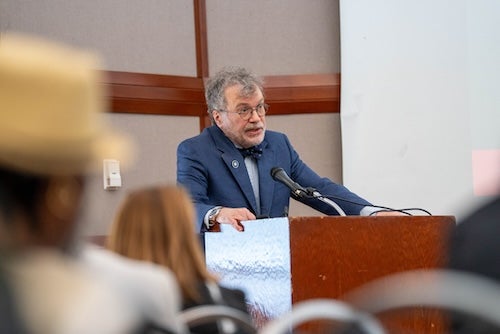
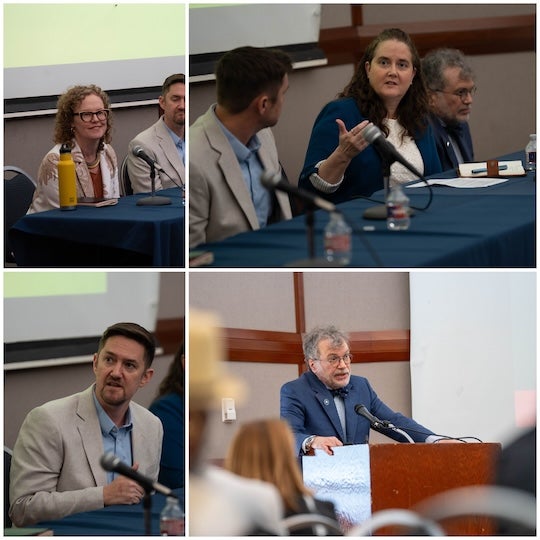
The annual Ethics and Compliance Symposium brought renowned vaccinologist Peter Hotez, senior fellow in disease and humanity at Rice University’s Baker Institute for Public Policy, to share his research and discuss the ethics of academic public engagement. Joined on a panel by Rice’s Kirstin Matthews, Kirsten Ostherr and Scott Solomon, the symposium emphasized the need for evidence-based communication to maintain public trust in science and medicine.
Sponsored by Rice’s Office of Ethics, Compliance and Enterprise Risk, the expert discussion kicked off with a welcome from Provost Amy Dittmar, who spoke about how ethics is an integral part of the academic and research mission.
“It is foundational to how we teach, how we conduct our research and how we serve society as a university,” Dittmar said. “This year’s theme, the Ethics of Academic Public Engagement, speaks directly to each part of that mission and probably even more so because of the moment that we are in right now."
Rice’s faculty are increasingly moving beyond campus to become active participants in public life by shaping policy and media discussions through expert opinion as well as working directly with communities. This translation of research into real-world impact is central to the university’s strategic goals, but it simultaneously introduces new complexities.
“We have to be mindful that as we are speaking with louder voices and more people are listening, what we say is increasingly important — and how we say it,” Dittmar said. “We are no longer speaking only to our peers or only to our students. We are speaking to broader audiences, often in real time, often on complex and evolving issues that don’t always have a clear answer, and increasingly we are doing so in an information environment that is faster, more fragmented and more challenging than ever before.”
Hotez was an important voice in the vaccine conversation at the beginning of the COVID-19 pandemic; he led the team that designed the COVID-19 vaccine named Corbevax and became a recognized voice in the media sphere. Declining trust in science and medicine during the pandemic was not necessarily due to poor communication by scientists but due to deliberate efforts by “bad actors,” he explained.
“What I want to do is talk to you in very direct ways, and that’s the reason I get attacked so much, because I do talk about it in direct ways — on the premise that I haven’t found a way to talk about it other than to talk about it,” Hotez said. “In the university, we tend to speak in euphemisms and in tangential or indirect terms, and I think we do that often to the point where no one knows what the heck you’re actually trying to say. And I don’t want to do that today. I want to really lay it out in a very direct and forthright way, so we understand what’s at stake here and what you’re dealing with.”
Hotez’s presentation showed the massive global impact of vaccines over the past two decades. He described how organizations like the Gates Foundation and international partnerships with organizations such as the World Health Organization and UNICEF have worked together to expand childhood immunization worldwide. However, global childhood immunization levels stalled in 2023 in part due to vaccine hesitancy and motivated antiscience campaigns.
The panel discussed the role of civic scientists in bridging the gap between science and society. Matthews, fellow in science and technology policy at the Baker Institute, highlighted the institute’s Civic Scientist Program, which stresses the need for scientists to engage with the public. The program brings medical speakers to campus to share about science as a public good and also does outreach into K-12 schools to expand awareness of science communication.
“We also do research that, right now particularly, focuses on science advice for the federal government in an effort to do better,” Matthews said. “We define civic scientist — it was actually coined by Dr. Neal Lane, my colleague, when he was at the National Science Foundation — as someone who uses their technical expertise, a scientist, an engineer, a medical doctor, to bridge a gap between science and society.”
Part of the problem is that research and the scientific community is mostly invisible to the public, Hotez said.
“What I find when I go out and I give talks or I’m on a podcast or something like that is that it’s often people’s first time ever meeting an evolutionary biologist,” said Solomon, a biologist, professor and science communicator. “I think that speaks to what Dr. Hotez was saying about ‘giving a face to the science.’ It’s sometimes seen as this sort of mystery black box. ‘Who are the scientists? What are they doing? Where are they working? We’re not quite sure and we hear things.’ And what I typically find is that people are curious, they’re interested. And if you give them information in a way that is accessible and open, they eat it up, and they have lots of questions, and they want to know more.”
Ostherr, director of the Medical Humanities Program and co-founder of the Medical Futures Lab at Rice, shared a tactic from the United Kingdom — “experts by experience.” These are people or patients with personal, lived experience of a public service or caring for someone who uses physical health, mental health or social care services.
“Part of this issue of public trust is around how we decide what it is important to research, to spend time and money and attention on, and then expect people to just accept when we say ‘this is really important and you should be listening to us,’” Ostherr said. “We do need to have a bit more of a reciprocal feedback loop. So it’s not just going out, but it’s listening, too, and I think that’s really critical.”
Institutional support for community engagement is important, Ostherr said, not only training faculty and students on how to communicate scientific research but also by inviting the community in to experience more of what academic research can provide.
Learn more about the Office of Ethics, Compliance and Enterprise Risk or discover upcoming events, panels and programs that showcase Rice’s research.