
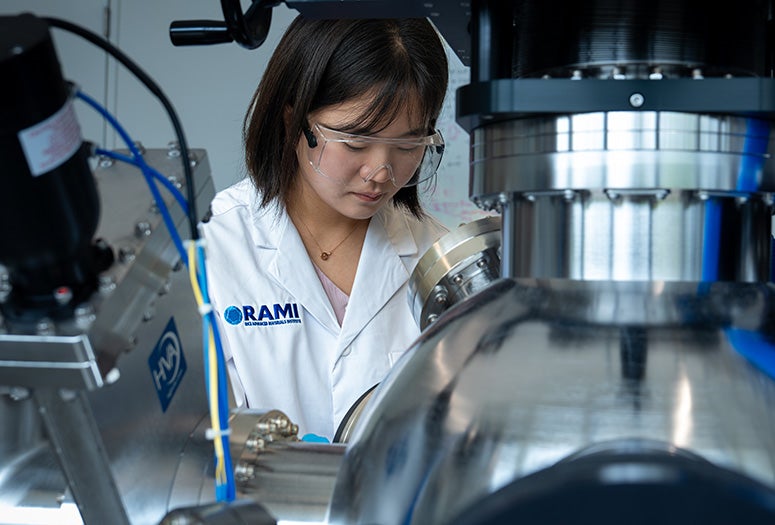
A team of researchers at Rice University engineered a new version of a well-known multiferroic that exhibits orders of magnitude higher performance at room temperature than its parent material.
The study, published in the Proceedings of the National Academy of Sciences, describes a modified version of bismuth ferrite that shows a 10-fold increase in magnetization and 100-fold increase in magnetoelectric coupling compared to standard varieties. The synthesis process entailed mixing bismuth ferrite with barium titanate while simultaneously growing the material as a thin film on a substrate that distorts its crystal structure.
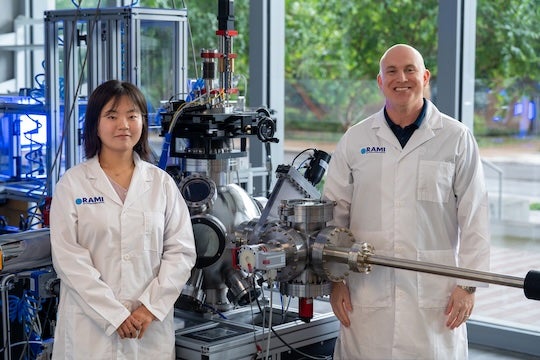
“Nobody had ever dialed both knobs ⎯ the strain and the chemistry ⎯ at once,” said Rice materials scientist Lane Martin, who led the study. “We were able to combine two different material systems into a new material with a new structure and a new combination of properties.”
Modern computing depends on moving and storing information by switching the flow of electrons on or off, a process that is now well understood and controlled in silicon-based systems. However, this material infrastructure has run up against an efficiency limit.
“Electronics today have an energy problem,” said Martin, Rice’s Robert A. Welch Professor of Materials Science and NanoEngineering. “Within the next five to 10 years, computing could use up as much as a quarter to a third of all the power generated, which is unsustainable.”
Materials scientists and engineers are exploring ways of using additional properties of electrons, as well as other fundamental particles, as a basis for new forms of computation. One approach focuses on controlling electron spin, a magnetic property.
“One class of materials that has been studied in earnest for 20-25 years at this point is multiferroics,” said Martin, who leads the Rice Advanced Materials Institute. “Multiferroics have, as the name implies, multiple order parameters. Ones we are most interested in are ferroelectric, so they have a spontaneous polarization which you can switch with an electric field and are also magnetic.”
Multiferroics are promising due to the coupling that occurs between these different properties, known as magnetoelectricity, which makes it possible for an electric field to change a material’s magnetism or a magnetic field to change its polarization. This switching could provide the physical basis for performing memory and logic operations using far less energy and even combining the two functions in a single element.
The challenge has been finding a single material that is both strongly ferroelectric and strongly magnetic at room temperature. Bismuth ferrite has long been researched as a potential candidate, but its magnetism is weak because its atomic moments cancel each other out.
Adding barium titanate, a nonmagnetic component, in combination with carefully engineered strain, had the unexpected effect of increasing the new material’s overall magnetization while preserving strong electric properties.
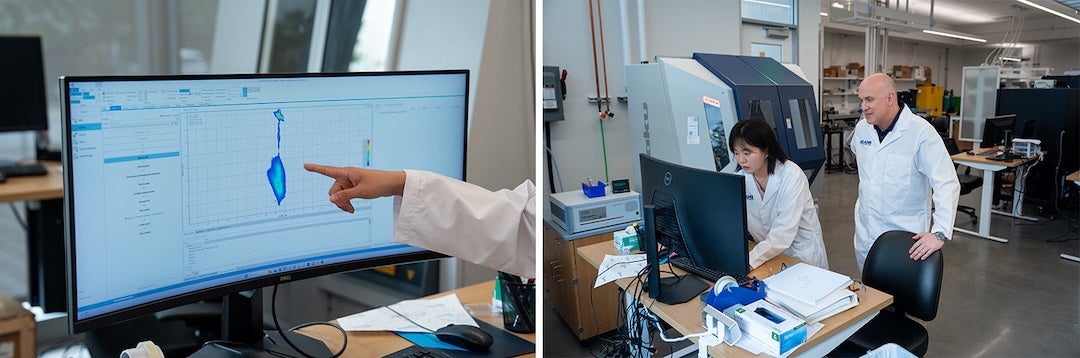
“I did not expect such a large increase in magnetization,” said Tae Yeon Kim, a postdoctoral researcher in Martin’s lab who is the first author on the study. “At first, I was excited by the new structure, but when I measured the magnetism, I became very anxious. We repeated the measurements many times to make sure it was real.”
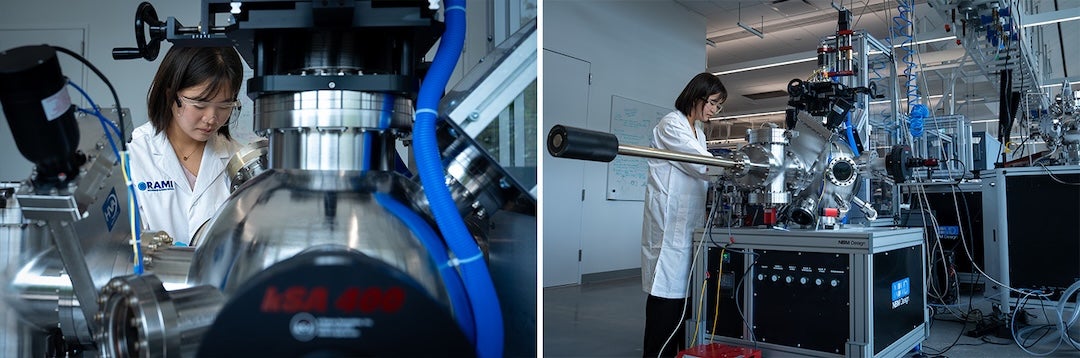
Kim’s caution was warranted since measuring the magnetic properties of thin films can be challenging. In order to validate her findings, Kim spent more than six months making and testing samples — even drafting another lab member to grow the same material independently using her recipe to assure they could reproduce the results.
Most of the work was done at Rice, but the team also used outside facilities, including synchrotron measurements at the Advanced Light Source at Lawrence Berkeley National Laboratory, and they worked with collaborators at the Bar-Ilan University, Drexel University, the Massachusetts Institute of Technology, Northeastern University, the University of California, Berkeley, the University of Pennsylvania and the U.S. Naval Research Laboratory on an array of approaches to understand this complex material.
Beyond the discovery of a promising new material, the work also points to a broader strategy for making new multiferroics by combining chemistry and strain to create structures with unexpected properties. Moreover, adding nonmagnetic atoms made the material more magnetic ⎯ a surprising result that could guide future materials design.
“This is the fun part of science,” Martin said. “When a material does something unexpected, we have to then figure out why.”
The research was supported by the Army Research Office (W911NF-21-1-0126, W911NF-21-1-0118, W911NF-21-2-0162), the U.S. National Science Foundation (DMR-2102895, DMR-2329111), the Army Research Laboratory (W911NF-24-2-0100), the U.S. Department of Energy (DE-AC02-05-CH11231, DE-AC02-05CH11231), the Massachusetts Technology Collaborative (22032) and the Israel Science Foundation (1479/21). The content herein is solely the responsibility of the authors and does not necessarily represent the official views of the funding organizations and institutions.
- Peer-reviewed paper:
-
Strong intrinsic multiferroism and magnetoelectric coupling in (1–x)BiFeO3-(x)BaTiO3 films | Proceedings of the National Academy of Sciences | DOI: 10.1073/pnas.2603475123
Authors: Tae Yeon Kim, Jesse Schimpf, Atanu Paul, Michael Xu, Atanu Samanta, Sajid Husain, Peter Meisenheimer, Isaac Harris, Peter Finkel, Thomas Mion, Margo Staruch, Anthony Ruffino, Stefan Masiuk, Liyan Wu, Tae Joon Park, Deokyoung Kang, Christoph Klewe, Paul Stevenson, Ramamoorthy Ramesh, Andrew M. Rappe, James LeBeau, Jonathan Spanier, Ilya Grinberg and Lane Martin
https://doi.org/10.1073/pnas.2603475123 - Access associated media files:
-
Video is available at:
https://www.youtube.com/watch?v=-kVOp8snklU (Video by Jorge Vidal/Rice University)
Photos are avaialble at:
(Photos by Jorge Vidal/Rice University)