
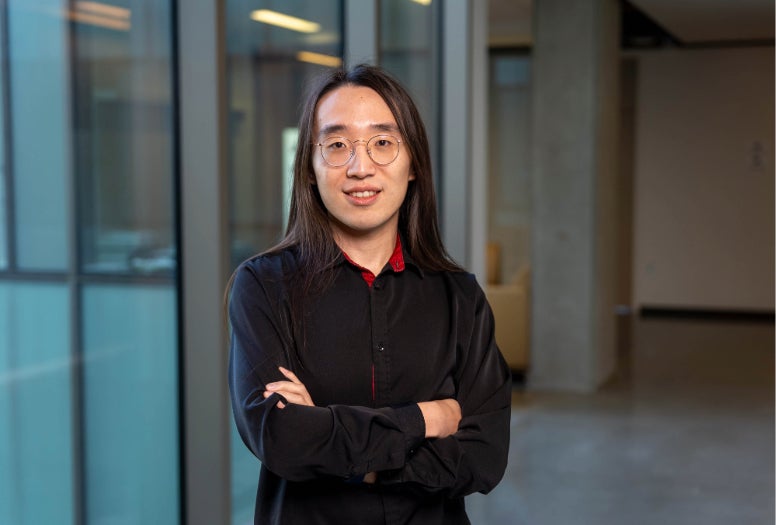
Fang Xie, a postdoctoral fellow in Rice University’s physics and astronomy department and Extreme Quantum Materials Alliance (eQMA), has received the ACS-Moore Postdoctoral Bridge Award in Quantum Materials. Xie, who received his doctorate from Princeton University before joining Qimiao Si’s group at Rice, studies theoretical condensed physics matter.
This award, from the American Chemical Society and the Gordon and Betty Moore Foundation, supports exceptional postdoctoral researchers in quantum materials by providing funding for a year’s salary and travel or research expenses, along with professional development and networking opportunities. The combination of funding and a structured cohort experience protects research momentum and accelerates awardees’ transition to independent academic leadership.
“Fang is full of ideas and has shown all the promises of going really far in independent research on quantum materials,” said Si, the Harry C. and Olga K. Wiess Professor of Physics and Astronomy and director of eQMA. “He is richly deserving of this prestigious award, and I could not be prouder.”
The award is run by an invitation-based process. Select institutes are invited to nominate postdoctoral fellows, and an expert selection committee selects approximately 30 recipients from this pool. At Rice, the Smalley-Curl Institute was responsible for identifying and nominating postdoctoral fellows. After internal review and selection, they prepared a nomination package to submit to the expert committee.
“Collaboration is a defining strength of Rice’s quantum materials community, and Fang’s creativity and intellectual energy will make that community even stronger,” said Junichiro Kuno, director of the Smalley-Curl Institute. “I am delighted to see his promise recognized through this prestigious award and look forward to the discoveries and new collaborations he will inspire.”
“I’ve been learning physics for more than 10 years, since my undergraduate program,” said Xie, who is applying to tenure-track positions this academic year. “I still feel like there are so many things I don’t know and important questions to answer, which is what I hope to keep doing.”
Xie’s past research focuses on quantum many-body physics in twisted bilayer 2D quantum materials, such as graphene and transition metal dichalcogenides. Graphene is a type of material similar to the graphite in pencils. That means a pencil tip is actually made up of millions of single atom-thick layers stacked upon each other, rather than a true three-dimensional structure. Xie studies what happens to the electrons when two single layers of materials are stacked upon each other, then one layer is rotated, putting their lattices out of alignment.
“When you have two lattices out of alignment with each other, you can actually see the diffraction pattern,” Xie said. “It’s like taking a photo of your computer screen with your cell phone. The pixels on your screen and the sensors in your camera are both lattices. If they’re not aligned, you can see stripes in the photo. On a much smaller scale, this happens in twisted quantum materials, and the response of the electrons to that modulation generates exotic physics.”
Over the next year while supported by this award, Xie will expand his research across adjacent quantum physics fields. He aims to further investigate electron interactions in quantum materials, apply quantum information tools to analyze their behavior and examine how they interact with photons, which are fundamental particles of what is normally called light.