
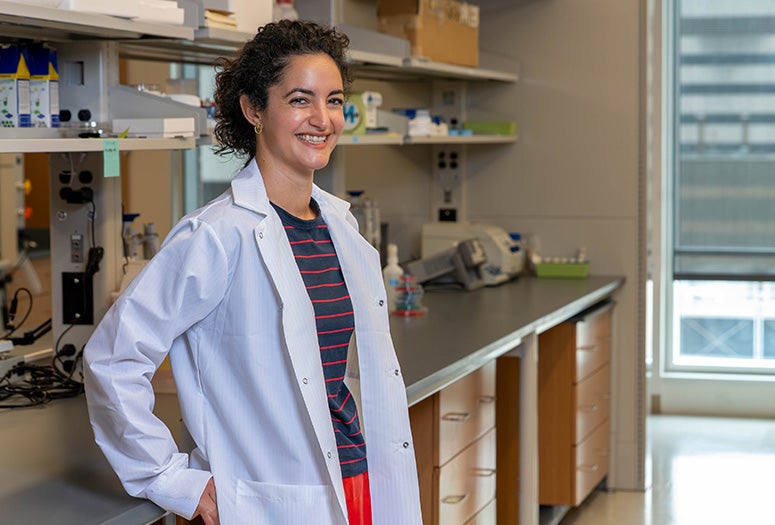
Rice University’s Christina Tringides has won a Pew Biomedical Scholar award, a prestigious recognition that supports early career investigators “of outstanding promise in science relevant to the advancement of human health,” according to the program website.
Tringides is one of 21 researchers to join the Pew Scholars Program in the Biomedical Sciences this year to earn the distinction.
The award will support a four-year project exploring how glioblastoma, one of the most common and aggressive forms of brain cancer, grows and spreads into healthy tissue. The research will also examine how different compounds change or limit cancer spread and could support the development of patient-specific therapies.
The research enacts a visionary approach to modelling biological processes. Tringides, who applies her materials science expertise to problems in neuroscience and biological systems, creates cell culturing environments that recreate key features of living tissue. Specifically, Tringides is working with hydrogels that mimic the brain’s extracellular matrix, the complex mesh of proteins and other molecules in which neurons are embedded.
“In almost every disease, this extracellular matrix in tissues will change ⎯ and this is also the case in brain cancer,” said Tringides, an assistant professor in materials science and nanoengineering. “Our expertise is in building these hydrogels that mimic the extracellular matrix, and we can readily tune the hydrogel mechanical properties.”
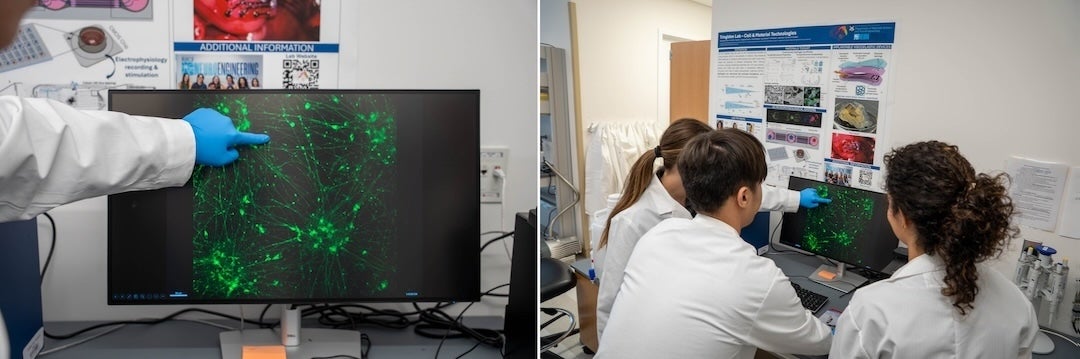
The ability to control the culturing environment has opened a new window into glioblastoma’s behavior: For the Pew-funded project, Tringides and her team will house neurons and tumor cells in seeding wells at opposite ends of microscopic mazelike structures. The researchers will then track how the cancer spreads, forms connections with neurons and changes the cells’ electrical activity over time.
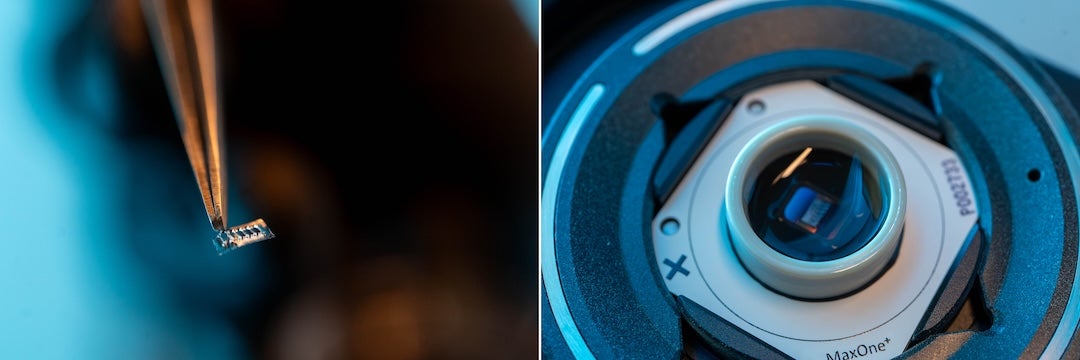
“As cancer crawls through the maze, we can look at how it is interacting with the neurons more and more, and measure how electrical activity is changing as a result,” said Tringides, who came to Rice in 2024 through a Cancer Prevention and Research Institute of Texas (CPRIT) recruitment award.
The ability to pair qualitative imaging with quantitative electrophysiology is especially important for understanding brain cancer, since brain tumor cells fire up in synchronized fashion according to a rhythm distinct from, and disruptive to, the firing patterns of healthy neural tissue. This is why about half of patients with primary brain cancer first present to the clinic with seizurelike symptoms.
This new generation of cancer models offers a rare combination of biological realism and experimental control. The hydrogels provide neurons and other cells with a three-dimensional space in which they can grow and organize in ways that more closely resemble what happens in the body, as opposed to cells grown in a petri dish.
The properties of the extracellular matrix influence cell behavior. For instance, cancerous cells appear to prefer, and may even promote, a stiffer matrix. Because the researchers can precisely tune the hydrogels’ texture and architecture, they can isolate factors that may encourage or impede tumor progression.
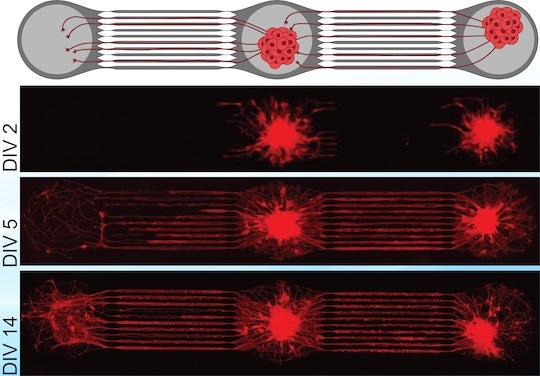
The platform also makes it easier to visualize critical structures such as synapses, the tiny junctions through which neurons communicate and that brain tumors can exploit to integrate themselves into neural networks.
“Imaging synapses is time-intensive ⎯ it can involve large data files that are hard to visualize, but if we know that the only place where we might have a synapse is this tiny 1 by 4 by 10 micron channel, it makes it much faster and reliable to image them,” Tringides said.
Furthermore, the models can be built using patient-derived cells, which means they could help researchers understand why different patients respond differently to therapies and identify new strategies for personalized treatment.
The project builds on a research direction that Tringides embarked on as a CPRIT Scholar.
“I was really committed to brain research, but deciding to apply for CPRIT funding is what led me to cancer neuroscience,” she said. “It is a really exciting time to be in this field, and the majority of the work we do in my lab now is on questions that I may have otherwise not considered if not for CPRIT.”
The Pew award will provide resources to pursue those questions while connecting Tringides with a national cohort of early career researchers tackling some of biomedicine’s most challenging problems. Tringides values that access and exposure to a research community ⎯ also a factor in her choosing to come to Rice, where close ties to the Texas Medical Center enable collaborations with neurosurgeons and physician-scientists.
“Having access to clinicians who see patients struggling with cancers such as the ones we study helps us focus on questions that are both scientifically interesting and clinically relevant,” Tringides said. “That’s one of the things that makes Rice so special.”
- Access associated media files:
-
https://rice.photoshelter.com/galleries/C0000ozmLFGQBqew/G00006v_ik5VXfVc/260507-Christina-Tringides_Pew-Fellowship (Photos by Jared Jones/Rice University)