

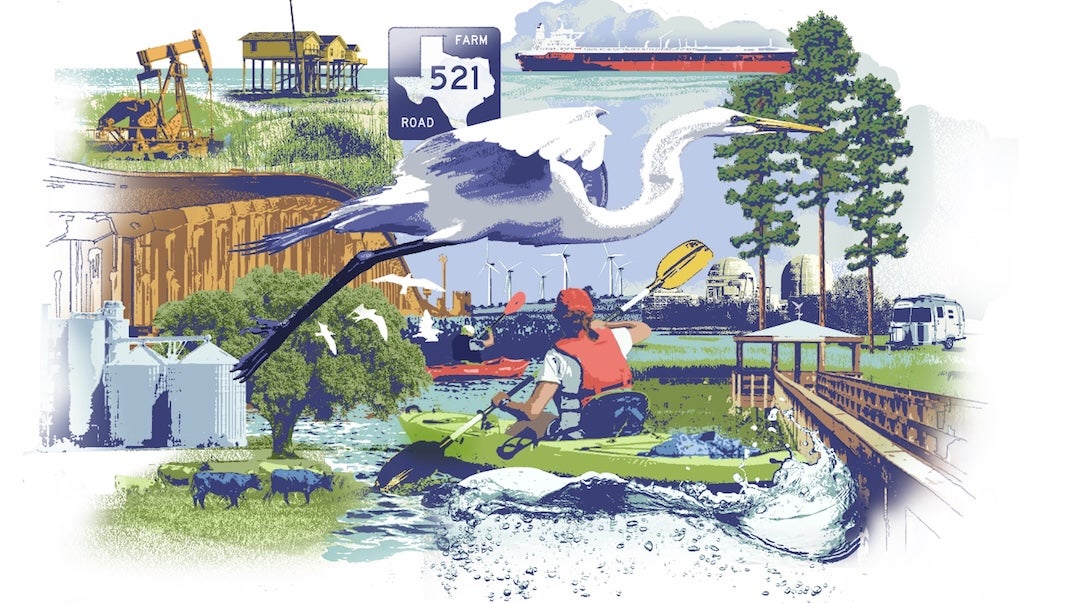
A coastal resilience vision that launched more than 15 years ago through Rice University’s Severe Storm Prediction, Education and Evacuation from Disasters (SSPEED) Center has reached a major milestone.
U.S. Rep. Randy Weber (R-Friendswood) has introduced H.R. 9325, the Lone Star Coastal National Recreation Area Act, legislation that would establish a new national recreation area across portions of Jefferson, Chambers, Galveston, Brazoria and Matagorda counties. If enacted, the bill would create the Lone Star Coastal National Recreation Area (LSCNRA), a locally led, partnership-based framework to expand outdoor recreation, support conservation, strengthen coastal economies and elevate the national and international profile of the upper Texas Gulf Coast.
“This bill represents the latest step in a long-running effort to rethink coastal resilience not only as a matter of infrastructure and storm protection but also as an opportunity to build a stronger and more durable nature-based recreation and tourism economy for the Texas coast,” said Jim Blackburn, co-director of the SSPEED Center and a professor in the practice of environmental law in the civil and environmental engineering department at Rice.
The concept of the LSCNRA grew out of work by Blackburn, his research partner, Elizabeth Winston-Jones and others after Hurricane Ike struck the Texas coast in 2008. At Rice’s SSPEED Center, researchers were studying coastal flooding, storm surge and long-term recovery through funding provided by Houston Endowment, and they also began asking a broader question: What kinds of economic activity could survive the natural rhythms of a hurricane-prone coast?
Native coastal ecosystems, including wetlands, bays, barrier islands and working lands, are naturally resilient. They can absorb storm impacts and recover in ways that conventional development often cannot. The SSPEED Center’s work explored how those ecosystems could also support economic activity through birding, kayaking, fishing, heritage tourism and other forms of outdoor recreation.
To pursue this concept, the Lone Star Coastal Alliance, a 501(c)(3) nonprofit organization was formed and today is led by Winston-Jones and J.P. Bryan of Galveston.
“This is a resilience strategy tailor made for the Texas coast and its rural, semirural and urban communities,” Winston-Jones said. “The idea was to develop an economic sector, built around the vast and ecologically significant open space, that would recover quickly after storms. Developed through stakeholder engagement, it provides a framework for local governments, landowners, conservation organizations, businesses and community partners to work together around a shared vision for the future of the upper Texas coast.”
“The Texas coast is one of the most ecologically rich regions in the country, but we have not always treated that abundance as an economic asset,” Blackburn added. “We are surrounded by ecological jewels, and the Lone Star Coastal National Recreation Area is a way to celebrate those jewels and make them more visible, accessible and valuable to the people who live here and to visitors from around the world.”
The proposed national recreation area is designed to differ from traditional national park models. Rather than relying on large-scale federal land ownership or a new regulatory authority, the LSCNRA would be built around voluntary participation, local leadership and partnerships among public, private and nonprofit landowners.
That model was central to the SSPEED Center’s early work on the concept. Rice researchers studied existing national recreation areas, including Boston Harbor Islands and Santa Monica Mountains, where the National Park Service helps coordinate and promote recreation across lands owned and managed by multiple entities. Under a similar approach on the Texas coast, state land would remain state land, nonprofit-owned property would remain privately held and private property rights would be preserved.
The goal, Blackburn said, was to create a structure that could work in Texas.
“Any successful coastal strategy here has to respect local decision-making and private property rights,” Blackburn said. “This proposal does that. It creates a platform for coordination, visibility and investment without taking control away from the people and communities that know the coast best.”
The idea of LSCNRA was developed in collaboration with the Lone Star Coastal Alliance, the National Parks Conservation Association, local governments, conservation organizations, landowners, business leaders and tourism advocates. Former U.S. Secretary of State James A. Baker III and Houston businessman John Nau were among the civic leaders who helped advance the effort, including development of the Lone Star Coastal Alliance and providing support for an economic study of the proposed recreation area.
That 2011 study, “Opportunity Knocks,” projected that after its 10th year, the recreation area could attract 1.5 million visitors annually, generate nearly $200 million in local sales, create more than 5,000 jobs, increase coastal employment by about 2% and grow local tourism-related jobs by 11%. Even though it only included four of the five counties, those numbers underscored one of the core arguments behind the proposal: Ecotourism, outdoor recreation and heritage tourism can create long-term economic value without placing more people and property in harm’s way.
Since that study was completed, the region’s visitor economy has grown substantially. Current data show the five-county region now supports approximately $2.7 billion in annual visitor spending and more than 26,000 tourism-related jobs, underscoring the significance of outdoor recreation and tourism to the upper Texas coast.
“This legislation reflects that the time is right to create a national park unit rooted in voluntary participation, local leadership and collaboration,” Winston-Jones said. “Houston is often viewed as a city of concrete and industry, without any recognition of the extraordinary ecological resources that surround it. This effort can help change the way people see the region. It can make outdoor recreation part of Houston’s identity and part of the coast’s future.”
“The SSPEED Center has always looked at the coast as a system,” Blackburn said. “Flood risk, environmental health, economic vitality and quality of life are connected. This proposal recognizes that protecting and celebrating natural systems can also create jobs, attract visitors and strengthen communities.”