
Imagine a car seat that reshapes itself around the person sitting in it, clothing that gently assists someone as they walk or a soft safety system that can sense an impending impact and respond.
At Rice University, mechanical engineer Vanessa Sanchez is working toward a future in which those functions could be built directly into fabric.
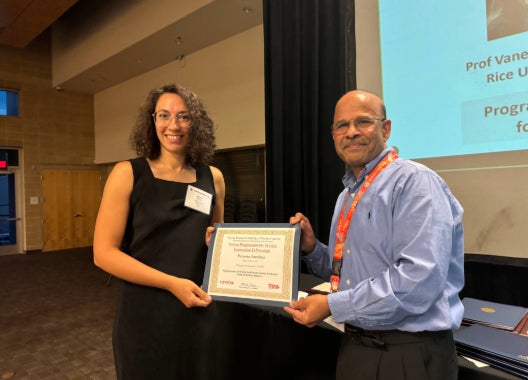
Sanchez, assistant professor of mechanical engineering, has received the Toyota Programmable System Innovation Fellowship to develop “Programmable 3D-Knitted Soft Robotic Textiles for Human-Centered Mobility.” The project will explore how sensing, movement and mechanical behavior can be programmed directly into knitted structures rather than added later as separate components.
The goal is to make the textile itself the robot.
“We tend to think of fabric as something passive — something that covers, cushions or supports another device,” Sanchez said. “We’re asking what happens when the textile becomes the device itself with sensing, movement and mechanical function built directly into its structure.”
Today’s soft robotic systems often combine fabrics with separate sensors, actuators, electronics and structural components. That can make devices bulky and complicated to manufacture and can limit their ability to comfortably conform to different bodies. Sanchez’s team is taking a different approach. By carefully controlling yarn selection, stitch patterns and three-dimensional knit architecture, she aims to encode mechanical behavior into a textile as it is manufactured. Functional fibers, pneumatic channels and sensors could be integrated into the same knitted structure, allowing a fabric to bend, twist, contract or inflate while also sensing its own movement and interaction with a user.
This approach builds on years of Sanchez’s work in the field of textiles, materials science and robotics — and the unconventional path she took to get here.
Sanchez began using a sewing machine as a young child, and she initially studied fashion design as an undergraduate.
“I began college studying fashion at FIT before transferring to Cornell to study fiber science,” Sanchez said. “That shift helped me realize I could bring together my interests in design and engineering.”
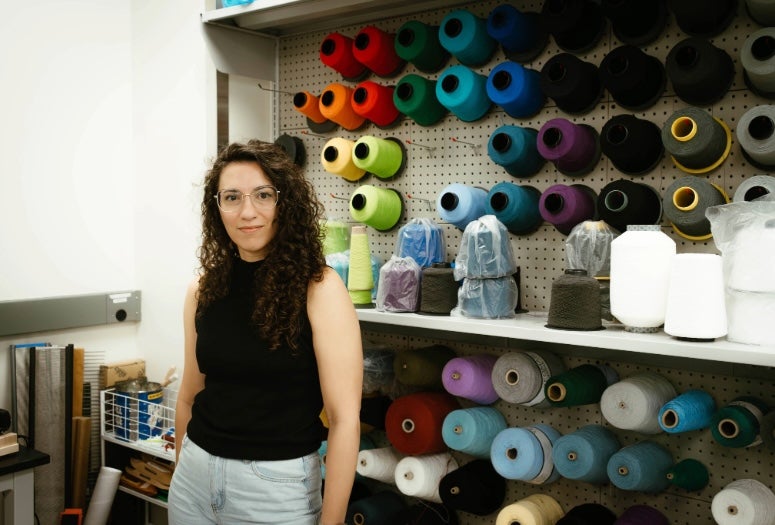
She later earned graduate degrees at Harvard University, where she worked on soft robotic systems designed to assist human movement, before conducting postdoctoral research at Stanford University. Today, she directs Rice’s texlab, where she designs robotic textiles and soft wearable systems.
That combination of textile design and engineering shapes the new Toyota-supported project.
“Textiles are already extraordinarily good at interacting with the human body,” Sanchez said. “They stretch, conform, distribute forces and move with us. If we can add robotic functionality without losing those qualities, we can begin designing systems that are much more natural and comfortable for people to use.”
The 12-month project will focus first on integrating sensing and actuation — the ability to detect changes and produce movement — within the same 3D-knitted structures.
Using materials including conductive fibers, pneumatic channels and composite knitted architectures, Sanchez’s team plans to create textile modules capable of programmed sequences of motion, such as contracting, bending, twisting and inflating.
At the same time, embedded sensing could allow those structures to detect information such as strain, pressure, deformation and loading. Eventually, that capability could enable a robotic textile to sense what is happening to it and adjust its behavior in response.
Sanchez’s lab has already developed technologies featuring textile-based sensors, programmed textile actuators, morphing fabrics and knitted pneumatic actuators capable of producing specific motions based on their structure. At Rice, her group is also investigating AI-guided textile design and new manufacturing techniques for knitted robotic systems.
The fellowship will allow her to begin bringing those capabilities together into more integrated systems.
The second phase of the project will translate those textile systems into prototype technologies relevant to mobility. Possible applications include wearable devices that provide localized assistance to help a person move, seating or interior surfaces that change shape or stiffness in response to a user and soft safety structures that deploy or deform to absorb energy.
The prototypes will be developed in collaboration with Toyota researchers and evaluated for performance, sensing, manufacturability, weight, adaptability and safe interaction with people.
The research reflects a general shift toward designing robots that can operate more naturally alongside humans. For Sanchez, the project is part of a larger effort to expand what textiles can do.
“I’m continuously trying to understand the relationship between fibers and yarns and their structures so well that I can be really innovative and build something brand new,” she said. “Ultimately, I want to use textiles to create new kinds of machines and systems that can support people.”