
By Kelly Peters,
Special to Rice News
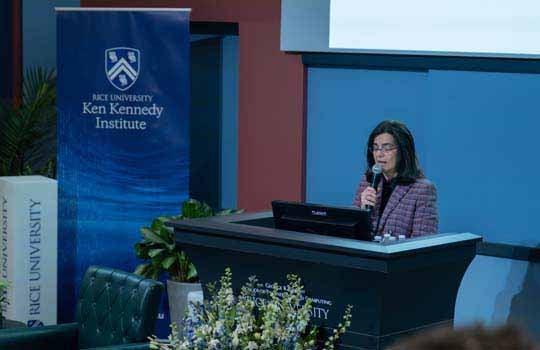
Rice University’s Ken Kennedy Institute celebrated its 40th anniversary with a symposium at Duncan Hall recently, honoring four decades of research at the forefront of computing, data science and artificial intelligence. The day also served as an opportunity to showcase the expansive expertise and interdisciplinary collaborations across Rice’s faculty and students, with a central theme of exploring the responsibilities shaping the future of AI and computing research.
“While this celebration honors our history, it’s equally a celebration of the people and the ideas that shape our community,” said Lydia Kavraki, director of the Ken Kennedy Institute.
The event brought together the Rice community, alumni, industry partners, policymakers, and distinguished lecturers to explore how technical breakthroughs and public governance can develop side by side while tackling global challenges. The invited keynotes were hosted in partnership with the Baker Institute for Public Policy's Civic Scientist lecture series.
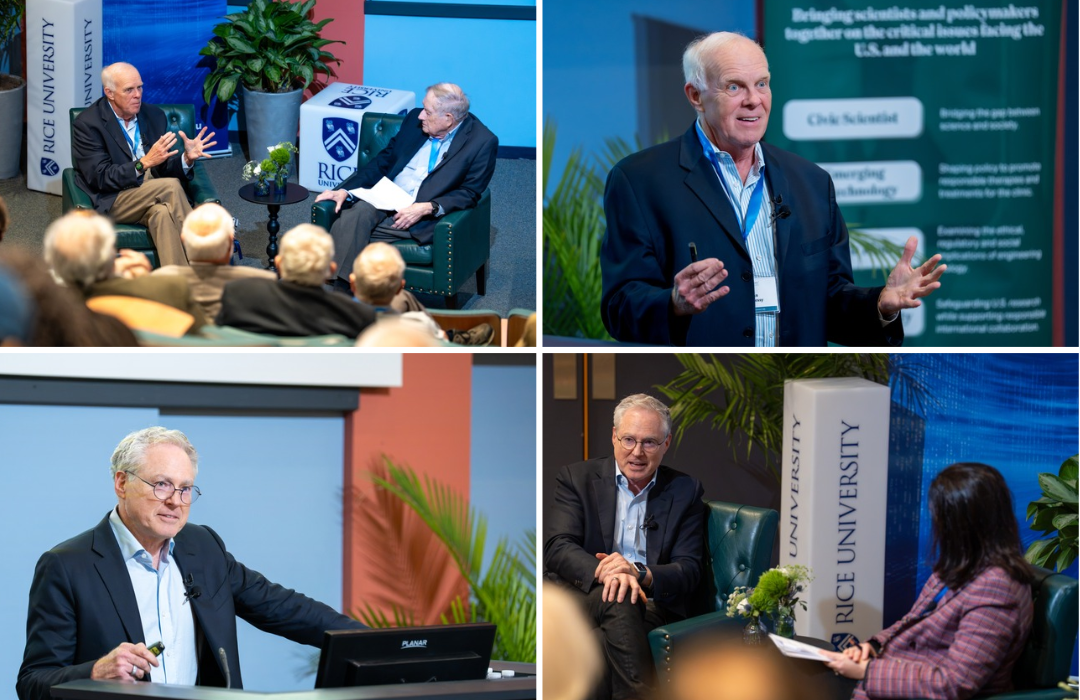
John L. Hennessy, president emeritus of Stanford University, and Eric Horvitz, chief scientific officer of Microsoft, headlined the celebration. Their talks highlighted the rapid advancements in large-scale machine learning and the increasing demand for computational resources that follow, offering their perspectives on the progress that lies ahead to realize the full potential of next-generation AI and computing.
Following each lecture, Hennessy and Horvitz were joined by Neal Lane, senior fellow in science and technology policy at Rice’s Baker Institute, and professor Kavraki, respectively, for fireside chat-style conversations that explored the critical role universities play in progressing interdisciplinary, civic-minded, and human-centered research.
These discussions continued with panels featuring Ken Kennedy Institute faculty members who provided a glimpse of the foundational and use-inspired research that defines the institute’s newly expanded research cluster initiative—an interdisciplinary, faculty-led effort that establishes core focus areas for AI and computing research across the university.
“This initiative captures what the Institute is about: talented people imagining new possibilities, pursuing ambitious research together, and advancing AI and computing in ways that make a meaningful difference,” Kavraki said.
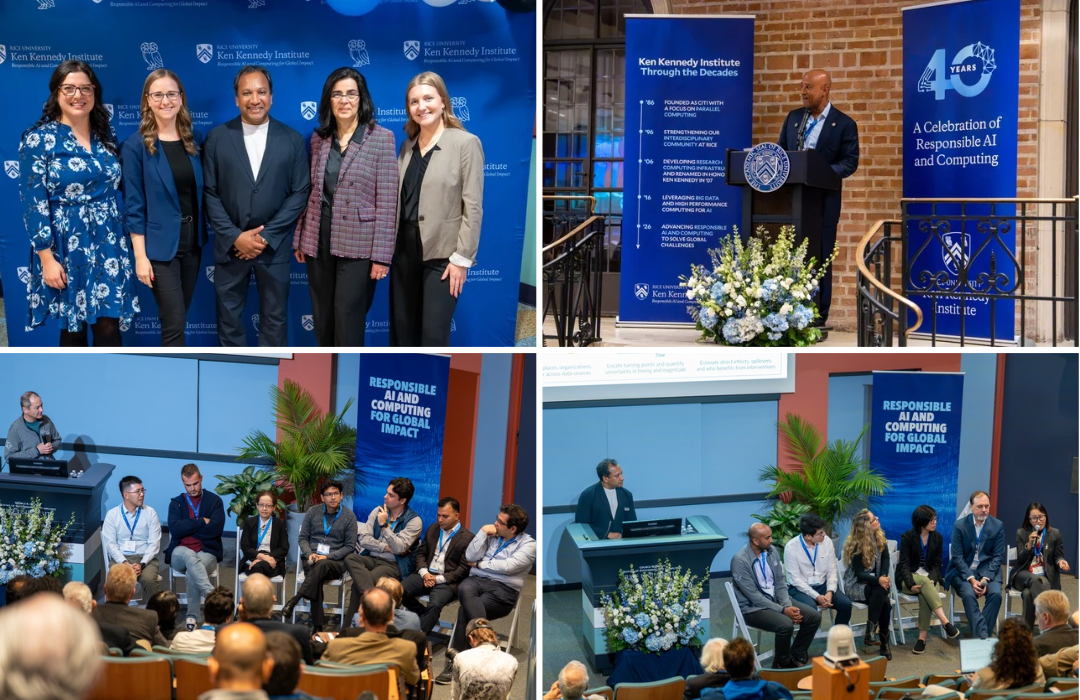
The gathering reinforced Rice’s position as a regional research anchor. The faculty panels demonstrated how the research cluster initiative’s distinct teams align with Rice’s emphasis on responsible AI while intersecting with the university’s strategic pillars of health, urban communities and resilient futures. Examples of these efforts include research on interpretable health and personalized medicine, high-impact hazards like floods and hurricanes, human-machine collaboration and AI safety, among many others.
“Our greatest asset is our faculty, staff and students,” Kavraki said. “Their ideas, ambitions and collaborations that bring them together allow us to connect foundational advances and address challenges across disciplines.”
Today, the institute has 164 faculty members from 23 departments across Rice’s five schools, and an additional 181 affiliated staff and researchers. The anniversary symposium provided a showcase of the breadth and depth of the research led by these faculty members and their students, with over 100 student poster presenters throughout the event.
The Ken Kennedy Institute’s growth can be traced from its roots in high-performance computing when it was established by Ken Kennedy in 1986 as the Computer and Information Technology Institute. Over time, many remarkable leaders have influenced its lasting impact, including former directors Moshe Vardi, Willy Zwaenepoel and Sidney Burrus.
“The institute has evolved through several defining chapters, from pioneering research in parallel computing to building an interdisciplinary research community across Rice and strengthening the university's research computing infrastructure,” Kavraki said. “Now, we have embraced emerging directions in big data and responsible AI, responding to the growing importance of computing and AI in research, education and society.”
Learn about the Ken Kennedy Institute’s initiatives at kenkennedy.rice.edu.