
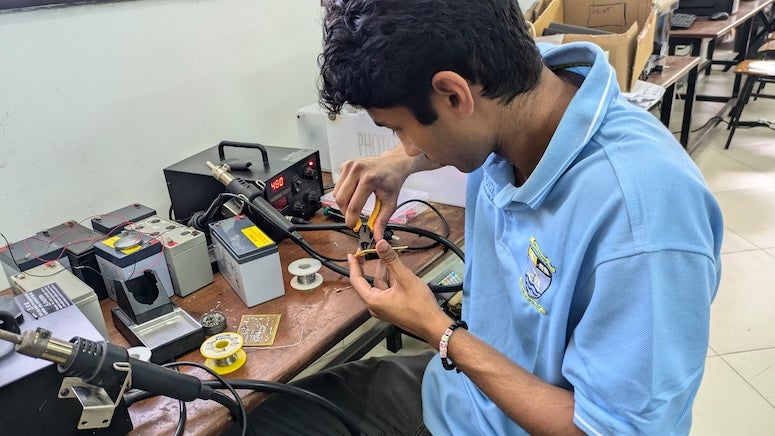
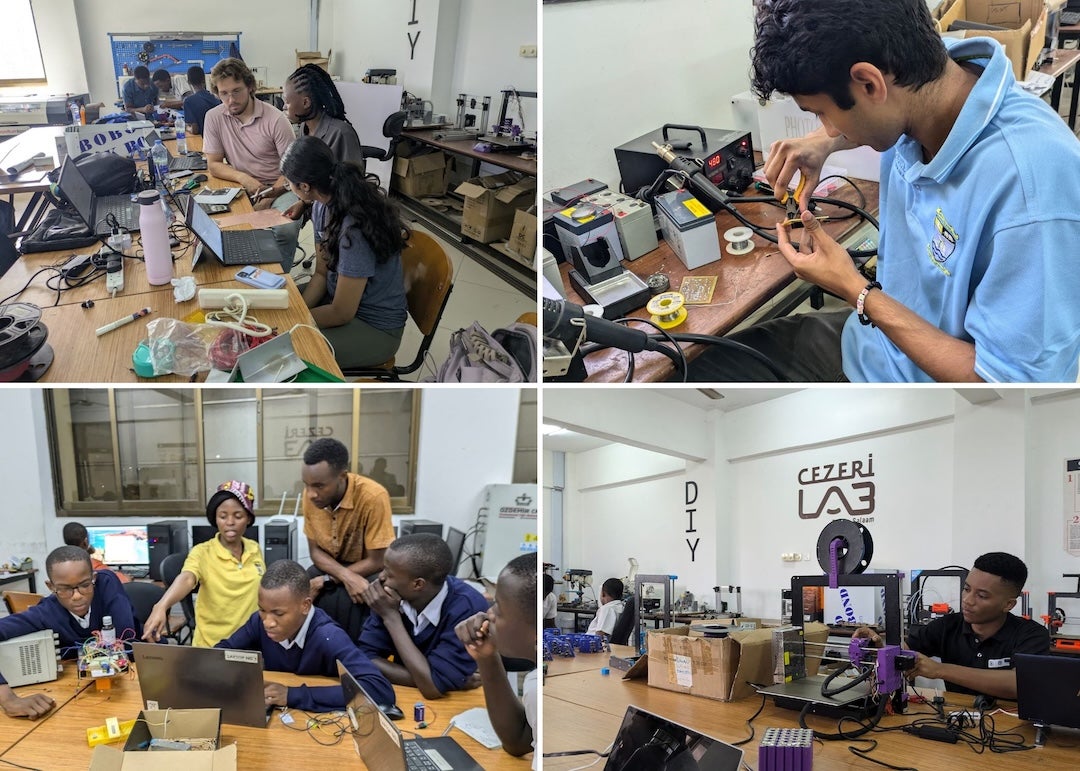
When the Rice360 Institute for Global Health Technologies launched the first design studios in partner universities across Africa during Phase 1 of the NEST360 initiative, the vision was clear: create sustainable, university-based ecosystems that empower students to design, prototype and commercialize lifesaving technologies inspired by real needs in their own communities.
Today, that vision is thriving, powered by a growing network of design studios modeled after Rice’s Oshman Engineering Design Kitchen (OEDK) and by a collaborative, invention education approach that is transforming engineering training and strengthening innovation capacity across Africa.
“The studios are one of the first NEST360 initiatives to ensure true sustainability during NEST360 Phase 2,” said Williams Baah, innovation education (IvE) Africa programs coordinator. “The sustainability outside NEST360 funding has been advancing at the studios since 2024 through the development of our own strategic partnerships both locally and internationally. As we grow and develop the studios’ sustainability models, the IvE network remains deeply connected to Rice360 through bidirectional engineering student project collaborations. The connection between Rice and its partners in Africa makes our community of innovators so powerful and extends the global reach of our students.”
The IvE initiative challenges student innovators from partnering universities to collaboratively develop high-impact global health technologies. Guided by local clinical and industry partners, students engage in hands-on, project-based learning to tackle urgent problems, from maternal and newborn health to medical device affordability, manufacturing constraints and infrastructure limitations.
Rooted in the OEDK approach, this model blends engineering fundamentals with hands-on invention, rapid prototyping and commercialization training. Students learn not only how to design technology but how to translate ideas into real-world solutions. The IvE curriculum immerses undergraduate engineering teams in experiential health care innovation, both in the classroom and in clinical or community settings. Students begin by identifying and framing a problem, then move through an iterative process of designing, prototyping, testing and refining solutions based on real user feedback.
“Solving real-world challenges requires collaboration,” said Kiara Lee, Rice360’s director of education strategy and GLHT assistant teaching professor. “Universities, local industry, ministries of health and government partners are working together to support invention education, leading to stronger career pathways and future employment for students.”
Bidirectional internships between African design studios and the OEDK in Houston extend these opportunities even further. Rice students travel to work in African design studios, while African students come to Rice, often building lifelong professional relationships. Moreover, Rice360, OEDK, NEST360 and universities across Africa continuously share best practices, faculty exchanges, competitions, curriculum development, internships and research collaborations.
One of the most powerful examples of independent innovation growth is the work happening at the Dar es Salaam Institute of Technology (DIT) Design Studio in Tanzania, where invention education includes hands-on training in intellectual property development and patent protection.
“Intellectual property (IP) awareness and teaching students how to protect their IP is an important part of invention education at the DIT Design Studio,” said Joel Ngushwai, engineer and coordinator of the Design Studio and IvE Network at DIT. “The studio has been working to strengthen IP awareness and practical engagement among our students and staff.”
Over the past year, DIT students and faculty have successfully filed more than eight patents on technologies developed within the Design Studio, a milestone bolstered by IvE infrastructure and training. The Design Studio now integrates IP modules into workshops, hosts mentorship sessions and partners with legal agencies to streamline filing processes. It is also developing an institutional IP policy and preparing to launch an Innovation and IP Support Desk to scale capacity nationwide.
The studio’s patented and patent-pending projects, ranging from a bubble CPAP machine and transport incubator to a UV sterilizer and 3-D printer, illustrate the power of designing with foresight. These innovations address urgent needs while also strengthening health care systems for the future: protecting patients and providers, saving lives at critical moments and empowering continued innovation through accessible manufacturing. Together, they reflect a design philosophy focused not just on what works today but on what will matter tomorrow.
That forward-looking approach extends well beyond Tanzania. As part of the larger IvE network, DIT shares training materials and case studies with universities across Africa. The goal is to build a collaborative and sustainable innovation ecosystem led by African educators, students and industry stakeholders.
“This is much bigger than a design studio,” said John A. Msumba, director of DIT Mwanza Campus and NEST Principal Investigator for DIT. “It is a movement to build an independent, Africa-led innovation community that will shape the future of global health engineering.”