
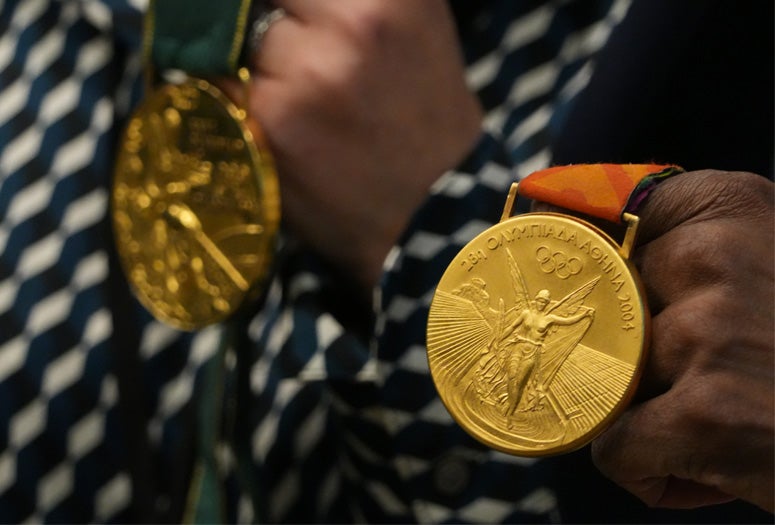
When Briana Scurry stepped to the podium at Rice University’s BioScience Research Collaborative, she brought with her more than a Hall of Fame career. She brought the weight of what it means to win, to lose and to survive the space in between.
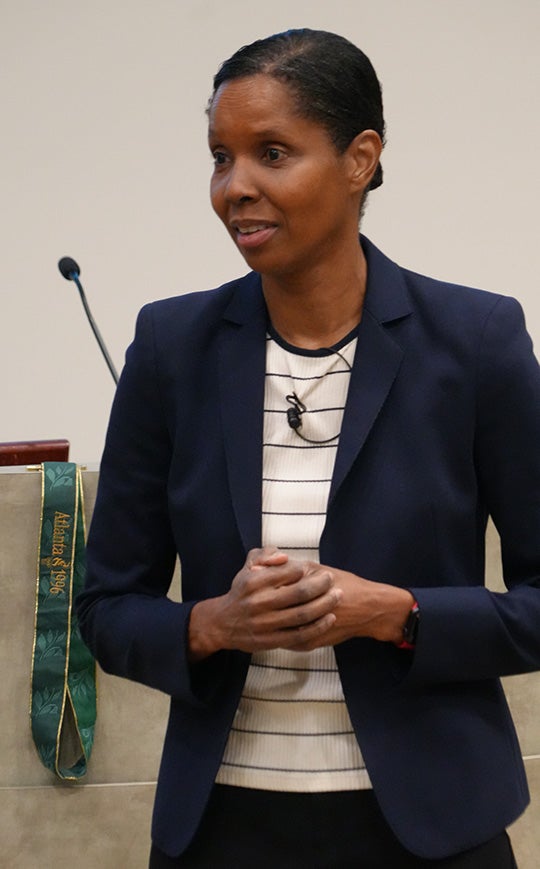
Scurry, a former U.S. Women’s National Team goalkeeper and two-time Olympic gold medalist, opened “The World at Play: The Beautiful Game in 2026” with a keynote that moved fluidly between triumph and trauma. She spoke about the highs of elite sports and the devastating lows that followed a career-ending concussion: the desperate search for medical care, the financial strain that led her to pawn her Olympic medals and the spiral that nearly cost her life.
She spoke candidly about what it means to reach the pinnacle of a sport and still feel abandoned by it as injury, isolation and the relentless pressure to perform can collide in ways few people see. Her story ultimately turned toward survival and care, shaped by the people who helped her step back from the brink and reclaim both her life and the symbols of her career.
When Scurry’s remarks ended, no one rushed for the exits. Instead, nearly everyone in the room formed a line. Some thanked Scurry for her honesty. Others wanted to see her two gold medals up close. One by one, attendees were invited to hold them, even to slip one over their head. Scholars, students, physicians, writers, fans and athletes stood together, taking photos and sharing quiet, emotional exchanges. What could have been a symbolic gesture became something far more intimate and communal.
That spirit of conversation defined the two-day conference organized by Rice’s School of Humanities and Arts faculty Jacqueline Couti and Caroline Fache ahead of the 2026 World Cup. Designed around short roundtables rather than formal presentations, “The World at Play” brought together professional players, kinesiologists, orthopedic surgeons, economists, historians, journalists and fans to examine soccer as a global force shaped by politics, labor, culture, technology and the body itself. Panels often began with thoughtful exchanges among speakers but came alive when the floor opened to the audience. Questions, reflections and lived experiences pushed conversations in new directions, blurring traditional boundaries between expert and participant.
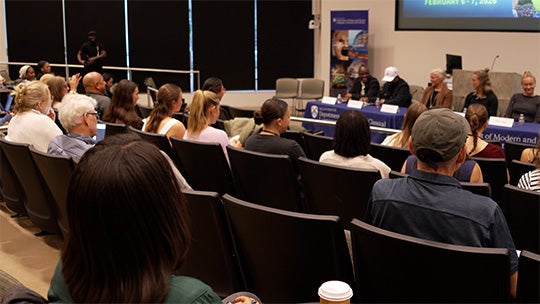
“The point was conversation,” said Fache, associate professor of French studies. “You often go to a conference and listen, but you don’t get to talk. We wanted more exchange than that.”
The conference’s second keynote speaker Laurent Dubois widened the lens even further, weaving together two days of conversations and demonstrating how they connect across time, space and cultural context. Dubois began by speaking about cultural and political histories of French soccer, showing how the sport has reflected and shaped debates around national identity, colonial legacies and belonging. His presentation then used images from the Africa Cup of Nations to illustrate how truly global the game of soccer is, highlighting how matches between countries and across continents are interconnected across time, geography and history.
“This approach reminded me of what Dean Kathleen Canning calls ‘connective humanities,’ the way seemingly separate events reveal deep connections,” said Couti, the Laurence H. Favrot Professor of French Studies and chair of Rice’s Department of Modern and Classical Languages, Literatures and Cultures. “His presentation was especially effective in linking soccer events that might appear disconnected but are tied together through shared histories of colonialism and cultural exchange.”
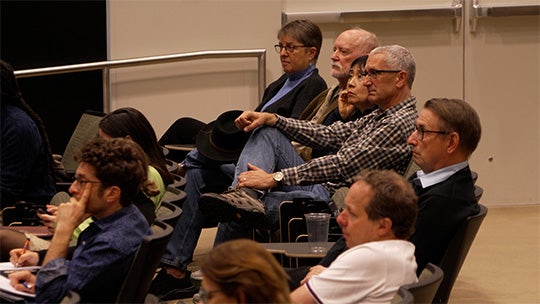
Faculty participants in “The World at Play” represented a wide range of academic units across Rice, including the School of Humanities and Arts and the School of Social Sciences with faculty drawn from the departments of modern and classical languages, literatures and cultures; history; English and creative writing; economics; sociology; and kinesiology. The conference also included participation from the Center for Latin American and Latinx Studies, the Center for the Study of Women, Gender and Sexuality and the Center for African and African American Studies as well as the Baker Institute for Public Policy. Support for the conference was provided in part by Rice’s Creative Ventures Fund.
“At the end of the day, we may say it’s interdisciplinary, but it’s always about us — the human — in different ways,” Couti said.
Both Fache and Couti emphasized that the conference’s openness — free to the public with space built in for informal exchange — was essential to its success.
“We’re hyperconnected, but we don’t know how to talk to people,” Couti said. “This was about creating a space where people could disagree, listen and still remain in conversation.”
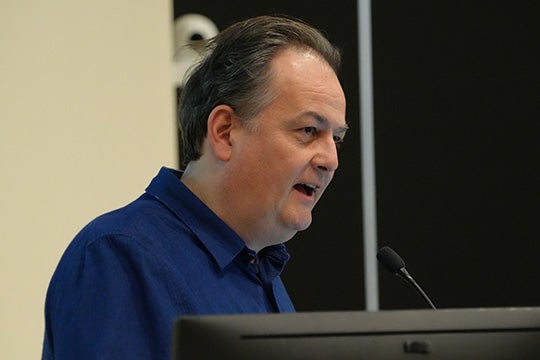
Fache noted that Rice was uniquely positioned to host such a gathering, bringing together voices across disciplines and beyond campus.
“This could only happen at a place like Rice,” Fache said.
The World Cup will be the largest sporting event ever, spanning three host countries and 16 host cities including Houston. The tournament will take place in June and July and is expected to engage millions of fans across North America and billions worldwide. Last month, Rice was named an Official Houston World Cup 2026 Host City Supporter.
By the end of the conference, that idea felt less like a claim and more like an observation. For two days, soccer became a shared language that allowed grief and joy, critique and care, expertise and lived experience to coexist. In a room full of people who might not otherwise meet, the beautiful game opened space for something else entirely: connection.