
Rice University researchers will investigate whether carbon credits could provide a new source of funding for a major coastal erosion and wetland protection project along the Gulf Intracoastal Waterway in Galveston County.
The Gulf Coast Protection District approved the 12-month study, led by Rice’s Severe Storm Prediction, Education and Evacuation from Disasters (SSPEED) Center, as the first project advanced through the Coastal Texas Research Council.
The research will examine whether revenue from “blue carbon” credits could help finance portions of the U.S. Army Corps of Engineers’ Coastal Texas Project. Blue carbon credits are generated by protecting, restoring or conserving coastal and marine ecosystems that absorb and store carbon.
“This is an opportunity to explore an entirely new model for financing public coastal infrastructure,” said Jim Blackburn, co-director of the SSPEED Center and Rice’s principal investigator. “Rather than depending exclusively on federal and state appropriations, we are asking whether private investment in high-quality carbon credits could help build projects that protect wetlands, communities and the coastal economy.”
The Galveston Bay Shoreline and Island Protection element of the Coastal Texas Project calls for living shoreline structures along portions of the north shore of West Galveston Bay and the Bolivar Peninsula on the south shoreline of East Bay. The structures would reduce erosion caused by vessel wakes, sea-level rise and other pressures while protecting marshes bordering the Gulf Intracoastal Waterway.
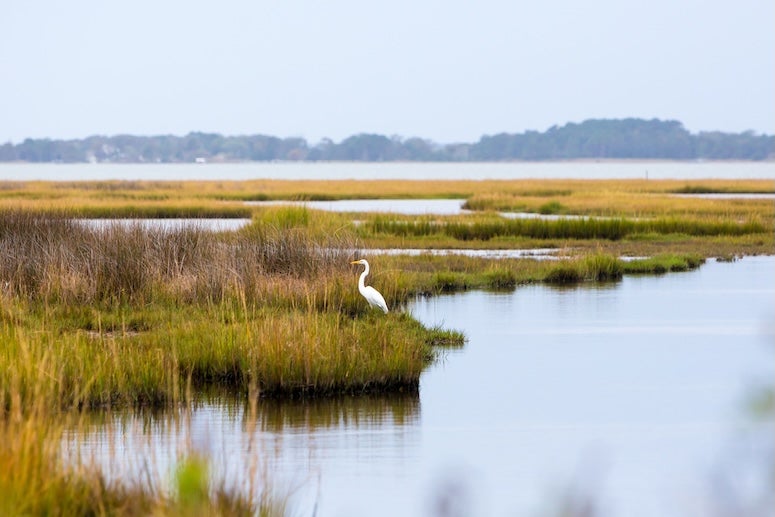
Those wetlands store carbon in their soils, provide habitat for fish and wildlife, reduce storm surge impacts and protect private property from land loss. When marshes erode, the carbon stored in the removed soil will be released into the environment. The Rice-led team will assess whether preventing that loss and allowing protected marshes to continue accumulating carbon could generate verified credits that companies would be willing to purchase. Revenue from those sales could offset a portion of the cost of constructing the living shoreline erosion control features.
“The central question is whether environmental protection here can pay for itself,” said Chris Ordoñez, program manager of nature-based solutions for Rice’s SSPEED Center. “We will determine how much carbon could be protected, what the shoreline structures would cost and what price buyers might be willing to pay for credits. If it works, then we can fund the project, keep fishery and wildlife habitats and build long-term storm resilience. This is what nature-based solutions could look like along the Texas coast.”
The researchers will evaluate approximately 30 miles of shoreline in West Bay and 20 miles in East Bay. They will combine coastal soil carbon data, geographic information system mapping, engineering designs and construction cost estimates to identify where carbon-credit financing may be most feasible. The team will then estimate the credits that could be generated by preventing wetland loss and storing additional carbon as protected marshes grow, and finally they will calculate the carbon price needed to offset construction costs at different sites.
The Coastal Texas Research Council was formed at the request of Gulf Coast Protection District, the nonfederal sponsor charged with the design and construction of the Coastal Texas Project. The council’s work will be essential to ensuring Texas advances a nationally significant coastal barrier system that protects local communities while strengthening disaster resilience for the state and the nation.
“We’ve brought together the best minds from across Texas and the Netherlands to ensure this once-in-a-generation project is based on strong science, innovative engineering and a deep commitment to the communities we serve,” said Coalter Baker, executive director of the Gulf Coast Protection District. “The collaboration we’re forming today can reduce timelines and costs while delivering smarter, more efficient solutions that build lasting resilience along the Gulf Coast.”
The study will also assess interest among coastal landowners and prospective buyers, evaluate whether the credits could meet certification standards and examine legal considerations associated with using private carbon-market revenue to finance state-supported infrastructure. To attract buyers, credits must represent climate benefits that are measurable, durable and not counted elsewhere. The nonprofit carbon registry BCarbon will evaluate the proposed projects using its blue carbon protocol, which Blackburn helped develop.
“This is not simply about putting a price on carbon,” Blackburn said. “The goal is to create a credible, transparent financing approach that protects the public interest while recognizing the full value of healthy coastal wetlands.”
Blackburn and Ordoñez will lead the work, while Sam Brody of Texas A&M University at Galveston will support the geographic information system analysis and coastal planner Lalise Mason, together with BCarbon, will contribute expertise in blue carbon assessment and credit verification.
If successful, Blackburn said, the approach could be applied beyond this project to other underfunded coastal resilience initiatives in Texas and across the Gulf Coast.
“Coastal protection needs are growing much faster than traditional funding sources can meet them,” Blackburn said. “If this concept proves feasible, it could open a new pathway for protecting thousands of acres of wetlands and advancing projects that might otherwise remain unfunded.”