A chemical fire or explosion erupts somewhere in the Houston area every six weeks on average. That figure comes from a 2016 Houston Chronicle report, which remains the most recent comprehensive accounting of industrial accidents in a city built on petrochemical industry. The gaps in that record are exactly what two Rice University students set out to fill.
Will Howley, a junior social policy analysis major, and Cindy Yan, a senior biosciences major, spent the 2025-26 academic year building a historical database of industrial accidents and disasters in the Houston area as part of Fondren Library’s Fondren Fellows program. Drawing on EPA enforcement records and newspaper archives spanning decades, they and junior civil engineering major Rifah Elahi documented the frequency, geography and media coverage of incidents along the Houston Ship Channel, which they identified as a persistent hotspot for environmental violations. The team’s goal: a publicly accessible tool that lets any Houston resident look up industrial incidents in their own neighborhood.
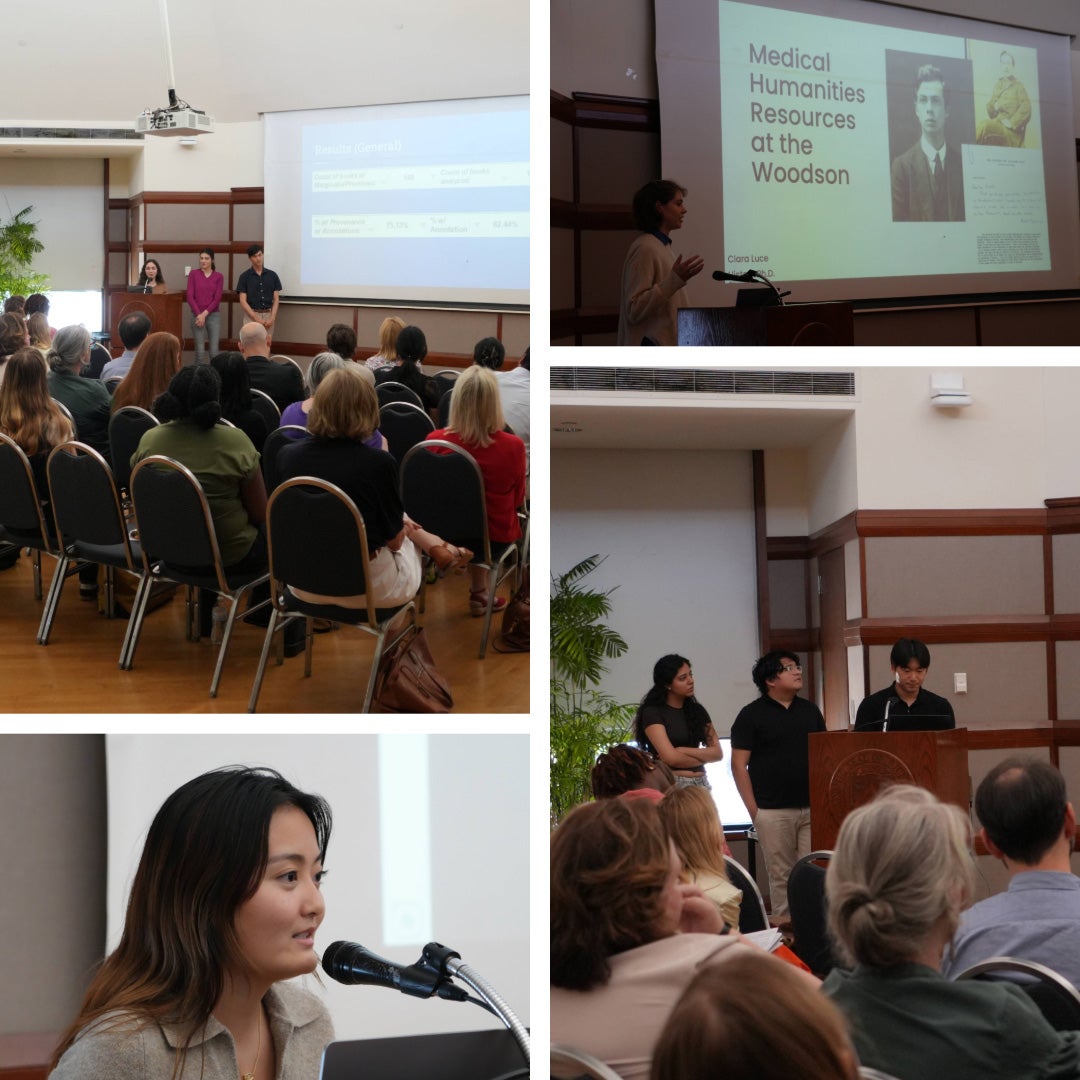
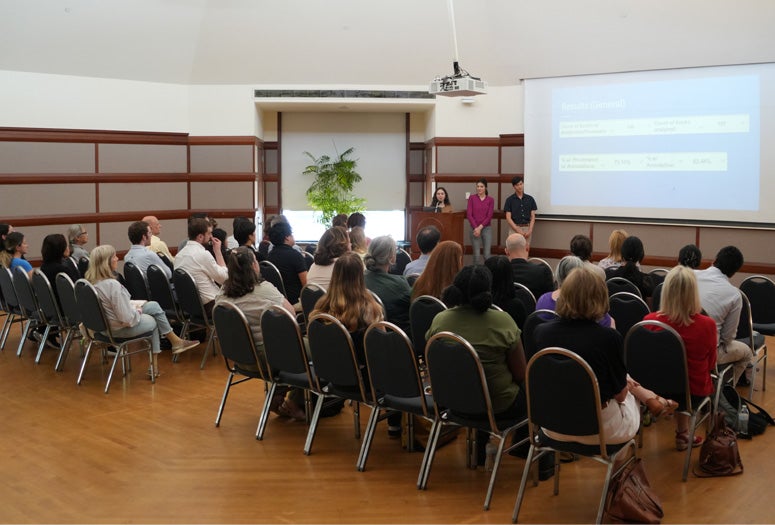
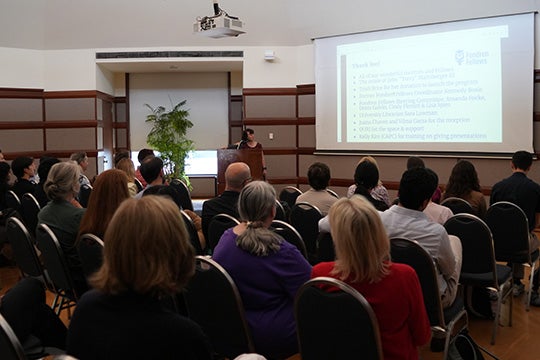
Fondren Fellows pairs Rice undergraduate and graduate students with faculty mentors and library staff to pursue original research projects grounded in Fondren’s collections and digital infrastructure. The program emphasizes work that is both academically rigorous and publicly useful. Six of the 14 active Fondren Fellows teams presented their findings at a showcase April 16 in Farnsworth Pavilion.
“Through the Fondren Fellows program, Rice students — guided and supported by their mentors — explore a range of open-ended questions relevant to the library and the broader community, such as how to make archival materials more accessible and how to collect and interpret data about the history of Houston,” said Lisa Spiro, assistant university librarian for digital scholarship and organizational development. “At the Fellows Showcase, students demonstrate how much they have learned and accomplished in just eight months, offering original insights and sharing significant outputs, such as databases, tools, research guides and enhancements to catalog records.”
Victoria Richards, a second-year doctoral student in English, and Huzaifa Hasan, a graduate student in business administration, trained their attention on a different kind of Houston history, one written in land deeds. Their project “Who Owned Freedmen’s Town?” traced property records in Houston’s Fourth Ward from 1867, when Black residents began building a community after Emancipation, to 1936, when the city began developing what became an all-white public housing complex on land it had accumulated there.
“What we found was that many families were, in effect, crowded out by short-term investors who were buying up land in Freedmen’s Town not as residents but as investors with something to speculate on,” Hasan said, noting that the investors often used promissory notes rather than capital to exchange property among Houston’s white elite. “That pushed these families out of ownership of these lands.”
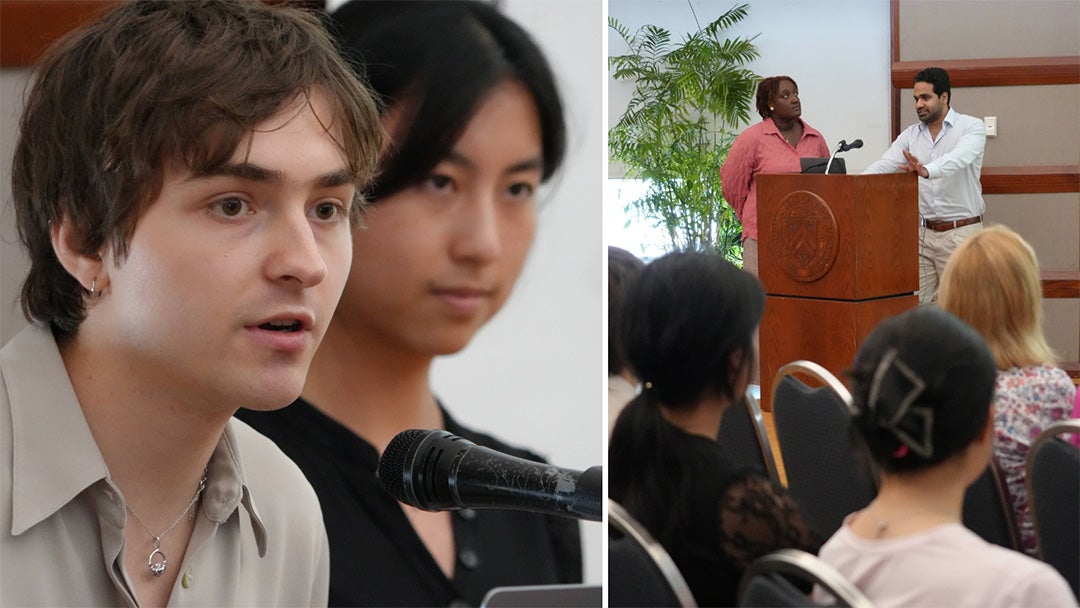
Richards approached the project at a more intimate scale, tracing individual families including the Jenkins family of Hardcastle Lot 12 through marriage certificates, divorce settlements, census data and court minutes. The records complicated easy narratives of dispossession.
“When you read these deeds, it gives you a narrative of the kinship that’s developed and shows you who actually owned Freedmen’s Town outside of just financier possession,” Richards said. “We see that there is continuity, there is stability in Black peoples’ lives in Freedmen’s Town.”
Four other projects rounded out the showcase. Jeslyn Cho, a junior political science major, spent the year organizing and digitizing papers and oral histories donated by Neal Lane, a former presidential science adviser and the M. Gillis University Professor Emeritus at Rice, for the White House Scientists Archive at the Woodson Research Center. The work brought her into close contact with Lane’s concept of the “civic scientist,” a researcher whose obligation extends beyond the lab.
“This fellowship was a great way for me to learn about the importance of being able to [use] science and the important role that scientists play in making sure that their findings are communicated to politicians and then used for policy,” Cho said.
Clara Luce, a graduate student in history, surveyed the Woodson Research Center’s holdings for materials relevant to medical humanities researchers and built a library guide connecting scholars to those collections, including materials related to the 1947 Texas City disaster and a letter from Robert Oppenheimer. A separate team — Jun Bae, a senior computer science major; Amy Xing, a senior mathematical economic analysis major; and Daniel Jachero, a junior computer science major — built Python-based tools to help researchers access and visualize public government data that is technically available but practically difficult to use.
Then there were the books, specifically what readers left behind in them. Gracie Miller, a sophomore cognitive sciences and philosophy major; Ryan Ellis, a senior business major; and Caroline Searls, a sophomore history major, spent the year examining books in the Woodson Research Center’s rare book collections, many printed in 16th- and 17th-century London, for marginalia, ownership marks and other traces of past readers. Of roughly 200 books they examined, approximately 75% contained some form of annotation or provenance mark, a figure they say surprised even them. Among the most striking finds: what appears to be a unique manuscript variant of a poem attributed to Henry Wotton written on the pages of an unrelated volume.
“It was a really extensive undertaking for us but also very exciting to see that there’s so much undocumented material inside of those books,” Miller said.
The team’s catalog will be incorporated into the Woodson’s existing library records, making the marginalia searchable for the first time. They described their work as the “very tip of the iceberg” of the Woodson’s 40,000 volumes.
Several of the Fondren Fellows projects presented at the showcase will continue under future fellowship cohorts. More information about the program, which is funded by an endowment from the John “Terry” Maltsberger III estate, and its ongoing projects is available on the Fondren Fellows website.