
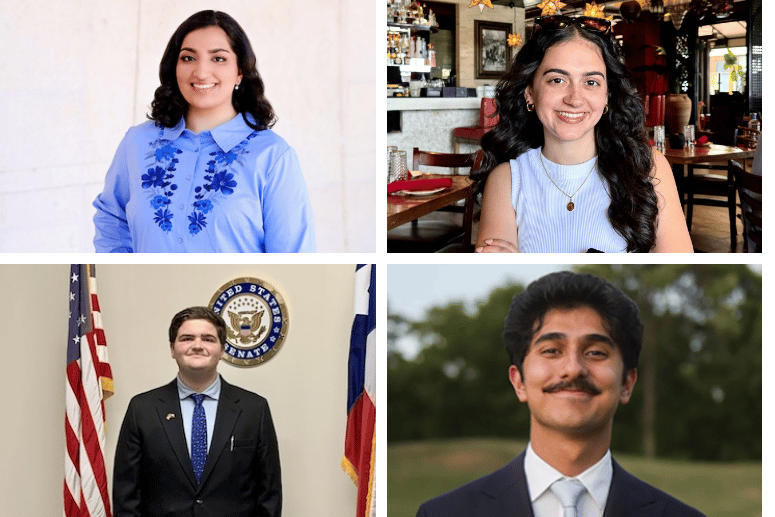
At a time when public trust, civic discourse and community health challenges dominate national conversations, four Rice University students are already working on solutions through research, advocacy and public service.
Their work spans issues including gun violence prevention, mental health policy, civic dialogue and community engagement — efforts that have now earned national recognition.

Rice sophomores Saami Baig, Mahtab B. Dastur, Eli Risinger and Simran Singh have been selected as 2026 Sumners Scholars, joining a group of just 37 students nationwide recognized for academic excellence, leadership and a commitment to strengthening democracy through public service. The scholarship, awarded by The Sumners Foundation of Irving, Texas, supports students pursuing careers in public policy, civic engagement and public service leadership.
The students traveled to Dallas and Austin for interviews and later celebrated together over FaceTime as acceptance emails began arriving.
“I was just like, ‘There’s literally no way,’” Baig said. “Eli, Mahtab and I all hopped on a FaceTime call after, and we were all super excited to be accepted together.”
Dastur recalled checking her phone while working on a constitutional law assignment in Fondren Library when messages from the group chat began flooding in.
“Being in Fondren, I couldn’t yell,” she said. “I was silently screaming, jumping up and down, completely in shock.”
Though their interests vary, all four students share a commitment to improving their communities through civic engagement and public service.
Baig’s work focuses on public safety and community violence prevention in Harris County, combining policy analysis and data-driven research aimed at improving public safety outcomes.
“We have a huge responsibility to improve public safety outcomes for our residents,” Baig said. “I care about making Harris County a safer place.”
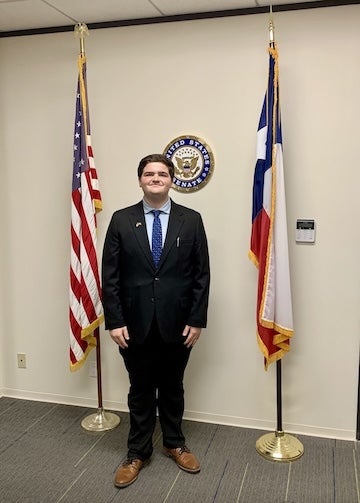
Risinger’s interests center on public policy, civic engagement and improving public systems. Through advocacy efforts and legislative engagement, he has explored how community involvement can create more accessible pathways for change.
“For the longest time, I had heard that writing legislation and advocating were difficult, convoluted processes,” Risinger said. “After delving into the work, I realized they were much more accessible than people had made them seem.”
He said that realization reinforced his desire to help others become more engaged in their communities.
“My ultimate goal is to help give people the hope and motivation they need to become changemakers,” Risinger said.

Singh’s work has focused heavily on mental health policy and equitable access to care. Through research and an internship with the Meadows Mental Health Policy Institute, she has studied how policy implementation gaps can leave vulnerable communities without adequate support.
“I’m interested in helping design policies that are both equitable and grounded in real data,” Singh said.
Singh said Rice has encouraged her to think critically about the relationship between law, policy and society through coursework and research opportunities.
For Dastur, public service has taken shape through advocacy, youth relationship violence prevention efforts and initiatives focused on civic dialogue and student leadership. She currently serves in leadership roles with the Rice Student Association and Duncan College government.
“I think dialogue is probably the single most important skill someone can have if they want to make a difference,” Dastur said. “I’m a big advocate for creating open spaces for dialogue and respecting differing opinions.”
The students said Rice’s emphasis on experiential learning and civic engagement helped shape their interests in public service.
Singh and Dastur pointed to classes such as the Public Service Practicum and Advocating for Ideas to Change the World as especially influential in helping them better understand how public service translates into action.
“Those classes push you to understand what public service actually looks like and how to engage with it meaningfully,” they said.
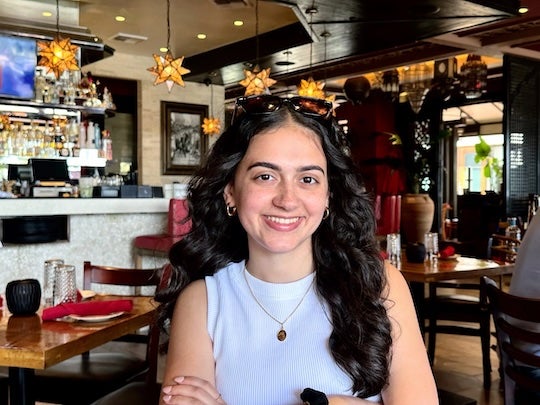
Dastur added that the collaborative culture at Rice also played a major role throughout the scholarship process.
“Honestly, there is nothing quite like a Rice student,” she said. “We’re such a supportive, encouraging and genuinely impressive community.”
As they look ahead to careers in law, policy and public leadership, the students said they remain optimistic about the future of civic engagement, particularly among younger generations.
“What gives me hope is the number of people, especially young people, who are actively engaged and committed to making a difference,” Singh said. “There’s a growing emphasis on accountability, equity and informed participation, which I think are all positive signs for the future.”