
What does the first psychiatric hospital for Black Americans after the Civil War have in common with a Czech film school, a rural Indian village and the eviction courts of Houston? At Rice University, they are all subjects of undergraduate research.
Nearly 100 students presented research and creative work across two days at the annual Humanities and Arts Festival held April 13-14 in conjunction with the Office of Undergraduate Research and Inquiry’s Inquiry Weeks. The event featured presentations ranging from oral arguments to research posters to short films.
“This year’s festival was a testament to the depth and range of what our students are capable of — from archival history to community-based fieldwork to filmmaking,” said Nicole A. Waligora-Davis, associate dean of humanities and arts. “Watching them present their rich, intellectual, vibrant and creative work with such rigor and confidence is exactly what the Humanities and Arts Festival is designed to celebrate.”
Allison Bullock
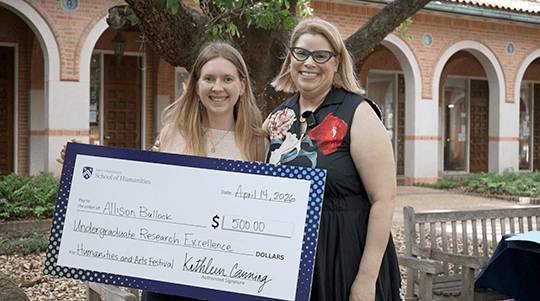
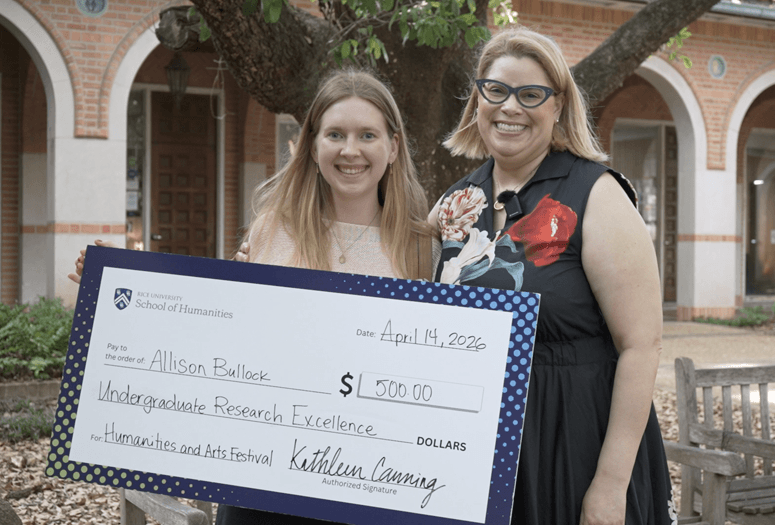
Allison Bullock, a senior majoring in history and psychology, received the Humanities Research Center Award for Undergraduate Research Excellence for her honors thesis “Pathologizing Freedom: Race, Commitment and Social Control at Virginia’s Central Lunatic Asylum, 1874-1885.” Virginia’s Central Lunatic Asylum for the Colored Insane (now Central State Hospital) was the first psychiatric institution established specifically for Black Americans following the Civil War. Analyzing commitment records from 1874 to 1885, Bullock examined how postbellum racial politics shaped physicians’ definitions of insanity, uncovering evidence of both Black resistance to an oppressive social order and white Virginians’ use of psychiatric commitment to preserve existing hierarchies.
“Although it was a long and at times difficult process, it’s very rewarding to have finished it and to be able to present it,” Bullock said.
Steven Burgess
Steven Burgess, a junior majoring in art and media studies, won Best Fiction Film for “Mother Knows Best,” a comedy he produced during a semester abroad at the Film and TV School of the Academy of Performing Arts in Prague.
Shot on 16 mm film stock after auditions with more than 70 European actors, the comedy uses a mother-son dynamic and hyperbolic humor to explore asexuality. Burgess said its place in a humanities festival was intentional.
“It’s incredibly important that film is in conversation with the humanities,” Burgess said.
Burgess said the success of Rice Cinema Club among students and Houston audiences reflects a broader point: Student filmmakers need platforms to show their work and the Humanities and Arts Festival is one of them.
Maya Harpavat
Maya Harpavat, a senior majoring in health sciences and English and creative writing, earned Best Medical Humanities Oral Presentation for research that reworked traditional models of nutritional intervention.
Rather than applying a top-down framework, Harpavat visited women in their homes and worked alongside them in government hospitals in rural village communities, examining maternal awareness of nutrition, daily dietary practices and structural factors including access to sanitation and financial resources. The approach highlighted a gap in conventional data collection: the role of cultural dynamics and family relationships in shaping health outcomes.
“Not only does this help inform interventions, but it also prioritizes the human experience at the forefront of research, which was really important to me,” Harpavat said.
Harpavat said that commitment to listening as methodology shaped her decision to pursue the medical humanities alongside a career in medicine.
Sam Peltrau
Sam Peltrau, a senior majoring in English and creative writing, took home Best Oral Presentation for a study that examines political questions in popular horror. Peltrau’s presentation drew on scholars including Saidiya Hartman, W.E.B. Du Bois and Derrick Bell to argue that contemporary Black vampire narratives (specifically AMC’s “Interview with the Vampire” and Ryan Coogler’s “Sinners”) are grappling with questions about racial liberation, the limits of law and the possibility of escape from racism itself. As Black vampire media gains visibility, Peltrau argues the stakes of reading these stories carefully are high.
“I strongly believe that storytelling may be humanity’s strongest and most well-wielded tool, and the skills we develop through humanistic research are key to understanding one another, ourselves and the world we build together,” Peltrau said.
Nhu Chu
Nhu Chu, a sophomore majoring in art and art history, received the Excellence in Creative Work Award for “Notes from the Stillness,” a series of drawings and paintings that began during a semester in Paris.
Working across watercolor and ink, Chu’s portraiture and observational scenes linger in quiet, overlooked moments: subjects suspended in their environments, softened edges blurring the line between presence and pause. The project, rooted in photographic stillness and the tradition of posed portraiture, is as much about how we look at subjects as what we see.
“Through this project, which began in Paris, I learned how to slow down and more closely observe what is in front of me,” Chu said. “Engaging with French culture and everyday life sharpened my awareness of subtle shifts in behavior, space and interaction, deepening my understanding of my experiences both abroad and in the U.S. It moved me beyond simply taking in information toward actively seeing and reflecting, especially within quieter, more contemplative spaces.”
Caitlin Reddig and Tegan Tien
Caitlin Reddig and Tegan Tien, both seniors, received Best Research Poster for a study that questions Houston’s national reputation as a model for homelessness response.
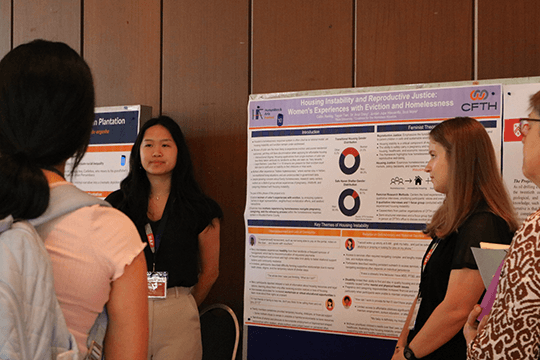
Reddig, who majors in psychology, sociology and the study of women, gender and sexuality, and Tien, who majors in health sciences and the study of women, gender and sexuality, used qualitative interviews and a feminist housing justice framework to examine how women of color experiencing eviction and mothers experiencing homelessness navigate pregnancy, caregiving and the rehousing process in Houston. Their research focuses on a population rarely tracked as a distinct group: mothers whose experiences of childbirth and caregiving unfold inside systems of housing instability.
“This past year has been an amazing opportunity to engage with the Houston community through partnering with the Coalition for the Homeless of Harris County,” the team said.
They will present their final findings at 5:30 p.m. April 29 in Room 123, Rayzor Hall.
Rachel Jeong
Rachel Jeong, a freshman majoring in cognitive sciences and media studies, earned Best Nonfiction Film for “DON’T POINT YOUR FINGER,” a nine-minute quasidocumentary made in professor Sindhu Thirumalaisamy’s Environmental Filmmaking class.
The film draws on ideas from Jeong’s fall semester courses in a self-reflexive exploration of time, attention and memory, interrogating the capitalist impulse to treat time as space to be filled and asking how the camera itself extends and distorts human cognition. For Jeong, the most striking revelation was what happened in the room when the film was shown.
“Filmmaking became a creative apparatus for intellectually synthesizing ideas I’d been sitting with all semester,” Jeong said. “What struck me most was how the artistic product created space for others to share in a collective experience of thinking and how powerful that is.”