
When future astronauts return to the moon through NASA’s Artemis program, they will need intuitive, reliable interfaces that help them navigate unfamiliar terrain, monitor mission-critical data and make quick decisions in high-pressure environments.
A team of Rice University students spent the past year helping design that future.
Rice’s OWL SUITS team, led by members of the Rice Augmented Reality/Virtual Reality Club, was selected for NASA SUITS, or Spacesuit User Interface Technologies for Students, a national software design challenge that invites college students to develop interface solutions for future human spaceflight. The Rice team traveled to NASA’s Johnson Space Center May 17-21 for SUITS Test Week, where students tested their system with NASA engineers, toured key facilities and presented their work alongside other selected teams from across the country.
“NASA SUITS gave us the chance to work on a real engineering challenge tied directly to the future of space exploration,” said junior Israel Cantu, a computer science major and one of the team co-leads. “It pushed us to think not just about what a system can do but how an astronaut or rover operator would actually use it in a mission environment.”
This year, Team OWL SUITS was assigned to develop a pressurized rover interface for a simulated lunar mission scenario. In the challenge scenario, an unmanned rover has gone offline at a known location on the moon. The Rice team’s software is designed to help an operator navigate a pressurized rover to locate and approach the disabled vehicle using autonomous path planning, real-time obstacle avoidance and clear displays of mission data such as crew vitals and vehicle resource status.
The project required the team to build a full software system from the ground up. Students designed the interface in Figma, conducted user testing and human factors research, stress-tested the system under degraded network conditions and developed autonomous navigation capabilities that allow the rover to plan an obstacle-aware route and reroute when new hazards appear.
The team worked closely with faculty mentor Robert LiKamWa, associate professor of electrical and computer engineering at Rice, and NASA mentor Alex Kanelakos, flight readiness manager for Exploration EVA at Johnson Space Center.
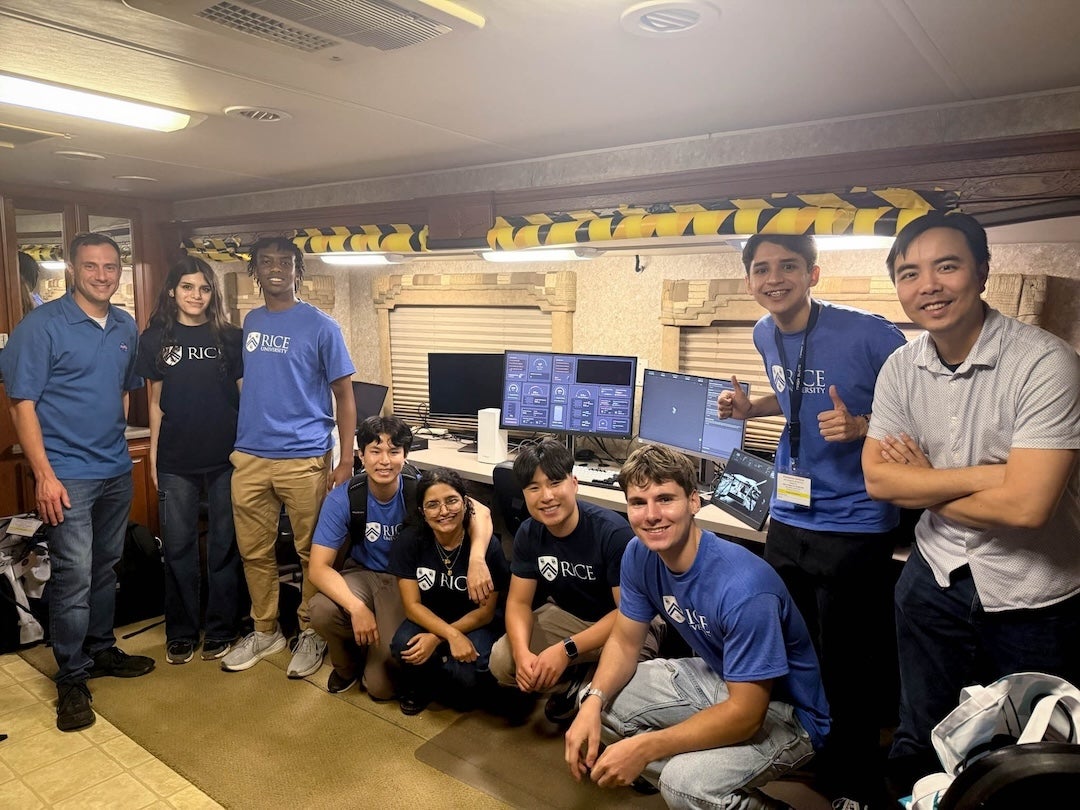
For the students, one of the central design challenges was reducing cognitive load. During a tour of NASA’s Mission Control Center, the team observed operators managing complex, multimonitor interfaces in real time — an experience that reinforced the importance of their own work.
“When someone is managing a high-stakes mission with multiple streams of information coming in at once, clarity is a safety requirement,” said junior Cameron Huang, a computer science major and team co-lead. “That became one of our guiding principles: How do we give the operator the information they need without overwhelming them?”
Seven Rice students attended Test Week: Cantu; Huang; junior Sumodha Pokhrel, a computer science major; sophomore Isabella Alvarez, a computer science major; senior Will Ingersoll, a cognitive science major with a concentration in human-computer interaction; junior Frank Liu, a computer science and business major; and sophomore Aurial Teemoi, a computer science and artificial intelligence major.
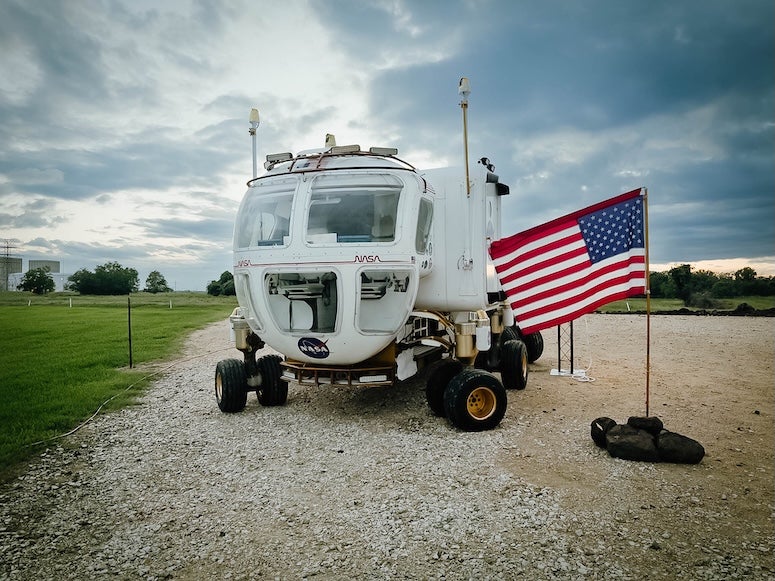
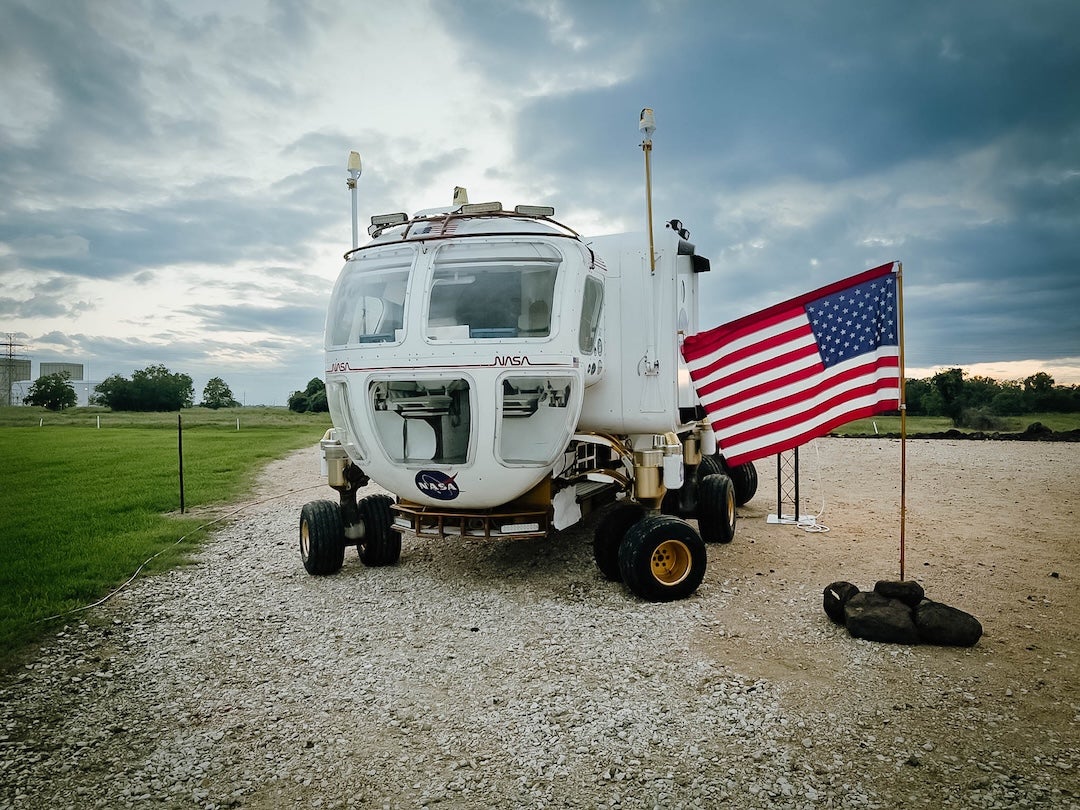
Over five days, the students participated in technical testing sessions, facility tours, guest speaker events, poster presentations and industry networking opportunities. They visited the Human Integrated Vehicles and Environments Lab, where the SUITS challenge originated; the Mission Control Center; the APACHE virtual reality simulation lab; the Human Exploration Research Analog facility; the Space Vehicle Mockup facility; and the Neutral Buoyancy Laboratory, where astronauts train for spacewalks in a 6.2-million-gallon pool. NASA also surprised teams with access to a real pressurized rover at the JSC rock yard, giving the Rice students a close look at the type of vehicle their interface was designed to support.
The team’s first formal testing session took place with Kanelakos, who evaluated the interface for approximately 45 minutes and provided feedback throughout the session. The students then worked overnight to prioritize and implement changes before the second test.
“Through the night, we focused on making changes that would most improve the user experience of the interface and worked to effectively communicate how our interface supports the mission,” Sumodha said. “We wanted the interface to be intuitive, reducing the astronaut’s cognitive load, so they can focus on the mission rather than figuring out our system.”
That ability to iterate quickly is a major part of the SUITS experience. Teams are expected not only to present a polished system but also to respond to real-time technical and design feedback from NASA evaluators. The week concluded with each team delivering a 15-minute exit pitch and participating in a Q&A session summarizing its project, design choices and testing experience.
“This project brought together so many parts of what we study at Rice — computer science, design, autonomy, human factors and teamwork,” Cantu said. “Being able to test our work at Johnson Space Center and receive feedback from NASA engineers made the experience incredibly meaningful.”