
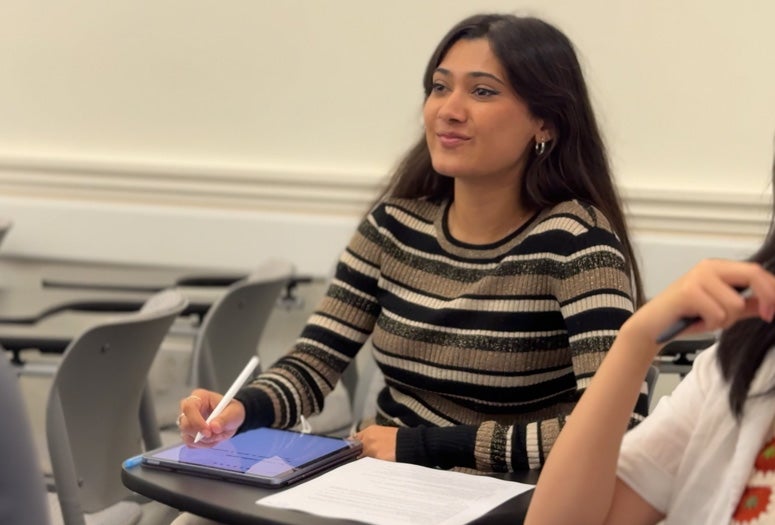
Children waiting for heart transplants at Texas Children’s Hospital can spend more than a year tethered to a mechanical device that keeps them alive. Until recently, Annesha Dey realized, little attention had been paid to what that year looks like for their families.
Dey is a Brown College senior at Rice University majoring in philosophy with minors in medical humanities and cell biology and biochemistry. She is also premed, enrolled in a master’s of public health program at UT Health Houston and, this spring, placed second for Best Medical Humanities Oral Presentation at Rice’s Humanities and Arts Festival.
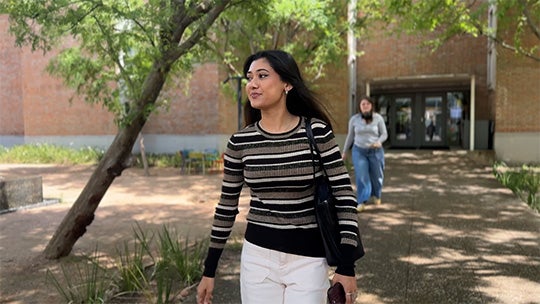
“My journey has definitely been an exercise in broadening my academic interests every year,” Dey said. “I’ve always been at this intersection of medicine, ethics, philosophy and science, and studying those topics over the past few years, I’ve just grown to see the connections between them.”
Her academic path wasn’t always this layered. Dey arrived at Rice as a biosciences major, intending to stay there. A desire to minor in medical humanities changed that, and a growing fascination with the philosophical dimensions of medicine ultimately led her to switch her major entirely.
The decision has held. Dey received a Carlson Undergraduate Summer Research Fellowship from Rice’s Humanities Research Center, which supports independent student research under faculty mentorship. She supplemented that award with funding from the Ross Rankin Moody Opportunity Fund to conduct archival research in medical humanities and history in London.
“I’m very grateful that Rice has given me the opportunity to explore the humanities while being premed,” she said. “At many universities, students don’t get to do that. It really is a privilege to be able to study interdisciplinary concepts.”
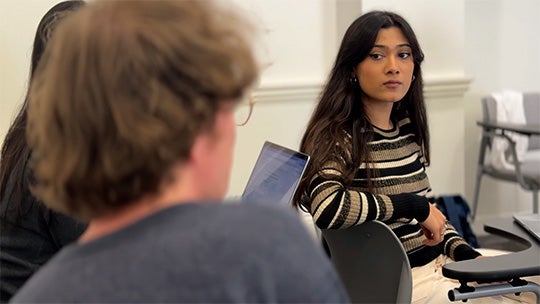
That interdisciplinary footing drives her most urgent ongoing work. Through Rice’s Medical Humanities Research Institute, Dey meets weekly with physician mentors at Texas Children’s Hospital to study the experiences of families whose children await heart transplants while on ventricular assist devices, mechanical circulatory support that can sustain a pediatric patient for a year or more.
“My research looks at the family experience of waiting — the emotional implications, all the uncertainty in that environment — and tries to inform better recommendations for doctors, so they can be more aware of what their patients and families are going through,” Dey said.
The project is squarely clinical, but it is also deeply philosophical, asking what medicine owes to families living inside prolonged uncertainty. For Dey, the value of philosophy lies precisely in its capacity to surface those kinds of questions across every domain it touches.
“People think of philosophy and assume you’re just reading, writing and asking questions — and that really is it,” Dey said. “But that contributes to every field and informs so many types of ethical dilemmas we face in our daily lives. Studying something that is both a science and an art of inquiry can only be useful, because at its core it’s logic — thinking and trying to find answers to the right questions.”
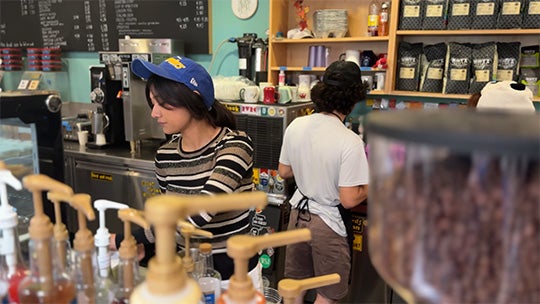
That same instinct to bring rigorous inquiry to overlooked human experiences also drew Dey to a student research team that completed interviews for a rare oral history archive documenting the lived experiences of Native Texans, developed in collaboration with the Texas Tribal Buffalo Project. Dey said the project was built around a principle of community ownership.
Beyond her research, Dey is dual-enrolled at Rice and UT Health Houston through the Rice-UT Public Health Scholars program, a four-plus-one master’s of public health track she will continue in the year after graduation while simultaneously applying to medical school.
“One day, I hope to be a medical author,” Dey said, “someone split between the clinic and writing, contributing philosophical questions about medical practice as it changes over my lifetime.”