
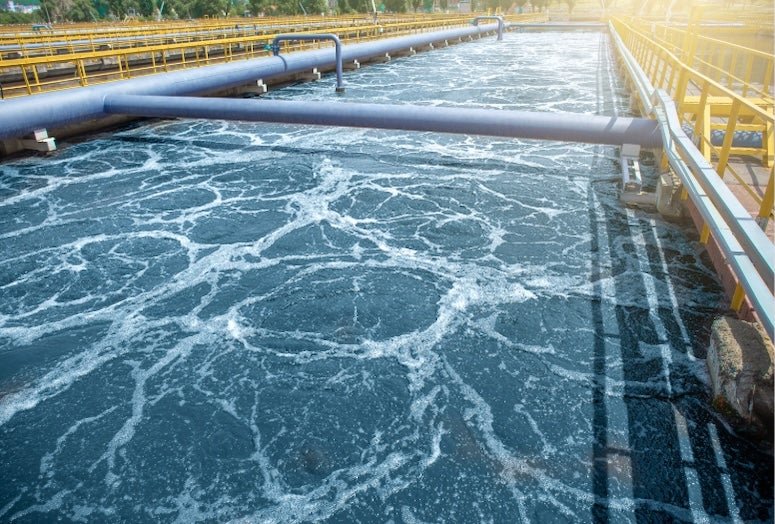
The rare earth elements that help power electric vehicles, wind turbines, medical imaging machines and other advanced technologies may be hiding in an unlikely place: industrial wastewater.
Rice University researchers have developed an ultraporous material capable of pulling several valuable and rare earth elements from complex waste streams, a potential step toward recovering critical minerals that might otherwise be discarded. The research was published in ACS Applied Materials & Interfaces.
The approach uses metal-organic frameworks, or MOFs — Nobel-prize winning materials built from metals and organic molecules into extraordinarily porous structures — and modifies their internal surfaces, so they preferentially grab rare earth elements. The researchers tested the material on neodymium, gadolinium and dysprosium, three rare earth elements important to magnets and other technologies.
“Rare earth elements are essential to many of the technologies we rely on, but their supply chains remain geographically concentrated,” said Qilin Li, the Karl F. Hasselmann Professor of Civil and Environmental Engineering at Rice and corresponding author of the study. “Instead of viewing industrial wastewater only as something that needs to be treated, we can begin thinking of it as a resource containing valuable materials that may be worth recovering.”

Rare earth elements possess unusual magnetic and electronic properties that make them difficult to replace in applications ranging from permanent magnets to aerospace and health care. Neodymium and dysprosium, for example, are used in powerful permanent magnets found in electric vehicles, wind turbines and drones, while gadolinium is used in MRIs. Separating small amounts of these elements from industrial wastewater is difficult, particularly because wastewater often contains much higher concentrations of other metals.
To tackle this challenge, the researchers started their experiments with a water-stable MOF called MIL-101. The researchers modified MIL-101 with a molecule called phosphonomethyliminodiacetic acid, or PMIDA. Inside the MOF’s nanoscale pores, PMIDA acts somewhat like a chemical hook, forming strong bonds with positively charged rare earth ions.
The researchers then varied how much PMIDA was added to the MOF to determine how the density of those binding sites affected the material’s performance. They paired their experiments with simulations that allowed the researchers to examine how rare earth ions and PMIDA molecules arrange themselves inside the pores.
The results revealed an important design principle: Adding more PMIDA did not simply create proportionally more capacity. Instead, higher concentrations of the ligand allowed multiple binding groups to coordinate around individual rare earth ions, producing stronger, more stable chemical complexes inside the pores. Additional simulations confirmed that those complexes became more strongly coordinated as PMIDA loading increased.
Yiming Liu, the study’s first author, conducted the work as a Rice postdoctoral researcher and is now an assistant professor of environmental engineering at South Dakota State University.

“What was especially interesting was that we could see not just whether the material captured the rare earths but why,” Liu said. “By combining experiments with molecular simulations, we could look inside the pores and see how changing the number of ligands changes the way these ions are held.”
At the highest PMIDA loading tested, the material captured as much as 160 milligrams of neodymium, 175 milligrams of gadolinium and 195 milligrams of dysprosium per gram of material. Those capacities were at least twice as high as values previously reported for the same water-stable MOF under similar conditions for neodymium and gadolinium.
Another encouraging result came when the researchers introduced iron, a common contaminant that can greatly outnumber rare earth elements in industrial waste.
Even when iron was present at 100 times the concentration of the rare earth elements, its effect on rare earth adsorption was minimal. In one test, rare earth uptake was only about 0.3% lower than it was without iron present. That selectivity matters because useful recovery technologies must be able to find relatively scarce target elements amid much larger quantities of unwanted material (such as iron).
The researchers also found that most of the captured rare earth elements could later be released from the MOF using dilute hydrochloric acid, allowing the valuable metals to be collected and potentially enabling the material to be reused.
“There is still a lot of work to be done to refine this technique, and future research will focus on improving selectivity so the MOF can release captured elements while maintaining durability, regeneration and ligand attachment,” Liu said. “Still, we are excited about the possibility of engineered MOFs offering a more sustainable alternative to the liquid-liquid solvent extraction currently used to capture rare earth elements.”
This research was supported by the NEWT Center of the National Science Foundation, Welch Foundation grant C-2248, and the Big-Data Private-Cloud Research Cyberinfrastructure MRI-award funded by NSF under grant CNS-1338099.